Journal of Arid Meteorology ›› 2026, Vol. 44 ›› Issue (1): 1-14.DOI: 10.11755/j.issn.1006-7639-2026-01-0001
• Column on "Regional Drought" • Previous Articles Next Articles
Synergistic impacts of Eurasian wave train mode and tropical convection on the compound hot and drought event in the Yangtze River Basin in late summer and early autumn in 2024
SHEN Shijian1( ), LI Jinjian1(), MA Hedi2, LI Xing1,2, MENG Qingyi3, LI Xiaoyu1
- 1. Sichuan Key Laboratory of Climate Change and Resource Utilization in Complex Terrain Regions/Sichuan Field Scientific Observation and Research Station of Urban Meteorology and Environment in Chengdu Plain/Sichuan Engineering Research Center for Meteorological Disaster Forecasting and Warning/College of Atmospheric Sciences,Chengdu University of Information Technology,Chengdu 610225,China
2. China Meteorological Administration Wuhan Institute of Heavy Rain/Heavy Rainfall Research Center of China/China Meteorological Administration Basin Heavy Rainfall Key Laboratory/Hubei Province Key Laboratory of Torrential Rain Monitoring and Warning,Wuhan 430205,China
3. Qianxinan Buyi and Miao Autonomous Prefecture Meteorological Bureau of Guizhou Province,Xingyi 562400,Guizhou,China
-
Received:2025-09-08Revised:2025-12-23Online:2026-02-28Published:2026-03-25
亚欧大陆波列模态与热带对流对长江流域2024年夏末秋初复合高温干旱事件的协同影响
沈诗荐1(), 李金建1(), 马鹤翟2, 李兴1,2, 孟庆怡3, 李霄宇1
- 1.复杂地形区域气候变化与资源利用四川省重点实验室/成都平原城市气象与环境四川省野外科学观测研究站/气象灾害预测预警四川省工程研究中心/成都信息工程大学大气科学学院,四川成都 610225
2.中国气象局武汉暴雨研究所/全国暴雨研究中心/中国气象局流域强降水重点开放实验室/暴雨监测预警湖北省重点实验室,湖北武汉 430205
3.贵州省黔西南布依族苗族自治州气象局,贵州兴义 562400
-
通讯作者:李金建 -
作者简介:沈诗荐(2001—),男,辽宁葫芦岛人,硕士生,主要从事气候变化与极端气候研究。E-mail: 673585091@qq.com。 -
基金资助:四川省自然科学基金项目(2025ZNSFSC1136);中国气象局流域强降水重点开放实验室开放研究基金项目(2023BHR-Y01)

CLC Number:
Cite this article
SHEN Shijian, LI Jinjian, MA Hedi, LI Xing, MENG Qingyi, LI Xiaoyu. Synergistic impacts of Eurasian wave train mode and tropical convection on the compound hot and drought event in the Yangtze River Basin in late summer and early autumn in 2024[J]. Journal of Arid Meteorology, 2026, 44(1): 1-14.
沈诗荐, 李金建, 马鹤翟, 李兴, 孟庆怡, 李霄宇. 亚欧大陆波列模态与热带对流对长江流域2024年夏末秋初复合高温干旱事件的协同影响[J]. 干旱气象, 2026, 44(1): 1-14.
share this article
Add to citation manager EndNote|Ris|BibTeX
URL: http://www.ghqx.org.cn/EN/10.11755/j.issn.1006-7639-2026-01-0001
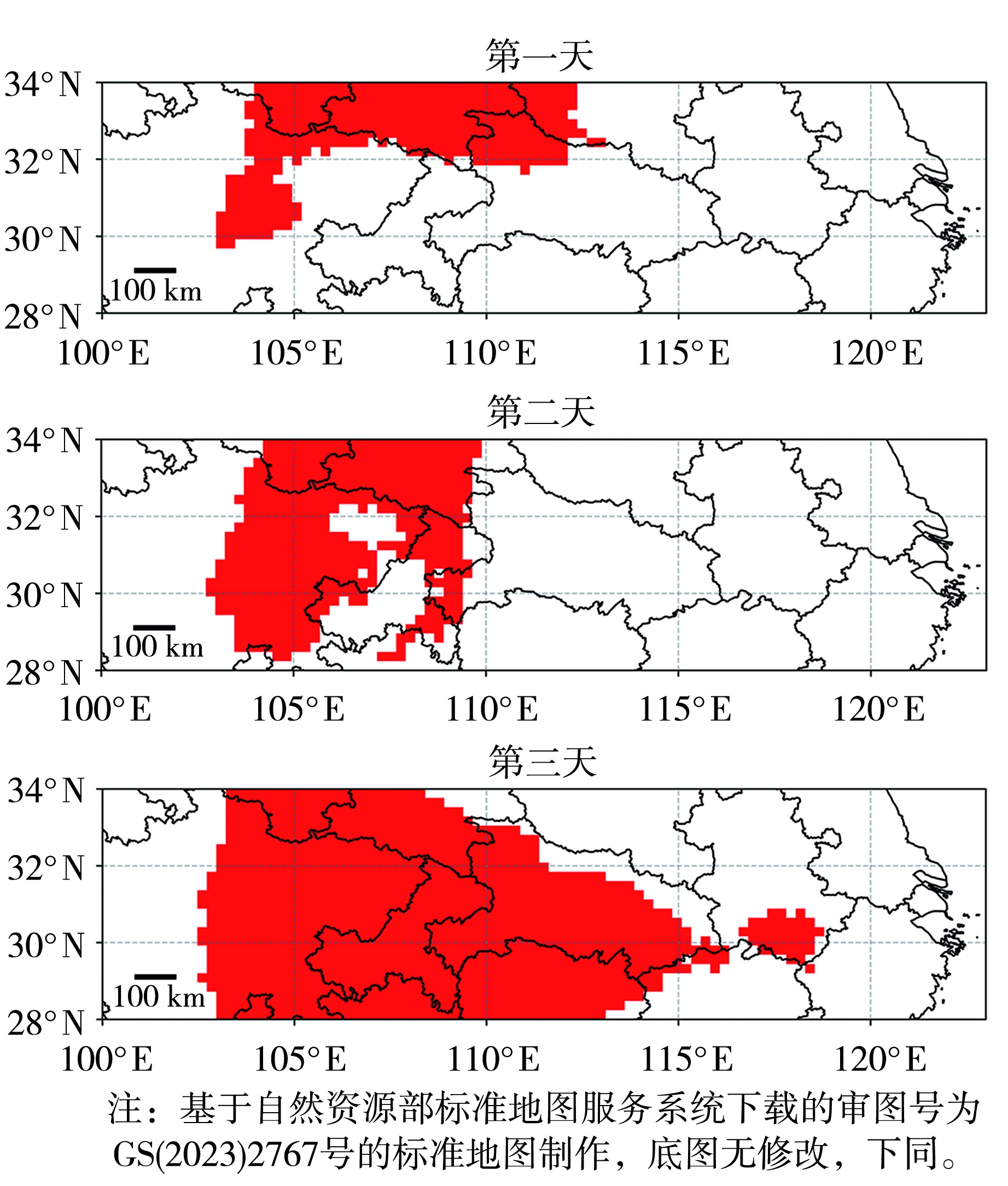
Fig.1 Three-dimensional evolution of a spatiotemporal continuous heat wave event in the Yangtze River Basin in 2008
Fig.1 Three-dimensional evolution of a spatiotemporal continuous heat wave event in the Yangtze River Basin in 2008
Tab.1 Characteristics of typical compound hot and drought events in the Yangtze River Basin from 1979 to 2024
| 起始时间 | 结束时间 | 持续时间/d | 高温强度/℃ | 最大覆盖面积/格点数 | SPI30 |
|---|---|---|---|---|---|
| 1981-06-11 | 1981-06-27 | 17 | 1.55 | 474 | -0.54 |
| 2013-07-22 | 2013-08-30 | 40 | 1.57 | 517 | -0.76 |
| 2016-08-11 | 2016-08-29 | 16 | 1.76 | 516 | -0.71 |
| 2022-07-28 | 2022-08-30 | 34 | 2.59 | 517 | -1.03 |
| 2024-07-28 | 2024-09-30 | 65 | 2.10 | 517 | -0.63 |
Tab.1 Characteristics of typical compound hot and drought events in the Yangtze River Basin from 1979 to 2024
| 起始时间 | 结束时间 | 持续时间/d | 高温强度/℃ | 最大覆盖面积/格点数 | SPI30 |
|---|---|---|---|---|---|
| 1981-06-11 | 1981-06-27 | 17 | 1.55 | 474 | -0.54 |
| 2013-07-22 | 2013-08-30 | 40 | 1.57 | 517 | -0.76 |
| 2016-08-11 | 2016-08-29 | 16 | 1.76 | 516 | -0.71 |
| 2022-07-28 | 2022-08-30 | 34 | 2.59 | 517 | -1.03 |
| 2024-07-28 | 2024-09-30 | 65 | 2.10 | 517 | -0.63 |
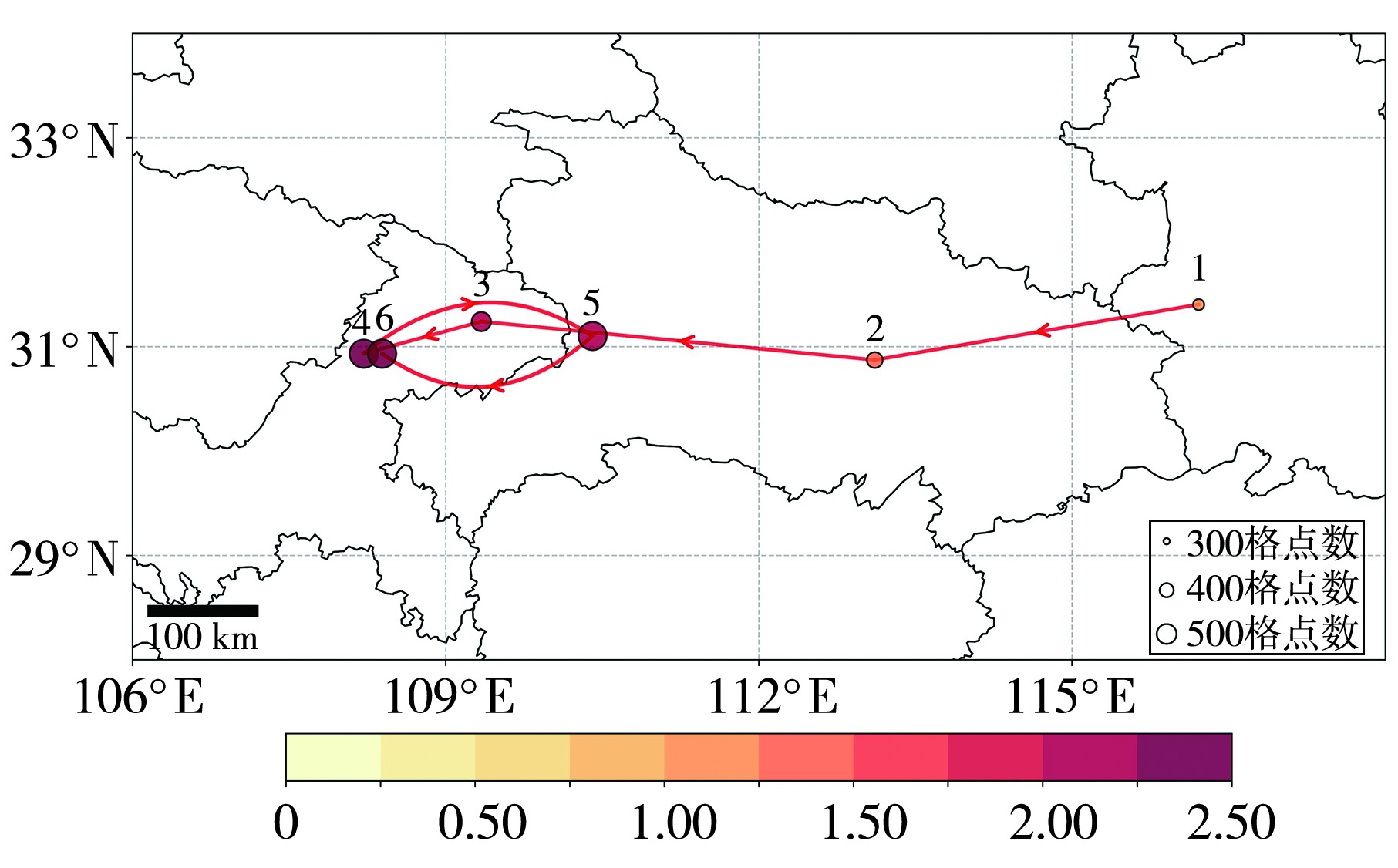
Fig.2 Spatial evolution track (red arrowed line) and hot intensity-weighted centroid distribution (colored bubbles,Unit: °C) of the compound hot and drought event over the Yangtze River Basin in 2024 (The red arrowed line connects the hot intensity-weighted centroids at 10-day intervals (15 days for the final segment); bubble size indicates the maximum affected area during each period)
Fig.2 Spatial evolution track (red arrowed line) and hot intensity-weighted centroid distribution (colored bubbles,Unit: °C) of the compound hot and drought event over the Yangtze River Basin in 2024 (The red arrowed line connects the hot intensity-weighted centroids at 10-day intervals (15 days for the final segment); bubble size indicates the maximum affected area during each period)
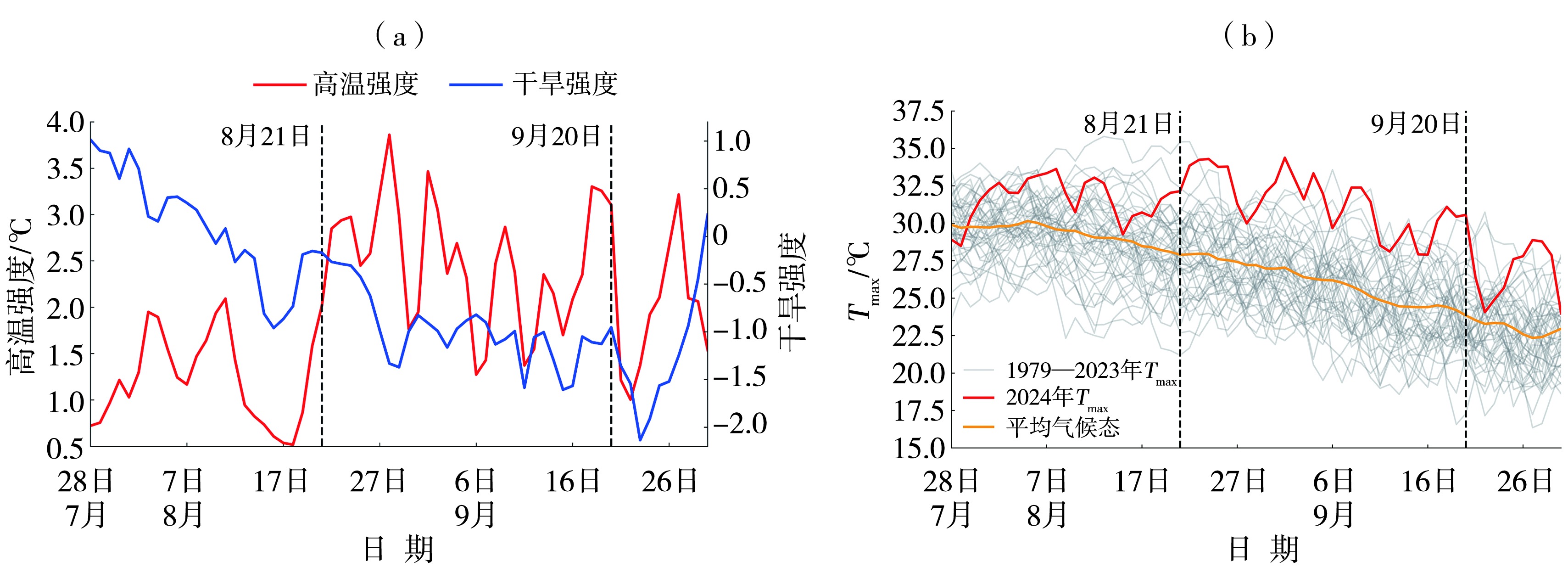
Fig.3 Daily variation of the hot intensity and SPI30 (a) of the compound hot and drought event from July 28 to September 30, 2024 and the regional average Tmax at the same period from 1979 to 2024 (b)
Fig.3 Daily variation of the hot intensity and SPI30 (a) of the compound hot and drought event from July 28 to September 30, 2024 and the regional average Tmax at the same period from 1979 to 2024 (b)
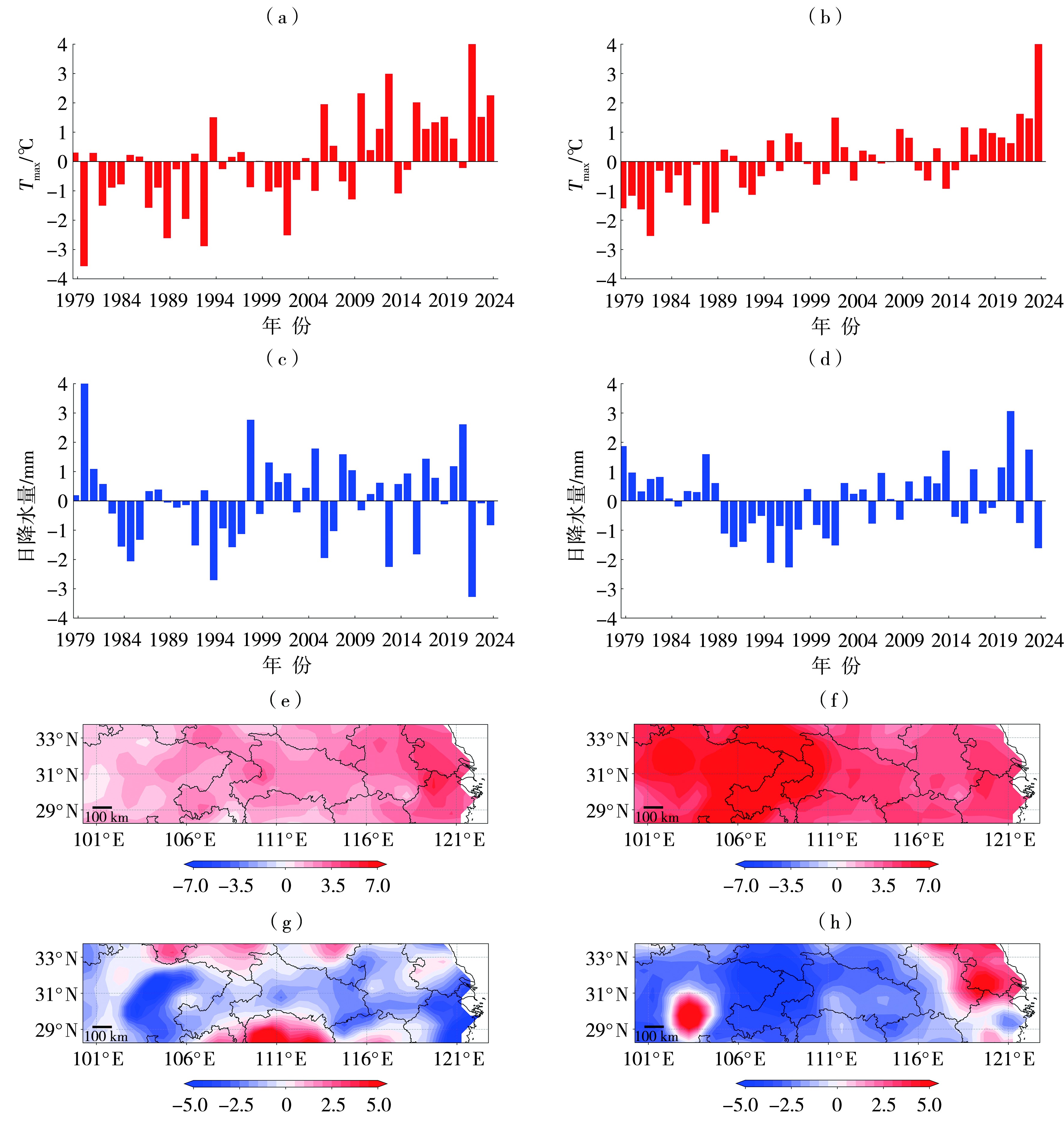
Fig.4 Interannual variation of mean Tmax anomalies (a, b) and mean precipitation anomalies (c, d) from 28 July to 20 August (a, c) and 21 August to 20 September (b, d) during 1979-2024, and spatial distribution of anomaly fields of Tmax (Unit: ℃) (e, f) and precipitation (Unit: mm) (g, h) from 28 July to 20 August (e, g) and 21 August to 20 September (f, h) 2024 in the Yangtze River Basin
Fig.4 Interannual variation of mean Tmax anomalies (a, b) and mean precipitation anomalies (c, d) from 28 July to 20 August (a, c) and 21 August to 20 September (b, d) during 1979-2024, and spatial distribution of anomaly fields of Tmax (Unit: ℃) (e, f) and precipitation (Unit: mm) (g, h) from 28 July to 20 August (e, g) and 21 August to 20 September (f, h) 2024 in the Yangtze River Basin
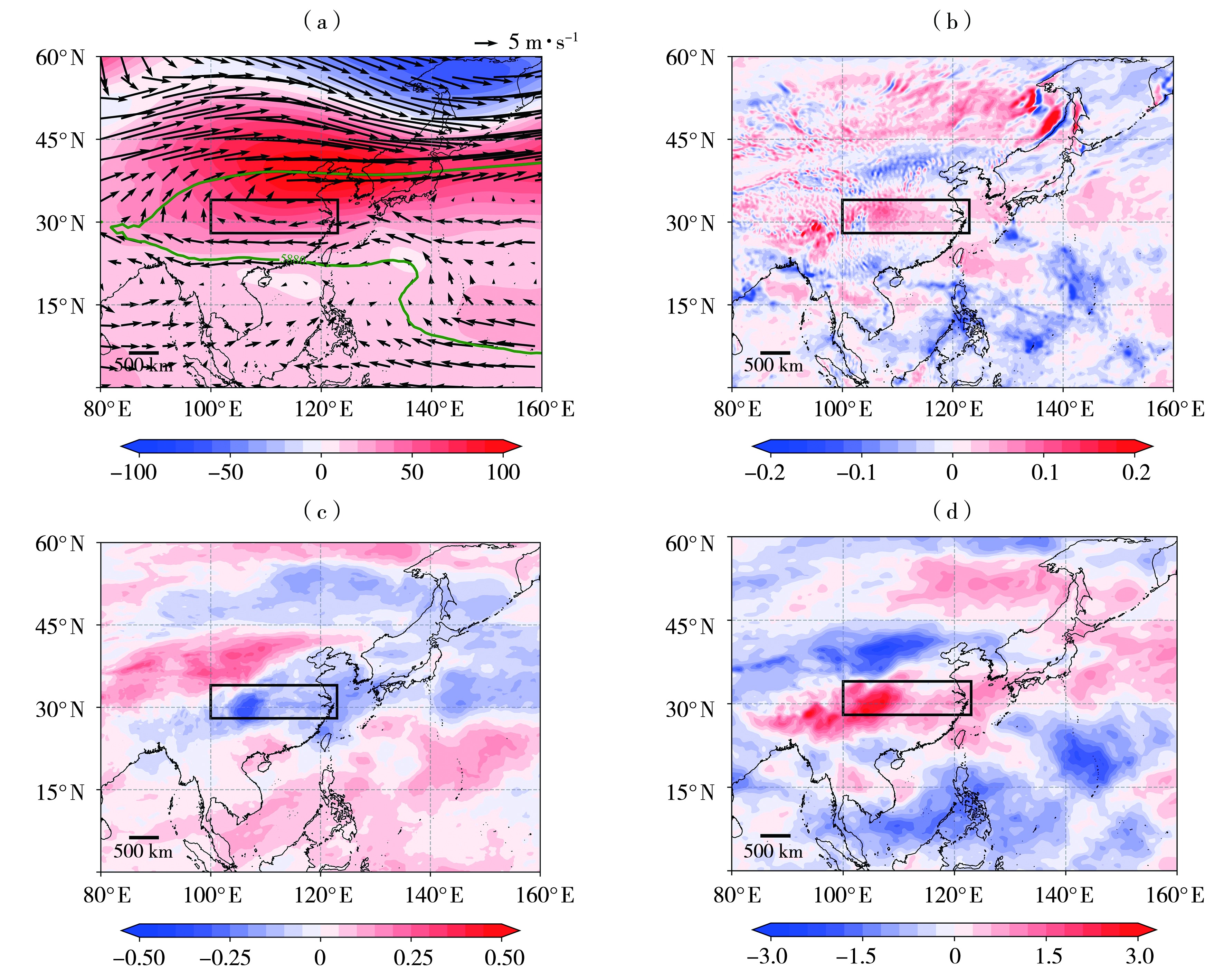
Fig.5 The 500 hPa geopotential height anomalies (the color shaded, Unit: gpm), and wind field (vectors, Unit: m·s-1) (a), 500 hPa vertical velocity anomalies (negative value indicates upward motion, Unit: Pa·s-1) (b), total cloud cover anomalies (c), and downward shortwave radiation anomalies (Unit: 10? J·m-2) (d) during 21 August to 20 September 2024 (The green line denotes 5 880 gpm, the black rectangle indicates the Yangtze River Basin)
Fig.5 The 500 hPa geopotential height anomalies (the color shaded, Unit: gpm), and wind field (vectors, Unit: m·s-1) (a), 500 hPa vertical velocity anomalies (negative value indicates upward motion, Unit: Pa·s-1) (b), total cloud cover anomalies (c), and downward shortwave radiation anomalies (Unit: 10? J·m-2) (d) during 21 August to 20 September 2024 (The green line denotes 5 880 gpm, the black rectangle indicates the Yangtze River Basin)
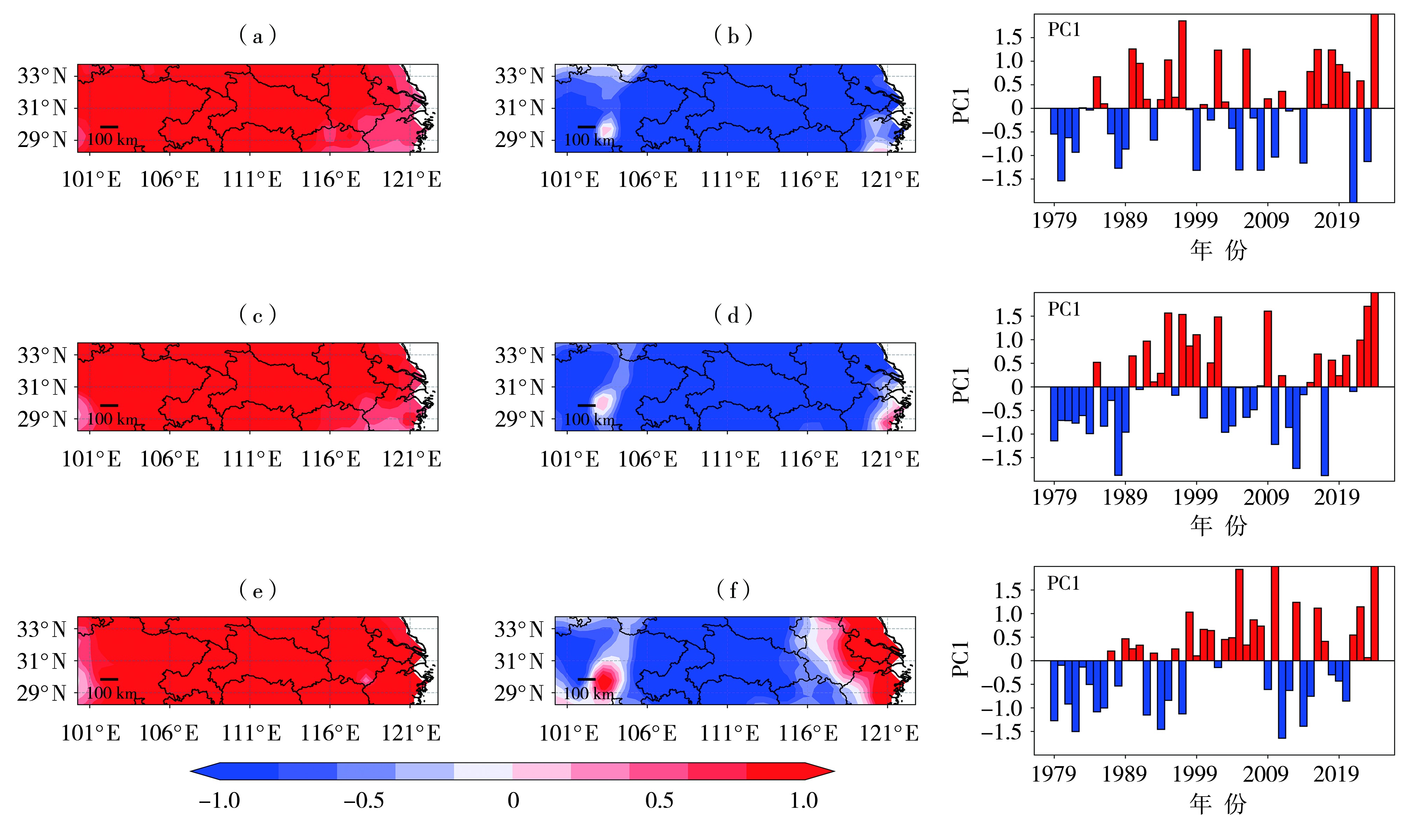
Fig.6 Spatial distribution of average Tmax (a, c, e) and average precipitation (b, d, f) combined with MVEOF1 and their corresponding common PC1 for the first (a, b), second (c, d), and third (e, f) ten-day periods from August 21 to September 20 during 1979-2024
Fig.6 Spatial distribution of average Tmax (a, c, e) and average precipitation (b, d, f) combined with MVEOF1 and their corresponding common PC1 for the first (a, b), second (c, d), and third (e, f) ten-day periods from August 21 to September 20 during 1979-2024
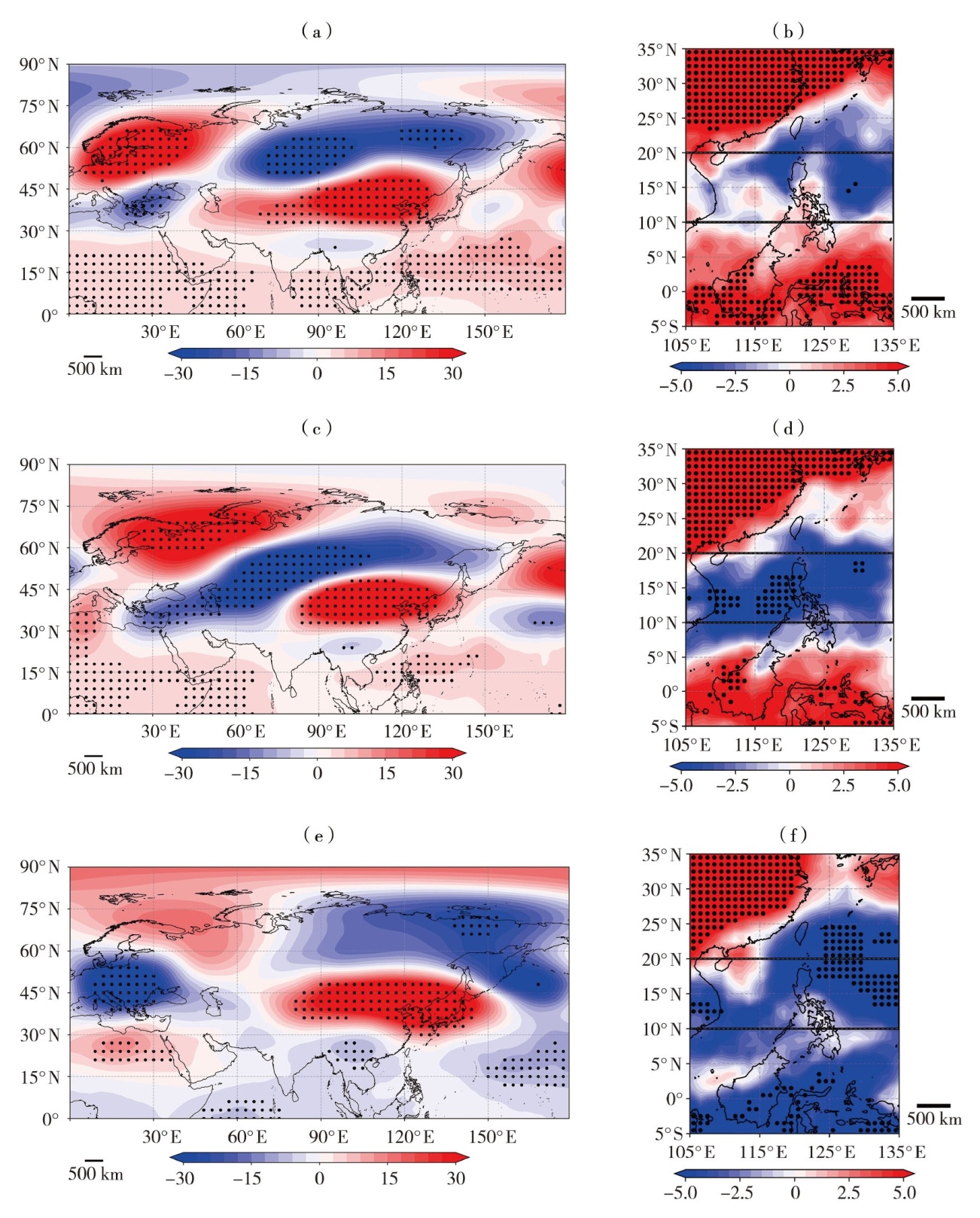
Fig.7 Spatial distribution of regression coefficients of PC1 onto the 200 hPa geopotential height over the Eurasian continent (Unit: gpm) (a, c, e) and OLR (Unit: W·m-2) over the south China Sea-Philippines-western Pacific region (b, d, f) for the first (a, b), second (c, d), and third (e, f) ten-day periods during August 21-September 20, 1979-2024 (The dotted area passed significance test (P≤0.05), the same as below; the black rectangle denotes the south China Sea-Philippines-western Pacific region)
Fig.7 Spatial distribution of regression coefficients of PC1 onto the 200 hPa geopotential height over the Eurasian continent (Unit: gpm) (a, c, e) and OLR (Unit: W·m-2) over the south China Sea-Philippines-western Pacific region (b, d, f) for the first (a, b), second (c, d), and third (e, f) ten-day periods during August 21-September 20, 1979-2024 (The dotted area passed significance test (P≤0.05), the same as below; the black rectangle denotes the south China Sea-Philippines-western Pacific region)
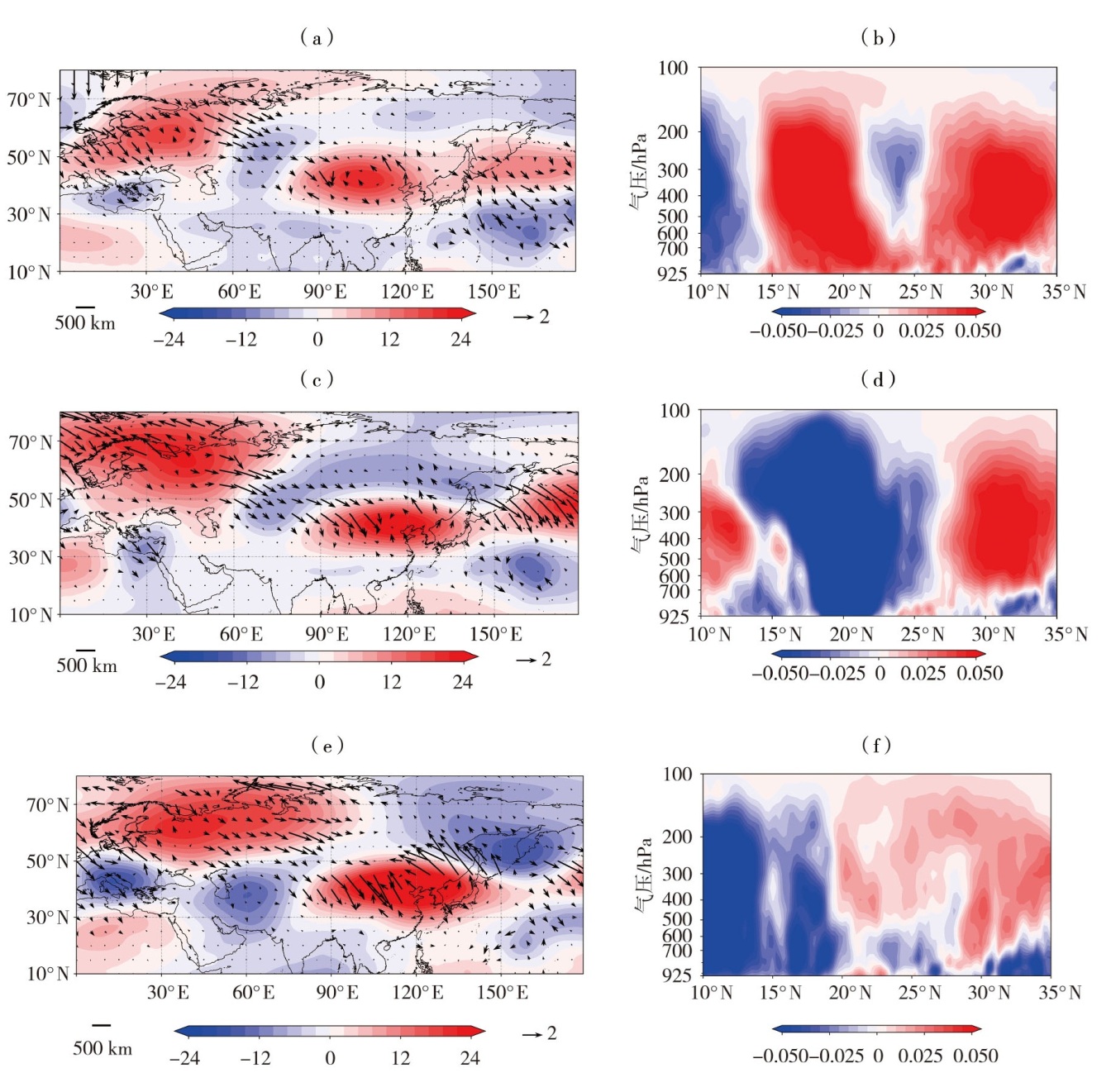
Fig.8 Anomalous 200 hPa stream function (the color shaded, Unit: 106 m2·s-1) and T-N wave activity flux (vectors, Unit: m2·s-2) (a, c, e) and the meridional mean vertical velocity cross section averaged over 105°E—120°E (negative values indicate upward motion, Unit: Pa·s-1) (b, d, f) for the first (a, b), second (c, d), and third (e, f) ten-day periods during August 21-September 20 in 2024
Fig.8 Anomalous 200 hPa stream function (the color shaded, Unit: 106 m2·s-1) and T-N wave activity flux (vectors, Unit: m2·s-2) (a, c, e) and the meridional mean vertical velocity cross section averaged over 105°E—120°E (negative values indicate upward motion, Unit: Pa·s-1) (b, d, f) for the first (a, b), second (c, d), and third (e, f) ten-day periods during August 21-September 20 in 2024
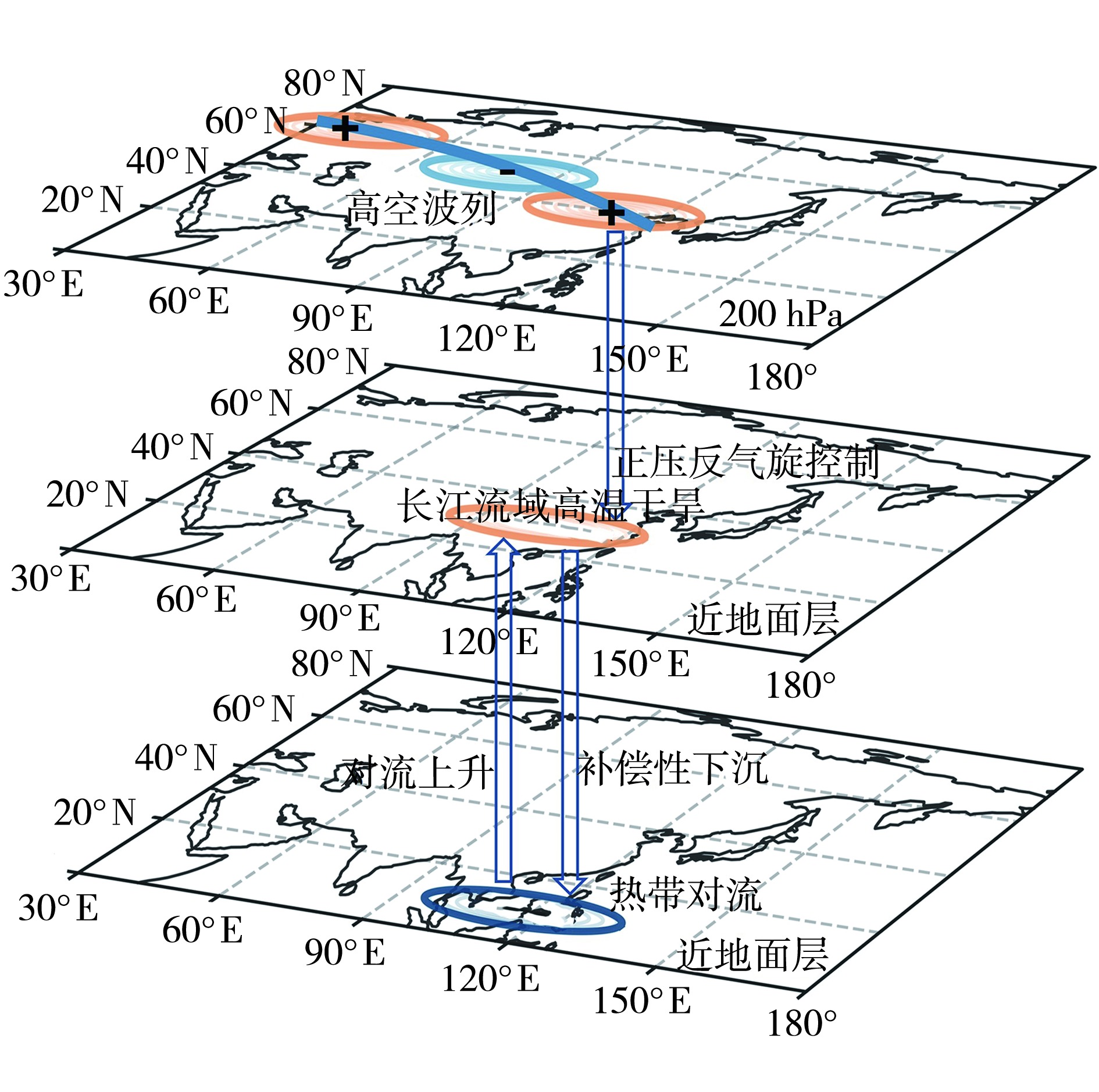
Fig.9 A schematic diagram of the mechanism of “autumn tiger” event in the Yangtze River Basin in 2024
Fig.9 A schematic diagram of the mechanism of “autumn tiger” event in the Yangtze River Basin in 2024
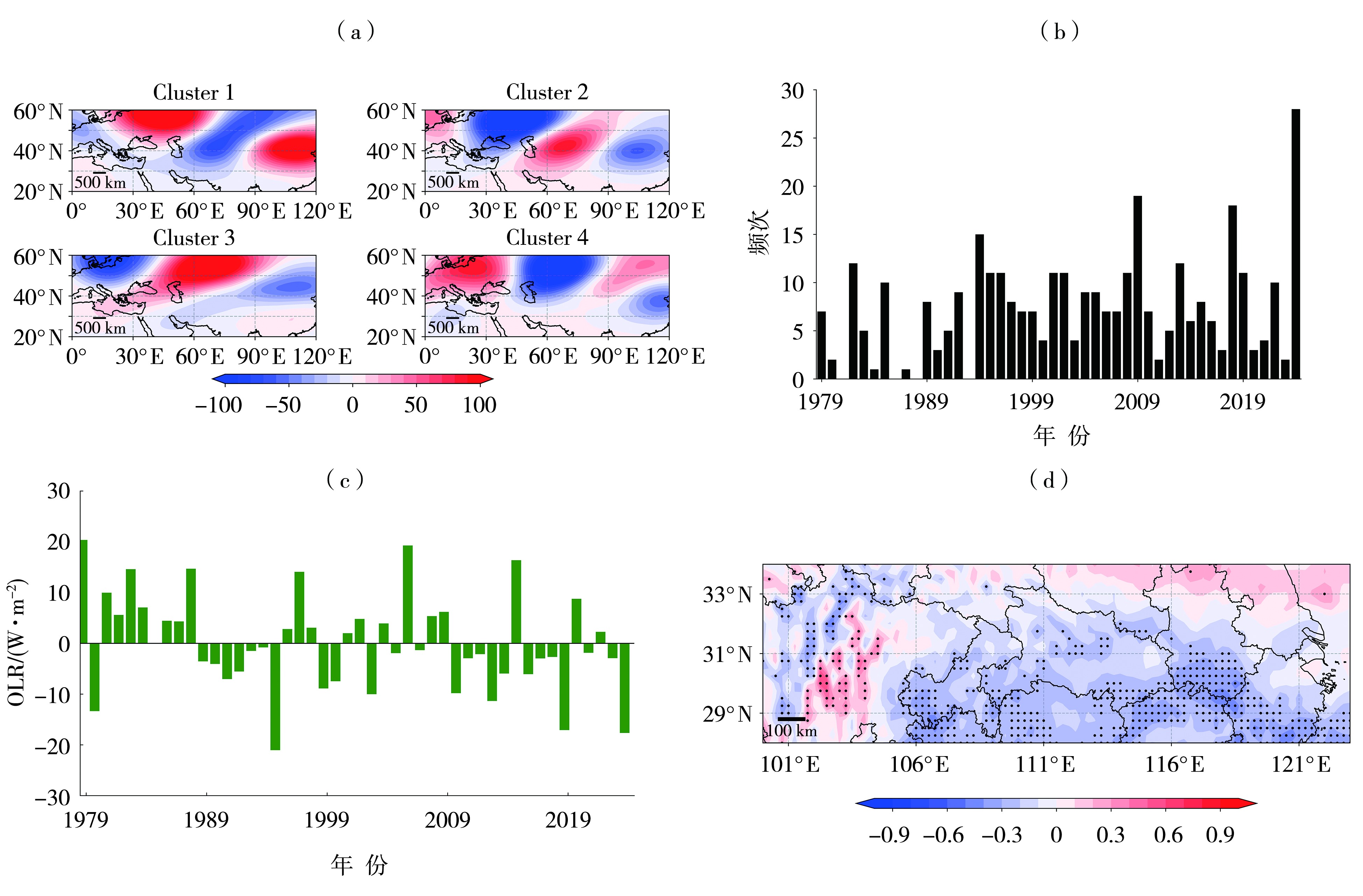
Fig.10 The K-means clustering results of the 200 hPa geopotential height anomaly field (Unit: gpm) (a), interannual variation of Cluster 1 mode frequency (b) and mean OLR anomaly over the south China Sea-Philippines-Western Pacific region (c), and spatial distribution of the correlation coefficients between mean OLR anomaly over the south China Sea-Philippines-Western Pacific region and 500 hPa vertical velocity anomaly in the Yangtze River Basin (d) from August 21 to September 20 during 1979-2024
Fig.10 The K-means clustering results of the 200 hPa geopotential height anomaly field (Unit: gpm) (a), interannual variation of Cluster 1 mode frequency (b) and mean OLR anomaly over the south China Sea-Philippines-Western Pacific region (c), and spatial distribution of the correlation coefficients between mean OLR anomaly over the south China Sea-Philippines-Western Pacific region and 500 hPa vertical velocity anomaly in the Yangtze River Basin (d) from August 21 to September 20 during 1979-2024
| [1] | 段欣妤, 张强, 张良, 等, 2024. 2022年长江流域重大干旱发展过程中西太平洋副热带高压的多维度异常特征[J]. 科学通报, 69(15):2 081-2 092. |
| [2] | 冯扬, 秦鹏程, 胡一阳, 等, 2025. 长江流域复合极端气候事件指标及识别方法综述[J]. 人民长江, 56(3):95-105. |
| [3] | 高洁, 肖红茹, 郭善云, 2023. 2022年夏季四川持续高温干旱特征及成因分析[J]. 沙漠与绿洲气象, 17(5):118-126. |
| [4] | 姜雨彤, 郝增超, 冯思芳, 等, 2023a. 长江与黄河流域复合高温干旱事件时空演变特征[J]. 水资源保护, 39(2):70-77. |
| [5] | 姜雨彤, 侯爱中, 郝增超, 等, 2023b. 长江流域2022年高温干旱事件演变及历史对比[J]. 水力发电学报, 42(8):1-9. |
| [6] | 全国气象防灾减灾标准化技术委员会, 2014. 区域性高温天气过程识别:QX/T 228—2014[S]. 北京: 气象出版社. |
| [7] | 孙蕊, 邓彪, 王顺久, 等, 2023. 2022年夏季四川省区域性高温和干旱过程监测评估[J]. 高原山地气象研究, 43(2):72-80. |
| [8] | 王喜元, 闫业超, 岳书平, 等, 2016. 1961—2010年长江流域高温热浪时空变化特征[J]. 云南大学学报:自然科学版, 38(4):602-609. |
| [9] | 杨含雪, 肖天贵, 金荣花, 2018. 北半球夏季EAP遥相关型的时空及环流特征研究[J]. 成都信息工程大学学报, 33(4):430-437. |
| [10] |
杨英杰, 曹倩, 税玥, 2024. 中亚复合高温干旱事件识别与特征分析[J]. 干旱气象, 42(1):19-26.
DOI |
| [11] | 余荣, 翟盘茂, 2021. 关于复合型极端事件的新认识和启示[J]. 大气科学学报, 44(5):645-649. |
| [12] |
张玉翠, 谭江红, 闫彩霞, 2024. 湖北省区域性高温、干旱及其复合事件变化特征及危险性评估[J]. 干旱气象, 42(6):825-835.
DOI |
| [13] | CHEN D, QIAO S B, YANG J, et al, 2024. Contribution of anthropogenic influence to the 2022-like Yangtze River valley compound heatwave and drought event[J]. npj Climate and Atmospheric Science, 7: 172. DOI:10.1038/s41612-024-00720-3. |
| [14] | CHEN Y, WANG A H, 2024. Role of land-atmosphere coupling in persistent extreme climate events in Eastern China in summer 2022[J]. Atmospheric and Oceanic Science Letters, 17(2): 100419. DOI:10.1016/j.aosl.2023.100419. |
| [15] |
CHEN Y, ZHAI P M, LIAO Z, et al, 2019. Persistent precipitation extremes in the Yangtze River Valley prolonged by opportune configuration among atmospheric teleconnections[J]. Quarterly Journal of the Royal Meteorological Society, 145(723):2 603-2 626.
DOI URL |
| [16] |
CHEN Y, ZHAI P M, 2015. Synoptic-scale precursors of the East Asia/Pacific teleconnection pattern responsible for persistent extreme precipitation in the Yangtze River Valley[J]. Quarterly Journal of the Royal Meteorological Society, 141(689):1 389-1 403.
DOI URL |
| [17] |
COLLINS B, 2022. Frequency of compound hot-dry weather extremes has significantly increased in Australia since 1889[J]. Journal of Agronomy and Crop Science, 208(6):941-955.
DOI URL |
| [18] | HAO Z C, HAO F H, SINGH V P, et al, 2018. Changes in the severity of compound drought and hot extremes over global land areas[J]. Environmental Research Letters, 13(12): 124022. DOI:10.1088/1748-9326/aaee96. |
| [19] | HAO Z C, HAO F H, XIA Y L, et al, 2022. Compound droughts and hot extremes: Characteristics, drivers, changes, and impacts[J]. Earth-Science Reviews, 235: 104241. DOI:10.1016/j.earscirev.2022.104241. |
| [20] | HERRERA-LORMENDEZ P, DOUVILLE H, MATSCHULLAT J, 2023. European summer synoptic circulations and their observed 2022 and projected influence on hot extremes and dry spells[J]. Geophysical Research Letters, 50(18): e2023GL104580. DOI:10.1029/2023GL104580. |
| [21] | HUA W J, QIN M H, DAI A G, et al, 2021. Reconciling human and natural drivers of the tripole pattern of multidecadal summer temperature variations over Eurasia[J]. Geophysical Research Letters, 48(14): e2021GL093971. DOI:10.1029/2021GL093971. |
| [22] |
HUANG X M, ZHANG T T, JIANG X W, et al, 2021. Interannual variability of mid-summer heat wave frequency over the Sichuan Basin[J]. International Journal of Climatology, 41(10):5 036-5 050.
DOI URL |
| [23] | IPCC, 2021. Climate change 2021: The physical science basis[R]. Cambridge: Cambridge University Press. |
| [24] | LUO M, LAU N C, LIU Z, et al, 2022. An observational investigation of spatiotemporally contiguous heatwaves in China from a 3D perspective[J]. Geophysical Research Letters, 49(6): e2022GL097714. DOI:10.1029/2022GL097714. |
| [25] | LUO M, WU S J, LAU G N, et al, 2024. Anthropogenic forcing has increased the risk of longer-traveling and slower-moving large contiguous heatwaves[J]. Science Advances, 10(13): eadl1598. DOI:10.1126/sciadv.adl1598. |
| [26] |
QIAN Z H, SUN Y X, MA Q R, et al, 2024. Understanding changes in heat waves, droughts, and compound events in Yangtze River Valley and the corresponding atmospheric circulation patterns[J]. Climate Dynamics, 62(1): 539-553.
DOI |
| [27] | RIDDER N N, UKKOLA A M, PITMAN A J, et al, 2022. Increased occurrence of high impact compound events under climate change[J]. npj Climate and Atmospheric Science, 5, 3. DOI:10.1038/s41612-021-00224-4. |
| [28] |
SHAN B Y, VERHOEST N E C, DE BAETS B, 2024. Identification of compound drought and heatwave events on a daily scale and across four seasons[J]. Hydrology and Earth System Sciences, 28(9):2 065-2 080.
DOI URL |
| [29] | TANG S K, QIAO S B, WANG B, et al, 2023. Linkages of unprecedented 2022 Yangtze River Valley heatwaves to Pakistan flood and triple-dip La Niña[J]. npj Climate and Atmospheric Science, 6: 44. DOI:10.1038/s41612-023-00386-3. |
| [30] | TRIPATHY K P, MUKHERJEE S, MISHRA A K, et al, 2023. Climate change will accelerate the high-end risk of compound drought and heatwave events[J]. Proceedings of the National Academy of Sciences of the United States of America, 120(28): e2219825120. DOI:10.1073/pnas.2219825120. |
| [31] | WANG C, LI Z, CHEN Y N, et al, 2024. Characteristic changes in compound drought and heatwave events under climate change[J]. Atmospheric Research, 305: 107440. DOI:10.1016/j.atmosres.2024.107440. |
| [32] | WANG R L, LI X, MA H D, et al, 2023a. Persistent meteorological drought in the Yangtze River Basin during summer-autumn 2022: Relay effects of different atmospheric internal variabilities[J]. Atmosphere, 14(9): 1402. DOI:10.3390/atmos14091402. |
| [33] | WANG R, LÜ G N, NING L, et al, 2021. Likelihood of compound dry and hot extremes increased with stronger dependence during warm seasons[J]. Atmospheric Research, 260: 105692. DOI:10.1016/j.atmosres.2021.105692. |
| [34] | WANG Z Q, LUO H L, YANG S, 2023b. Different mechanisms for the extremely hot central-eastern China in July-August 2022 from a Eurasian large-scale circulation perspective[J]. Environmental Research Letters, 18(2): 024023. DOI:10.1088/1748-9326/acb3e5. |
| [35] | World Meteorological Organization, 2012. Standardized precipitation index user guide (WMO-No. 1090)[R]. Geneva: WMO. |
| [36] |
XIE W X, ZHOU B T, LI H, 2025. Emerging interannual variability of compound heat waves over the Yangtze River valley since 2000[J]. Journal of Climate, 38(2): 597-609.
DOI URL |
| [37] |
XU P Q, WANG L, DONG Z Z, et al, 2022. The British-okhotsk corridor pattern and its linkage to the silk road pattern[J]. Journal of Climate, 35(17):5 787-5 804.
DOI URL |
| [38] | YIN Z J, YANG S, WEI W, 2023. Prevalent atmospheric and oceanic signals of the unprecedented heatwaves over the Yangtze River Valley in July-August 2022[J]. Atmospheric Research, 295: 107018. DOI:10.1016/j.atmosres.2023.107018. |
| [39] | ZHOU B Q, HU S J, PENG J J, et al, 2023. The extreme heat wave in China in August 2022 related to extreme northward movement of the eastern center of SAH[J]. Atmospheric Research, 293: 106918. DOI:10.1016/j.atmosres.2023.106918. |
| [40] |
ZHOU X Y, LI Y, XIAO C, et al, 2025. High-impact extreme weather and climate events in China: Summer 2024 overview[J]. Advances in Atmospheric Sciences, 42(6):1 064-1 076.
DOI |
| [1] | ZHANG Rong, HUANG Zhiyong, TANG Xingzhi, WANG Wenyu. Analysis of summer drought-flood alternation characteristics in Hubei Province from 1960 to 2024 [J]. Journal of Arid Meteorology, 2026, 44(1): 37-46. |
| [2] | LI Jialiang, PENG Liying, LIU Zuren, YU Shaorong, LIANG Jiajie. Drought characteristics in western Guangdong over the past 50 years based on SPEI [J]. Journal of Arid Meteorology, 2026, 44(1): 47-55. |
| [3] | HE Huigen, ZHANG Chi, CHENG Qingyan, LI Yonghua, GAN Weiwei, JIN Yan. Analysis on differences of characteristics and atmospheric circulation causes of meteorological drought during summer in Sichuan-Chongqing region [J]. Journal of Arid Meteorology, 2025, 43(3): 355-365. |
| [4] | WANG Yuetong, HE Dongpo, LI Zhongyan, WANG Shuo, CHEN Zaoyang. Analysis of two meteorological drought events in Guizhou Province and establishment of drought prediction model based on machine learning [J]. Journal of Arid Meteorology, 2024, 42(5): 671-682. |
| [5] | CHEN Xiaoxiao, HUANG Zhiyong, QIN Pengcheng, XIA Zhihong, YAO Yao, TANG Xingzhi, WANG Yingqiong. Atmospheric circulation and sea surface temperature characteristics of summer high temperature anomaly in the middle reaches of the Yangtze River [J]. Journal of Arid Meteorology, 2024, 42(4): 553-562. |
| [6] | JIANG Zhongbao, WANG Yukun, YANG Xueyan, LI Shangfeng, YU Xiujing, PAN Chunxiao, QIU Yixuan. Characteristics of climate comfort period in Changbai Mountain region from 1961 to 2018 [J]. Journal of Arid Meteorology, 2024, 42(4): 620-628. |
| [7] | WANG Yun, WANG Lijuan, LU Xiaojuan, ZHANG Jinyu, WANG Zhilan, SHA Sha, HU Die, YANG Yang, YAN Pengcheng, LI Yiping. Analysis of the characteristics and causes of drought in China in the first half of 2023 [J]. Journal of Arid Meteorology, 2023, 41(6): 884-896. |
| [8] | XIE Ao, LUO Boliang, DENG Jianbo, GAO Xiaxia. Characteristics and cause analysis of extreme and persistent drought in summer, autumn and winter in 2022/2023 in Hunan Province [J]. Journal of Arid Meteorology, 2023, 41(6): 910-922. |
| [9] | WANG Ying, ZHANG Shu, XU Yongqing, QUE Linjing, LI Xinhua, HUANG Yingwei, CHEN Xue, WANG Lei. Meteorological drought and atmospheric circulation anomalies characteristics in Heilongjiang Province from May to September in recent 50 years [J]. Journal of Arid Meteorology, 2023, 41(4): 540-549. |
| [10] | HAO Lisheng, MA Ning, HE Liye. Circulation anomalies characteritics of the abnormal drought and high temperature event in the middle and lower reaches of the Yangtze River in summer of 2022 [J]. Journal of Arid Meteorology, 2022, 40(5): 721-732. |
| [11] | LI Yiping, ZHANG Jinyu, YUE Ping, WANG Suping, ZHA Pengfei, WANG Lijuan, SHA Sha, ZHANG Liang, ZENG Dingwen, REN Yulong, HU Die. Study on characteristics of severe drought event over Yangtze River Basin in summer of 2022 and its causes [J]. Journal of Arid Meteorology, 2022, 40(5): 733-747. |
| [12] | FAN Jinjin, QIN Pengcheng, SHI Ruiqin, LI Mengrong, DU Liangmin. Characteristics of compound hot and drought disasters in Hubei under the background of climate change [J]. Journal of Arid Meteorology, 2022, 40(5): 780-790. |
| [13] | JIAO Yang, ZHANG Yongjing, YIN Chengmei, CHU Yingjia. Response of summer rainstorm in Shandong Province to change of spring atmospheric heat sources in southeastern Tibet Plateau and its adjacent areas [J]. Journal of Arid Meteorology, 2022, 40(3): 406-414. |
| [14] | XU Weiping, MENG Xiangxin, GU Weizong, BO Zhongkai. Relationship between extremely low temperature in spring in Shandong Province and North Atlantic SST in preceding winter [J]. Journal of Arid Meteorology, 2022, 40(2): 202-211. |
| [15] | GUO Guangfen, DU Liangmin, XIAO Ying, GAO Yaqi, WU Yao. Spatio-temporal Distribution Characteristics of Summer Extreme Precipitation in the Yangtze River Basin [J]. Journal of Arid Meteorology, 2021, 39(2): 235-243. |
| Viewed | ||||||
|
Full text |
|
|||||
|
Abstract |
|
|||||