干旱气象 ›› 2025, Vol. 43 ›› Issue (6): 920-930.DOI: 10.11755/j.issn.1006-7639-2025-06-0920
郑州短时强降水精细时空分布特征及地形影响
1.中国气象局农业气象保障与应用技术重点实验室 河南 郑州 450003 2.河南省郑州市气象局 河南 郑州 450005
-
收稿日期:2025-03-07修回日期:2025-08-25出版日期:2025-12-31发布日期:2026-01-19 -
通讯作者:李荣(1973—),河南南阳人,正高级工程师,主要从事灾害性天气预报预警技术研究。E-mail:lrong_ZZ@163.com。
-
作者简介:崔慧慧(1988—),河南郑州人,高级工程师,主要从事灾害性天气预报预警技术研究。E-mail:huihuismile2008@126.com。 -
基金资助:河南省科技厅科技攻关计划项目(242103810092);全国暴雨研究开放基金(BYKJ2025M05);河南省气象局重点实验室面上项目(KM202334);河南省气象局大城市气象预报服务创新团队共同资助
Fine-scale spatio-temporal characteristics of short-term heavy precipitation and topographic influences in Zhengzhou
CUI Huihui1,2( ), LI Rong1,2(), SUN Cunyong1,2
1. Key Laboratory of Agrometeorological Support and Applied Technique ,CMA Zhengzhou 450003, China 2. Zhengzhou Meteorological Bureau of Henan Province Zhengzhou 450005, China
-
Received:2025-03-07Revised:2025-08-25Online:2025-12-31Published:2026-01-19

摘要:
为深入认识郑州复杂地形下短时强降水的精细特征,基于2013—2022年国家站和区域站逐小时降水数据,常规观测资料以及高精度地理信息数据,分析郑州短时强降水的多时间尺度和空间变化规律,探讨降水强度、发生频次与地形因子的关系;并结合郑州2021年7月(“21·7”)的极端特大暴雨事件,揭示地形对短时强降水触发和增强的热动力机制。结果表明,郑州短时强降水站次呈波动增加趋势,7—8月为高发期,14:00—20:00(北京时,下同)为活跃时段,峰值出现在18:00—20:00,白天山区发生概率显著高于平原;≥20 mm·h?¹的短时强降水主要出现在山区,而≥50 mm·h?¹的极端强降水更易发生在郑州主城区及新密市一带,反映出山区频次高但强度相对偏弱、城区极端性更强的空间分布特征;环流分型显示,弱天气尺度强迫背景下,山区短时强降水站次明显多于平原;地形对短时强降水强度分布影响不显著,但对发生站次有明确影响。“21·7”暴雨过程中,地形辐合线的触发作用以及迎风坡抬升与下垫面热力差异共同导致的对流增强机制较为突出。
中图分类号:
引用本文
崔慧慧, 李荣, 孙存永. 郑州短时强降水精细时空分布特征及地形影响[J]. 干旱气象, 2025, 43(6): 920-930.
CUI Huihui, LI Rong, SUN Cunyong. Fine-scale spatio-temporal characteristics of short-term heavy precipitation and topographic influences in Zhengzhou[J]. Journal of Arid Meteorology, 2025, 43(6): 920-930.

图1 郑州行政区域划分、气象站点分布及地形高度(单位:m)
Fig.1 Administrative area division, meteorological station distribution and terrain height (Unit: m) of Zhengzhou
图1 郑州行政区域划分、气象站点分布及地形高度(单位:m)
Fig.1 Administrative area division, meteorological station distribution and terrain height (Unit: m) of Zhengzhou
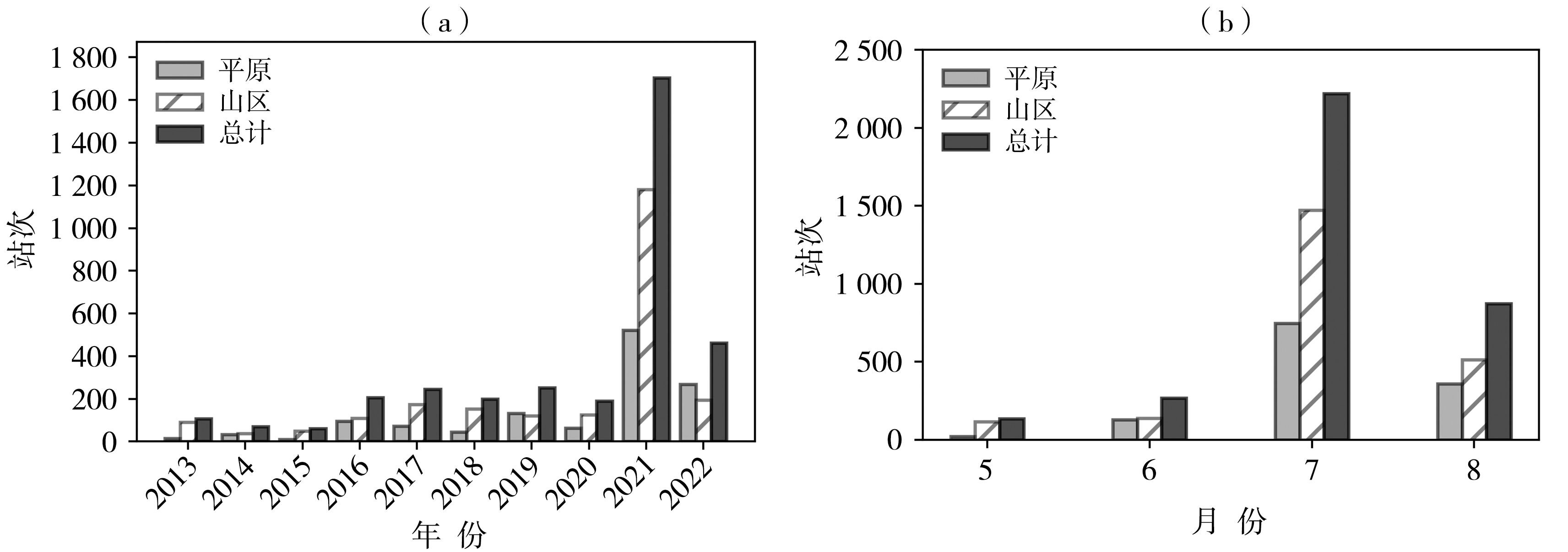
图2 2013—2022年郑州短时强降水逐年(a)和5—8月逐月(b)发生站次变化
Fig.2 The yearly (a) and monthly (May to August) (b) variations of the number of stations occurring short-term heavy precipitation from 2013 to 2022 in Zhengzhou
图2 2013—2022年郑州短时强降水逐年(a)和5—8月逐月(b)发生站次变化
Fig.2 The yearly (a) and monthly (May to August) (b) variations of the number of stations occurring short-term heavy precipitation from 2013 to 2022 in Zhengzhou
表1 2013—2022年5—8月郑州各月短时强降水最大雨强
Tab.1 Maximums of short-term heavy precipitation intensity from May to August during the period of 2013-2022 in Zhengzhou
| 2013 | 2014 | 2015 | 2016 | 2017 | 2018 | 2019 | 2020 | 2021 | 2022 | |
|---|---|---|---|---|---|---|---|---|---|---|
| 5月 | 52.3 | 72.6 | 29.3 | — | 77.8 | 68.6 | 27.7 | — | 39.2 | — |
| 6月 | 61.6 | 92.5 | — | 85.2 | 45.7 | 38.9 | 37.3 | 48.4 | 39.9 | 61.9 |
| 7月 | 121.8* | 60.9 | 41.8 | 79.2* | 58.3 | 84.7* | 64.9 | 56.1 | 201.9* | 103.7* |
| 8月 | 97.6 | 92.5* | 58.1* | 45.9 | 77.9* | 78.9 | 88.2* | 92.4* | 71.4 | 49.6 |
表1 2013—2022年5—8月郑州各月短时强降水最大雨强
Tab.1 Maximums of short-term heavy precipitation intensity from May to August during the period of 2013-2022 in Zhengzhou
| 2013 | 2014 | 2015 | 2016 | 2017 | 2018 | 2019 | 2020 | 2021 | 2022 | |
|---|---|---|---|---|---|---|---|---|---|---|
| 5月 | 52.3 | 72.6 | 29.3 | — | 77.8 | 68.6 | 27.7 | — | 39.2 | — |
| 6月 | 61.6 | 92.5 | — | 85.2 | 45.7 | 38.9 | 37.3 | 48.4 | 39.9 | 61.9 |
| 7月 | 121.8* | 60.9 | 41.8 | 79.2* | 58.3 | 84.7* | 64.9 | 56.1 | 201.9* | 103.7* |
| 8月 | 97.6 | 92.5* | 58.1* | 45.9 | 77.9* | 78.9 | 88.2* | 92.4* | 71.4 | 49.6 |

图3 2013—2022年郑州短时强降水逐小时站次和最大雨强变化
Fig.3 Hourly variation of the number of stations occurring short-term heavy precipitation and maximum rainfall intensity from 2013 to 2022 in Zhengzhou
图3 2013—2022年郑州短时强降水逐小时站次和最大雨强变化
Fig.3 Hourly variation of the number of stations occurring short-term heavy precipitation and maximum rainfall intensity from 2013 to 2022 in Zhengzhou

图4 2013—2022年郑州小时雨量≥20 mm(a、c)、≥50 mm(b、d)的短时强降水站次(a、b)和降水强度(c、d)空间分布
Fig.4 Spatial distributions of station numbers (a, b) and precipitation intensity (c, d) for short-term heavy precipitation events with hourly rainfall equal to or greater than 20 mm (a, c) and equal to or greater than 50 mm (b, d) from 2013 to 2022 in Zhengzhou
图4 2013—2022年郑州小时雨量≥20 mm(a、c)、≥50 mm(b、d)的短时强降水站次(a、b)和降水强度(c、d)空间分布
Fig.4 Spatial distributions of station numbers (a, b) and precipitation intensity (c, d) for short-term heavy precipitation events with hourly rainfall equal to or greater than 20 mm (a, c) and equal to or greater than 50 mm (b, d) from 2013 to 2022 in Zhengzhou

图5 郑州短时强降水强度(a)、站次(b)与海拔的箱线图 (R代表短时强降水强度;F代表短时强降水站次)
Fig.5 The box plots of short-term heavy precipitation intensity (a), station numbers (b) and altitude in Zhengzhou (The R represents precipitation intensity, F represents the number of stations occurring short-term strong precipitation)
图5 郑州短时强降水强度(a)、站次(b)与海拔的箱线图 (R代表短时强降水强度;F代表短时强降水站次)
Fig.5 The box plots of short-term heavy precipitation intensity (a), station numbers (b) and altitude in Zhengzhou (The R represents precipitation intensity, F represents the number of stations occurring short-term strong precipitation)

图6 郑州短时强降水的天气学概念模型 (a)副热带高压内部型,(b)高空西北气流型,(c)台风低压型,(d)高空槽型
Fig.6 Meteorological conceptual model of short-term heavy precipitation in Zhengzhou (a) internal type of subtropical high pressure, (b) high-altitude northwest airflow type, (c) typhoon low pressure type, (d) high altitude trough type
图6 郑州短时强降水的天气学概念模型 (a)副热带高压内部型,(b)高空西北气流型,(c)台风低压型,(d)高空槽型
Fig.6 Meteorological conceptual model of short-term heavy precipitation in Zhengzhou (a) internal type of subtropical high pressure, (b) high-altitude northwest airflow type, (c) typhoon low pressure type, (d) high altitude trough type
表2 通过显著性检验的短时强降水个例的影响系数和显著性值(α=0. 05)
Tab. 2 Influence coefficients and significance values for short-term heavy precipitation cases passing the significance test (α=0. 05)
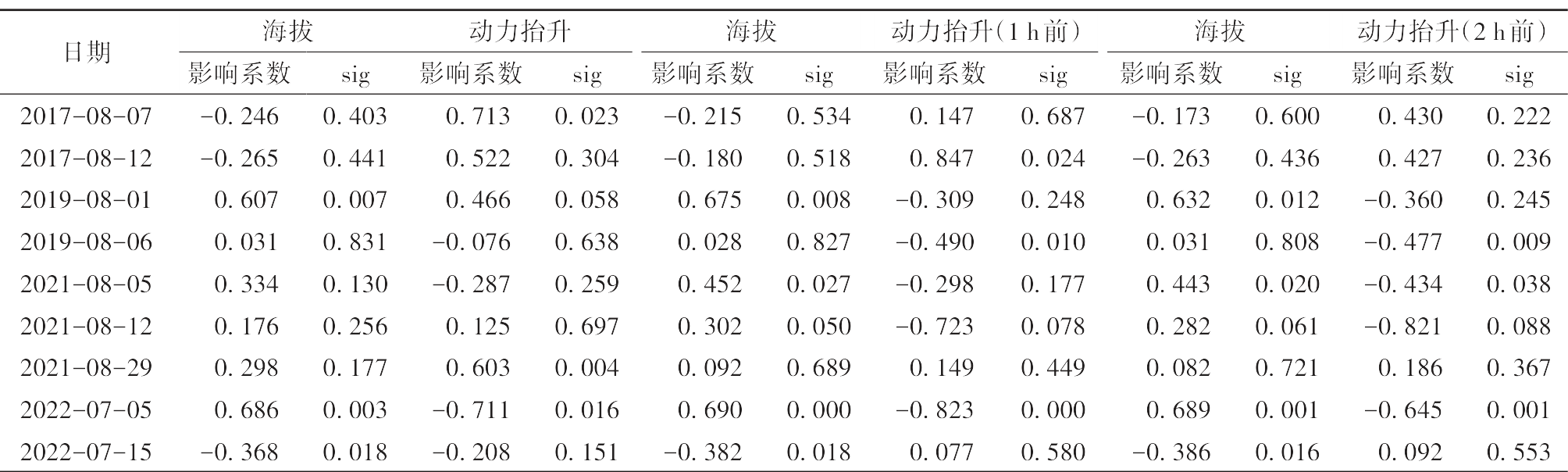 |
表2 通过显著性检验的短时强降水个例的影响系数和显著性值(α=0. 05)
Tab. 2 Influence coefficients and significance values for short-term heavy precipitation cases passing the significance test (α=0. 05)
| |

图7 2021年7月19日08:00(a)和20日08:00(b)925 hPa水平风场(箭矢,单位:m·s-1)及水汽通量(填色,单位:g·cm-1·hPa-1·s-1)分布 (图中●表示郑州)
Fig.7 The 925 hPa horizontal wind field (arrow vectors, Unit: m·s-1) and water vapor flux (the color shaded, Unit: g·cm-1·hPa-1·s-1) at 08:00 July 19 (a) and 08:00 July 20 (b), 2021 (The ● represents the location of Zhengzhou)
图7 2021年7月19日08:00(a)和20日08:00(b)925 hPa水平风场(箭矢,单位:m·s-1)及水汽通量(填色,单位:g·cm-1·hPa-1·s-1)分布 (图中●表示郑州)
Fig.7 The 925 hPa horizontal wind field (arrow vectors, Unit: m·s-1) and water vapor flux (the color shaded, Unit: g·cm-1·hPa-1·s-1) at 08:00 July 19 (a) and 08:00 July 20 (b), 2021 (The ● represents the location of Zhengzhou)

图8 2021年7月18日20:00—21日08:00巩义文化站逐小时雨量变化
Fig.8 Variation of hourly precipitation at Gongyi Wenhuazhan Station from 20:00 July 18 to 08:00 July 21, 2021
图8 2021年7月18日20:00—21日08:00巩义文化站逐小时雨量变化
Fig.8 Variation of hourly precipitation at Gongyi Wenhuazhan Station from 20:00 July 18 to 08:00 July 21, 2021

图9 2021年7月19日08:00郑州地面风场(a)和09:00雷达组合反射率因子(b,填色,单位:dBZ) [图9(a)中红色方框表示中尺度辐合区、图9(b)中红色方框表示山区对流反复触发区]
Fig.9 Surface wind field at 08:00 (a) and composite radar reflectivity at 09:00 (the color shaded, Unit: dBZ) (b) over Zhengzhou on 19 July 2021 (The red rectangle in figure 9 (a) denotes a mesoscale convergence zone, and the red rectangle in figure 9 (b) indicates an area with repeatedly triggered convection over the mountainous region)
图9 2021年7月19日08:00郑州地面风场(a)和09:00雷达组合反射率因子(b,填色,单位:dBZ) [图9(a)中红色方框表示中尺度辐合区、图9(b)中红色方框表示山区对流反复触发区]
Fig.9 Surface wind field at 08:00 (a) and composite radar reflectivity at 09:00 (the color shaded, Unit: dBZ) (b) over Zhengzhou on 19 July 2021 (The red rectangle in figure 9 (a) denotes a mesoscale convergence zone, and the red rectangle in figure 9 (b) indicates an area with repeatedly triggered convection over the mountainous region)
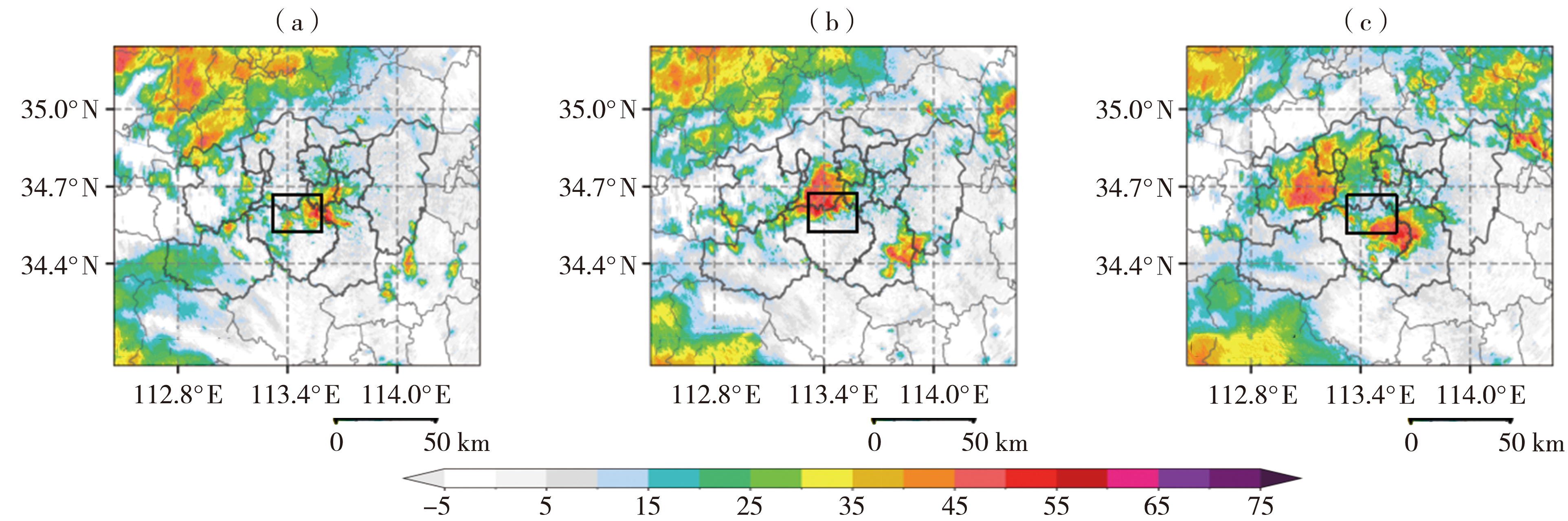
图10 2021年7月19日08:30(a)、09:12(b)、10:00(c)郑州雷达组合反射率因子(单位:dBZ) (图中黑框表示嵩山东段迎风坡区)
Fig.10 Radar composite reflectivity (Unit: dBZ) in Zhengzhou at 08:30 (a), 09:12 (b), and 10:00 (c) on 19 July 2021 (The black rectangle indicates the area of the windward slope in the eastern section of the Songshan Mountain)
图10 2021年7月19日08:30(a)、09:12(b)、10:00(c)郑州雷达组合反射率因子(单位:dBZ) (图中黑框表示嵩山东段迎风坡区)
Fig.10 Radar composite reflectivity (Unit: dBZ) in Zhengzhou at 08:30 (a), 09:12 (b), and 10:00 (c) on 19 July 2021 (The black rectangle indicates the area of the windward slope in the eastern section of the Songshan Mountain)

图11 2021年7月19日08:00郑州地面温度(a)、露点(b)(等值线,单位:℃)与地形高度(填色,单位:m)分布
Fig.11 Distribution of surface temperature (isolines, Unit: °C) (a) and dew point (isolines, Unit: °C) (b)overlaid on topography (the color shaded, Unit: m) in Zhengzhou at 08:00 on 19 July 2021
图11 2021年7月19日08:00郑州地面温度(a)、露点(b)(等值线,单位:℃)与地形高度(填色,单位:m)分布
Fig.11 Distribution of surface temperature (isolines, Unit: °C) (a) and dew point (isolines, Unit: °C) (b)overlaid on topography (the color shaded, Unit: m) in Zhengzhou at 08:00 on 19 July 2021
| [1] | 陈炯, 郑永光, 张小玲, 等, 2013. 中国暖季短时强降水分布和日变化特征及其与中尺度对流系统日变化关系分析[J]. 气象学报, 71(3): 367-382. |
| [2] | 陈敏, 陈豫英, 陈荣, 等, 2025. 贺兰山东麓暴雨天气分型及气象要素演变特征研究[J]. 干旱气象, 43(3): 413-423. |
| [3] | 崔慧慧, 李荣, 郜彦娜, 等, 2023. “7·20”郑州极端特大暴雨降水细节特征和成灾过程研究[J]. 灾害学, 38(2):114-120. |
| [4] | 付超, 谌芸, 单九生, 2017. 地形因子对降水的影响研究综述[J]. 气象与减灾研究, 40(4): 318-324. |
| [5] | 傅抱璞, 1988. 山地气候要素空间分布的模拟[J]. 气象学报, 46(3): 319-326. |
| [6] | 傅抱璞, 1992. 地形和海拔对降水的影响[J]. 地理学报, 47(4): 302-314. |
| [7] | 高洁, 漆梁波, 2015. 上海地区短时强降水特点及其影响[J]. 气象与环境科学, 38(3): 52-60. |
| [8] | 黄小彦, 孙继松, 刘文婷, 2020. 地形作用下低空急流的演变与强降水对流风暴系统的相互作用[J]. 气象学报, 78(4): 551-567. |
| [9] | 廖菲, 洪延超, 郑国光, 2007. 地形对降水的影响研究概述[J]. 气象科技, 35(3): 309-316. |
| [10] | 林慧敏, 闵锦忠, 朱利剑, 等, 2023. 太行山地形在“7·19”华北持续性低涡暴雨中的作用[J]. 气象科学, 43(1): 46-58. |
| [11] | 孟丽霞, 许东蓓, 狄潇泓, 等, 2017. 甘肃省短时强降水的时空特征[J]. 沙漠与绿洲气象, 11(6): 34-39. |
| [12] | 乔春贵, 高牧原, 梁钰, 等, 2024. 河南省近30年分级短时强降水时空分布特征分析[J]. 气象与环境科学, 47(3): 72-81. |
| [13] | 苏爱芳, 吕晓娜, 崔丽曼, 等, 2021. 郑州“7.20”极端暴雨天气的基本观测分析[J]. 暴雨灾害, 40(5): 445-454. |
| [14] | 苏爱芳, 席乐, 吕晓娜, 等, 2022. 豫北“21·7”极端暴雨过程特征及成因分析[J]. 气象, 48(5): 556-570. |
| [15] | 孙继松, 2005. 气流的垂直分布对地形雨落区的影响[J]. 高原气象, 24(1): 62-69. |
| [16] | 唐永兰, 徐桂荣, 王晓芳, 等, 2023. 1992—2021年三峡库区夏季小时强降水时空分布特征[J]. 干旱气象, 41(4): 589-598. |
| [17] | 王国荣, 王令, 2013. 北京地区夏季短时强降水时空分布特征[J]. 暴雨灾害, 32(3): 276-279. |
| [18] | 汪小康, 崔春光, 王婧羽, 等, 2022. “21·7”河南特大暴雨水汽和急流特征诊断分析[J]. 气象, 48(5): 533-544. |
| [19] | 魏晓雯, 梁萍, 何金海, 2016. 上海地区不同类型短时强降水的大尺度环流背景特征分析[J]. 气象与环境科学, 39(2): 69-75. |
| [20] | 肖安, 尹小飞, 刘献耀, 2022. 江西省降水日变化时空分布特征[J]. 干旱气象, 40(5): 840-848. |
| [21] | 杨浩, 周文, 汪小康, 等, 2022. “21·7”河南特大暴雨降水特征及极端性分析[J]. 气象, 48(5): 571-579. |
| [22] | 杨丽杰, 曹彦超, 刘维成, 等, 2022. 陇东黄土高原旱区短时强降水的时空分布特征及地形影响研究[J]. 干旱气象, 40(6): 945-953. |
| [23] | 杨舒楠, 张芳华, 胡艺, 等, 2023. “23·7”华北特大暴雨过程的基本特征与成因初探[J]. 暴雨灾害, 42(5): 508-520. |
| [24] | 姚莉, 李小泉, 张立梅, 2009. 我国1小时雨量的时空分布特征[J]. 气象, 35(2): 80-87. |
| [25] | 俞小鼎, 2013. 短时强降水临近预报的思路与方法[J]. 暴雨灾害, 32(3): 202-209. |
| [26] | 张宁, 刘科男, 王遂缠, 等, 2020. 兰州市短时强降水的时空分布特征及地形因素[J]. 干旱气象, 38(2): 242-248. |
| [27] | 赵煜飞, 张强, 鞠晓慧, 等, 2024. 中国近30年短时极端降水特征分析[J]. 大气科学, 48(3): 1 144-1 156. |
| [28] | 郑祚芳, 王在文, 高华, 2013. 北京地区夏季极端降水变化特征及城市化的影响[J]. 气象, 39(12): 1 635-1 641. |
| [29] | 钟水新, 2020. 地形对降水的影响机理及预报方法研究进展[J]. 高原气象, 3 9(5): 1 122-1 132. |
| [30] | 周学云, 高文良, 吴亚平, 等, 2019. 定量研究雅安地形坡向坡度对降水分布的影响[J]. 气象科学, 39(3): 322-335. |
| [31] | LI Z H, LUO Y L, DU Y, et al, 2020. Statistical characteristics of pre-summer rainfall over South China and associated synoptic conditions[J]. Journal of the Meteorological Society of Japan, Series II, 98: 213-233. |
| [32] | LUO Y L, JI H, ZHANG M Y, et al, 2023. On the influences of urbanization on the extreme rainfall over Zhengzhou on 20 July 2021: A convection-permitting ensemble modeling study[J]. Advances in Atmospheric Sciences, 40: 393-409. |
| [33] | LUO Y L, WU M, REN F, et al, 2016. Synoptic situations of extreme hourly precipitation over China[J]. Journal of Climate, 29: 8 703-8 719. |
| [34] | RAO X N, ZHAO K, CHEN X C, et al, 2019. Influence of synoptic pattern and low-level wind speed on intensity and diurnal variations of orographic convection in summer over Pearl River Delta, South China[J]. Journal of Geophysical Research: Atmospheres, 124: 6 157-6 179. |
| [35] | ZHUO H, ZHAO P, ZHOU T J, 2014. Diurnal cycle of summer rainfall in Shandong of eastern China[J]. International Journal of Climatology, 34: 742-750. |
| [36] | ZHANG X H, YANG X M, WANG L, et al, 2021. Analysis on characteristic and abnormality of atmospheric circulations of the July 2021 extreme precipitation in Henan[J]. Transactions of Atmospheric Sciences, 44: 672-687. |
| [1] | 刘菊菊, 陈小婷, 彭力, 黄少妮, 潘留杰. 基于加密站点的陕西短时强降水时空特征分析[J]. 干旱气象, 2025, 43(6): 910-919. |
| [2] | 黄丽娜, 陈艳真, 陈宇航, 李忆平, 杨明灿, 陈诗琳. “杜苏芮”台风过程中莆田市特大暴雨阶段性和强度特征[J]. 干旱气象, 2025, 43(5): 713-722. |
| [3] | 武威, 徐丽娜, 单铁良. 基于倾斜旋转T模态主成分分析的沙颍河流域短时强降水环流分型研究[J]. 干旱气象, 2025, 43(5): 759-769. |
| [4] | 袁瑞瑞, 王坤, 高睿娜. FY-4A云覆盖率产品在宁夏的检验评估及订正[J]. 干旱气象, 2025, 43(5): 799-809. |
| [5] | 李浙华, 肖安, 涂满红, 吴文心. 1979—2019年4—9月江西省短时强降水变化趋势及成因分析[J]. 干旱气象, 2025, 43(4): 595-606. |
| [6] | 靳振华, 卜清军, 黄安宁. 冷涡背景下天津夏季三次不同强度极端短时强降水物理量特征对比分析[J]. 干旱气象, 2025, 43(3): 424-434. |
| [7] | 程瑶, 赵腾, 杨苑媛. ROSE2.1短时强降水自动报警产品在宁夏北部的适用性评估[J]. 干旱气象, 2025, 43(3): 469-478. |
| [8] | 万羽, 许冠宇, 钟敏, 刘瑞雪, 刘文婷. 基于多模式融合的湖北逐时短时强降水预报方法改进[J]. 干旱气象, 2025, 43(1): 143-152. |
| [9] | 任至涵, 倪长健, 石荞语, 陈宁. 基于最优概率分布函数的成都市近63 a干旱特征分析[J]. 干旱气象, 2024, 42(6): 844-853. |
| [10] | 刘菊菊, 赵强, 井宇, 张蔚然, 戴昌明. CMPAS融合产品在陕西短时强降水监测中的适用性评估[J]. 干旱气象, 2024, 42(2): 263-273. |
| [11] | 鲍丽丽, 程鹏, 王小勇, 何金梅, 闫昕旸, 尹春, 李晓琴, 赵文婧. 基于Logistic回归和神经网络的甘肃省道路结冰预警模型研究[J]. 干旱气象, 2024, 42(1): 137-145. |
| [12] | 肖贻青, 马永永, 陈小婷, 安大维, 黄少妮. 陕南汉江盆地一次冷锋触发的短时强降水过程及预报检验[J]. 干旱气象, 2023, 41(6): 972-983. |
| [13] | 唐永兰, 徐桂荣, 王晓芳, 肖艳姣, 祁海霞, 冷亮. 1992—2021年三峡库区夏季小时强降水时空分布特征[J]. 干旱气象, 2023, 41(4): 589-598. |
| [14] | 马志敏, 王将, 连钰, 张万诚, 牛法宝, 杨素雨. 云南一次强对流暴雨天气学成因分析[J]. 干旱气象, 2023, 41(4): 629-638. |
| [15] | 把黎, 奚立宗, 蔡迪花, 庞朝云, 张鑫海, 尹春. 基于微波辐射计资料的祁连山东段大气水汽和液态水时空变化特征[J]. 干旱气象, 2023, 41(1): 64-72. |
| 阅读次数 | ||||||
|
全文 |
|
|||||
|
摘要 |
|
|||||
