干旱气象 ›› 2026, Vol. 44 ›› Issue (1): 115-125.DOI: 10.11755/j.issn.1006-7639-2026-01-0115
京津冀地区一次极端暖区暴雨成因分析
董琪如1,2( ), 王莹3, 李英华1(), 杨旭4, 梁康壮1
- 1.天津市海洋气象重点实验室,天津市气象科学研究所,天津 300074
2.中国气象局水文气象重点开放实验室,北京 100081
3.天津市气象台,天津 300074
4.天津市环境气象中心,天津 300074
-
收稿日期:2025-04-27修回日期:2025-05-28出版日期:2026-02-28发布日期:2026-03-25 -
通讯作者:李英华(1981—),女,高级工程师,主要从事数值模拟研究。E-mail: liyinghua05@163.com。
-
作者简介:董琪如(1992—),女,高级工程师,主要从事资料同化技术及灾害性天气分析研究。E-mail: dongqiru77@163.com。 -
基金资助:灾害天气科学与技术全国重点实验室开放课题(2025KFA19);天津市科技重大专项(25ZXSFSN00060);中国气象局水文气象重点开放实验室开放研究课题(23SWQXM004);海河流域气象科技创新项目(HHXM-TD202504);天津市海洋气象重点实验室开放基金项目(2023TKLOM02);湖南省气象局创新发展专项(CXFZ2025-MSXM68)
Causes analysis of an extreme warm-sector rainstorm in Beijing-Tianjin-Hebei region
DONG Qiru1,2(), WANG Ying3, LI Yinghua1(), YANG Xu4, LIANG Kangzhuang1
- 1. Tianjin Key Laboratory for Oceanic Meteorology,Tianjin Institute of Meteorological Science,Tianjin 300074,China
2. China Meteorological Administration Hydro-Meteorology Key Laboratory,Beijing 100081,China
3. Tianjin Meteorological Observatory,Tianjin 300074,China
4. Tianjin Environmental Meteorological Center,Tianjin 300074,China
-
Received:2025-04-27Revised:2025-05-28Online:2026-02-28Published:2026-03-25

摘要:
随着华北暖区暴雨事件增多,研究暖区暴雨过程中尺度对流系统发生及演变机制对提升暖区暴雨预报能力具有重要意义。基于高分辨率(3 km)WRF(Weather Research & Forecasting Model)中尺度模式,结合欧洲中期天气预报中心第五代全球气候再分析数据集(ERA5)0.25°×0.25°再分析资料,利用常规、雷达观测数据快速更新同化,对京津冀地区一次极端暖区暴雨过程的环流背景、热动力结构、水汽输送特征进行数值模拟研究。结果表明:(1)经快速更新同化观测资料的高分辨率WRF模式能较好地模拟此次暖区暴雨过程,对中小尺度系统回波及传播机制有很好体现,验证了模式对暖区暴雨关键过程的表征能力;(2)此次过程动力特征表现为“3支急流”协同作用:950 hPa超低空急流、850 hPa低空急流配合200 hPa高空急流右侧出口区的强辐散,形成垂直抽吸结构。低层阶段性演变特征(超低空急流的建立-低空急流强度脉动-低空急流的增强与维持)是强降水过程发生并维持的关键因素。(3)在低空急流强度脉动及辐合造成的上升运动增强下,暖湿气流不断被抬升,促进水汽凝结并产生降水。同时中层弱干空气向下侵入高暖湿区,触发不稳定能量释放对此次过程也有加强作用。(4)低层高湿环境为暴雨提供了充沛水汽条件,随着低空东南急流的增强,促使来自渤海湾的水汽不断汇入京津冀地区。强水汽聚集再配合强有力的动力条件,是局地短时强降水发生的主要原因。
中图分类号:
引用本文
董琪如, 王莹, 李英华, 杨旭, 梁康壮. 京津冀地区一次极端暖区暴雨成因分析[J]. 干旱气象, 2026, 44(1): 115-125.
DONG Qiru, WANG Ying, LI Yinghua, YANG Xu, LIANG Kangzhuang. Causes analysis of an extreme warm-sector rainstorm in Beijing-Tianjin-Hebei region[J]. Journal of Arid Meteorology, 2026, 44(1): 115-125.
表1 模式主要参数化方案
Tab.1 Main parameterization schemes of the model
| 物理方案 | 选项设置 |
|---|---|
| 微物理方案 | 新Tompson |
| 近地面方案 | MM5相似理论 |
| 陆面方案 | Noah |
| 行星边界层方案 | ACM2 PBL |
| 积云参数化方案 | Kain-Fritsch(d02区无) |
| 长波辐射方案 | RRTM |
| 短波辐射方案 | Dudhia |
表1 模式主要参数化方案
Tab.1 Main parameterization schemes of the model
| 物理方案 | 选项设置 |
|---|---|
| 微物理方案 | 新Tompson |
| 近地面方案 | MM5相似理论 |
| 陆面方案 | Noah |
| 行星边界层方案 | ACM2 PBL |
| 积云参数化方案 | Kain-Fritsch(d02区无) |
| 长波辐射方案 | RRTM |
| 短波辐射方案 | Dudhia |
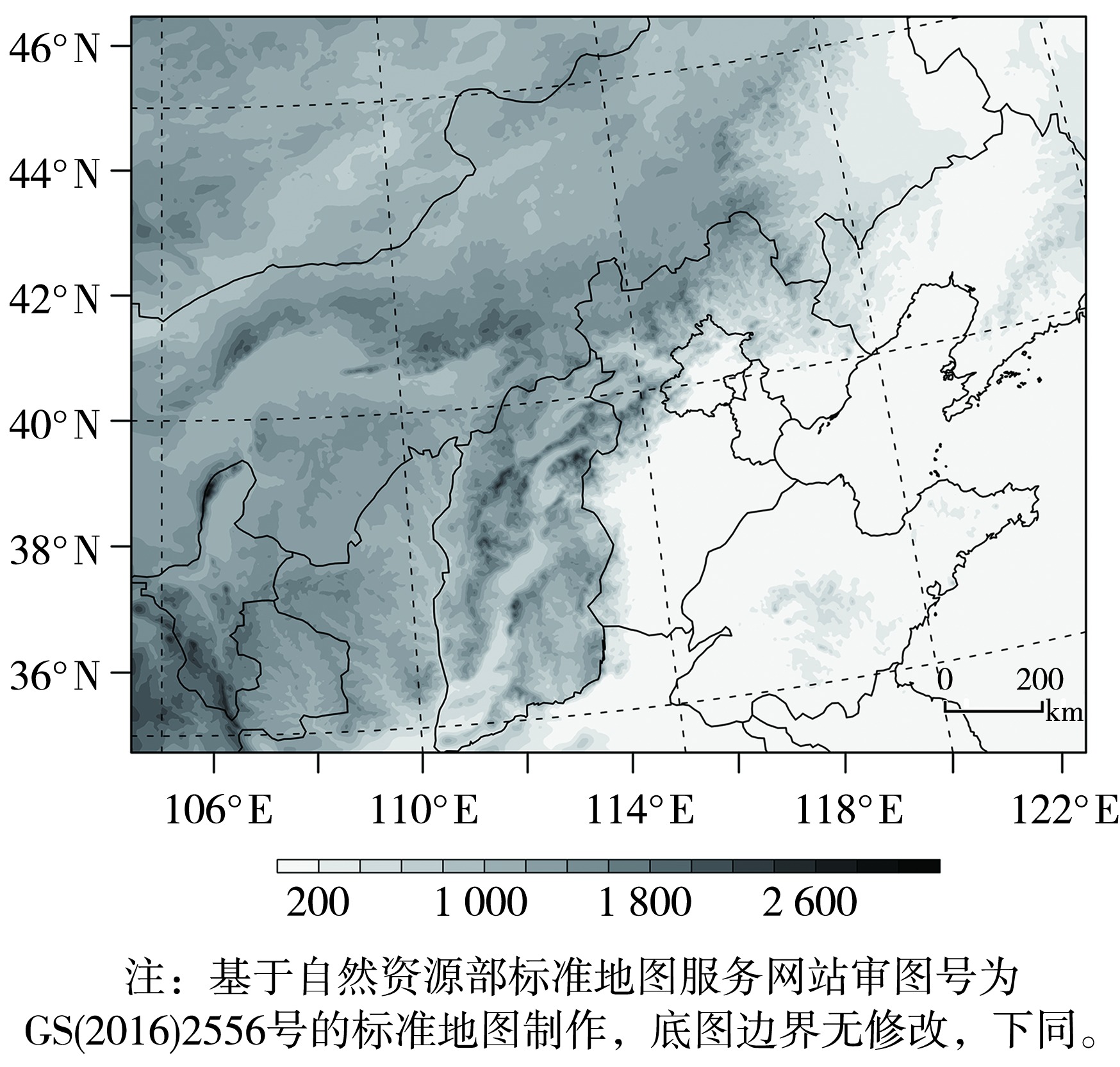
图1 快速更新同化系统预报内层3 km区域 (阴影为地形高度,单位:m)
Fig.1 The 3 km inner forecast area of rapid update assimilation system (The shaded for terrain height,Unit: m)
图1 快速更新同化系统预报内层3 km区域 (阴影为地形高度,单位:m)
Fig.1 The 3 km inner forecast area of rapid update assimilation system (The shaded for terrain height,Unit: m)
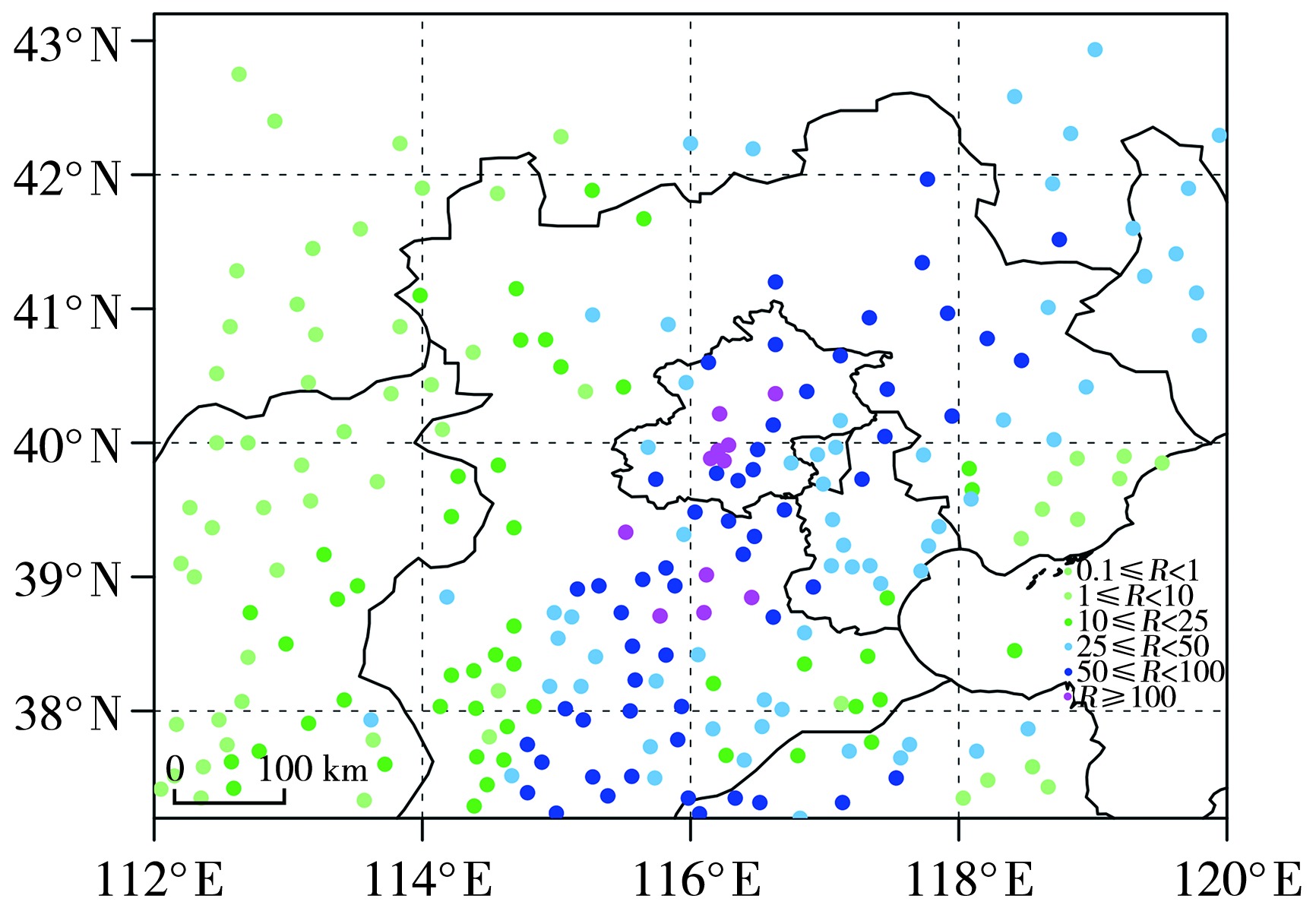
图2 2020年8月12日00:00—13日00:00 24 h累计降水量(R)(单位:mm)空间分布
Fig.2 The 24 h accumulative precipitation (R) from 00:00 August 12 to 00:00 August 13,2020 (Unit: mm)
图2 2020年8月12日00:00—13日00:00 24 h累计降水量(R)(单位:mm)空间分布
Fig.2 The 24 h accumulative precipitation (R) from 00:00 August 12 to 00:00 August 13,2020 (Unit: mm)
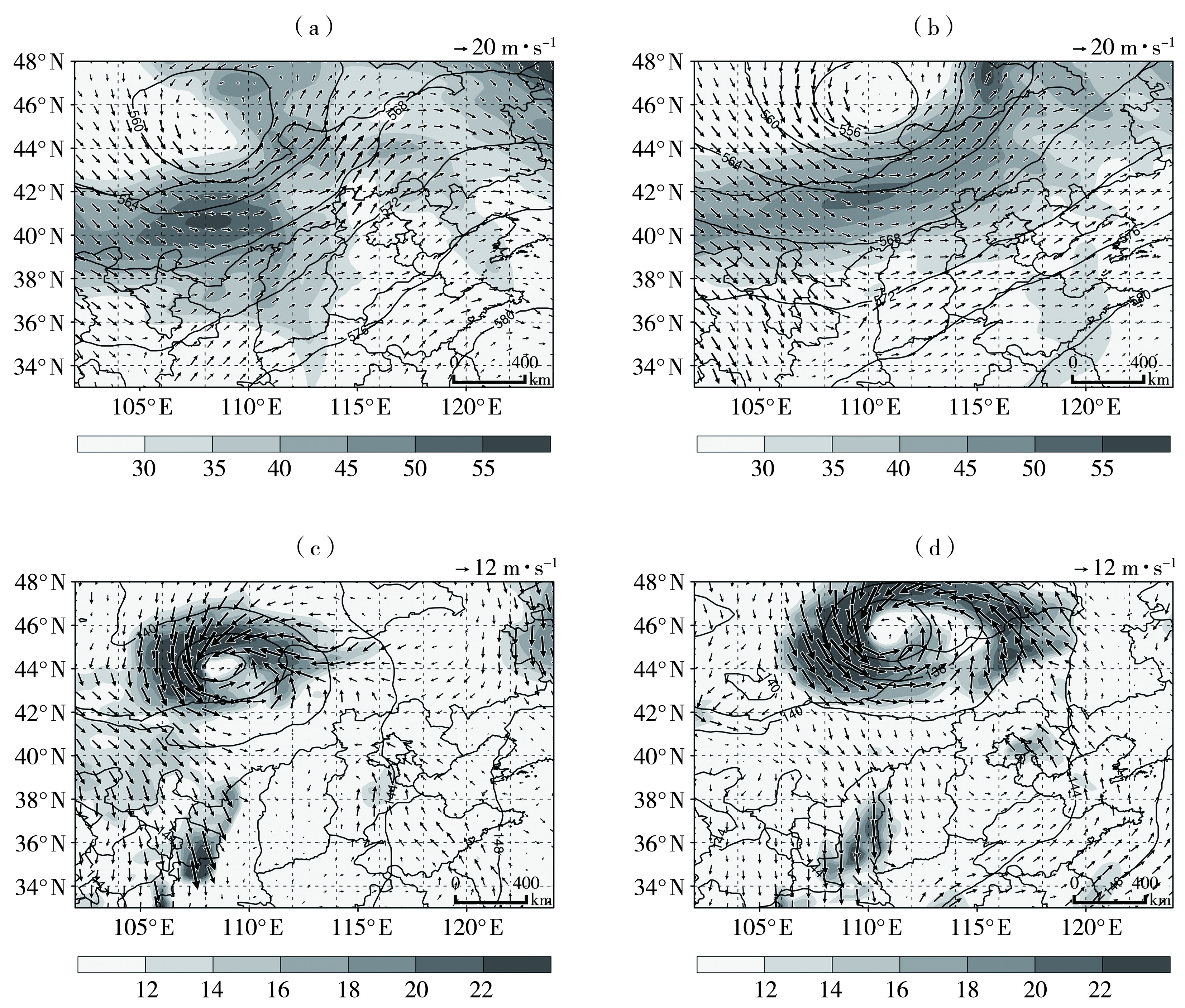
图3 2020年8月12日06:00(a、c)和15:00(b、d)500 hPa位势高度(实线,单位:dagpm)、风场(箭矢,单位:m·s-1)和200 hPa高空急流(阴影,单位:m·s-1)(a、b),以及850 hPa位势高度(等值线,单位:dagpm)、风场(箭矢,单位:m·s-1)和低空急流(阴影,单位:m·s-1)(c、d)
Fig.3 The 500 hPa geopotential height (contour lines,Unit: dagpm),wind field (arrow vectors,Unit: m·s-1) and 200 hPa high-level jet (the shaded,Unit: m·s-1)(a,b),and 850 hPa geopotential height (contour lines,Unit: dagpm),wind field (arrow vectors,Unit: m·s-1),and low-level jet ( the shaded,Unit: m·s-1)(c,d) at 06:00 (a,c) and 15:00 (b,d) August 12,2020
图3 2020年8月12日06:00(a、c)和15:00(b、d)500 hPa位势高度(实线,单位:dagpm)、风场(箭矢,单位:m·s-1)和200 hPa高空急流(阴影,单位:m·s-1)(a、b),以及850 hPa位势高度(等值线,单位:dagpm)、风场(箭矢,单位:m·s-1)和低空急流(阴影,单位:m·s-1)(c、d)
Fig.3 The 500 hPa geopotential height (contour lines,Unit: dagpm),wind field (arrow vectors,Unit: m·s-1) and 200 hPa high-level jet (the shaded,Unit: m·s-1)(a,b),and 850 hPa geopotential height (contour lines,Unit: dagpm),wind field (arrow vectors,Unit: m·s-1),and low-level jet ( the shaded,Unit: m·s-1)(c,d) at 06:00 (a,c) and 15:00 (b,d) August 12,2020
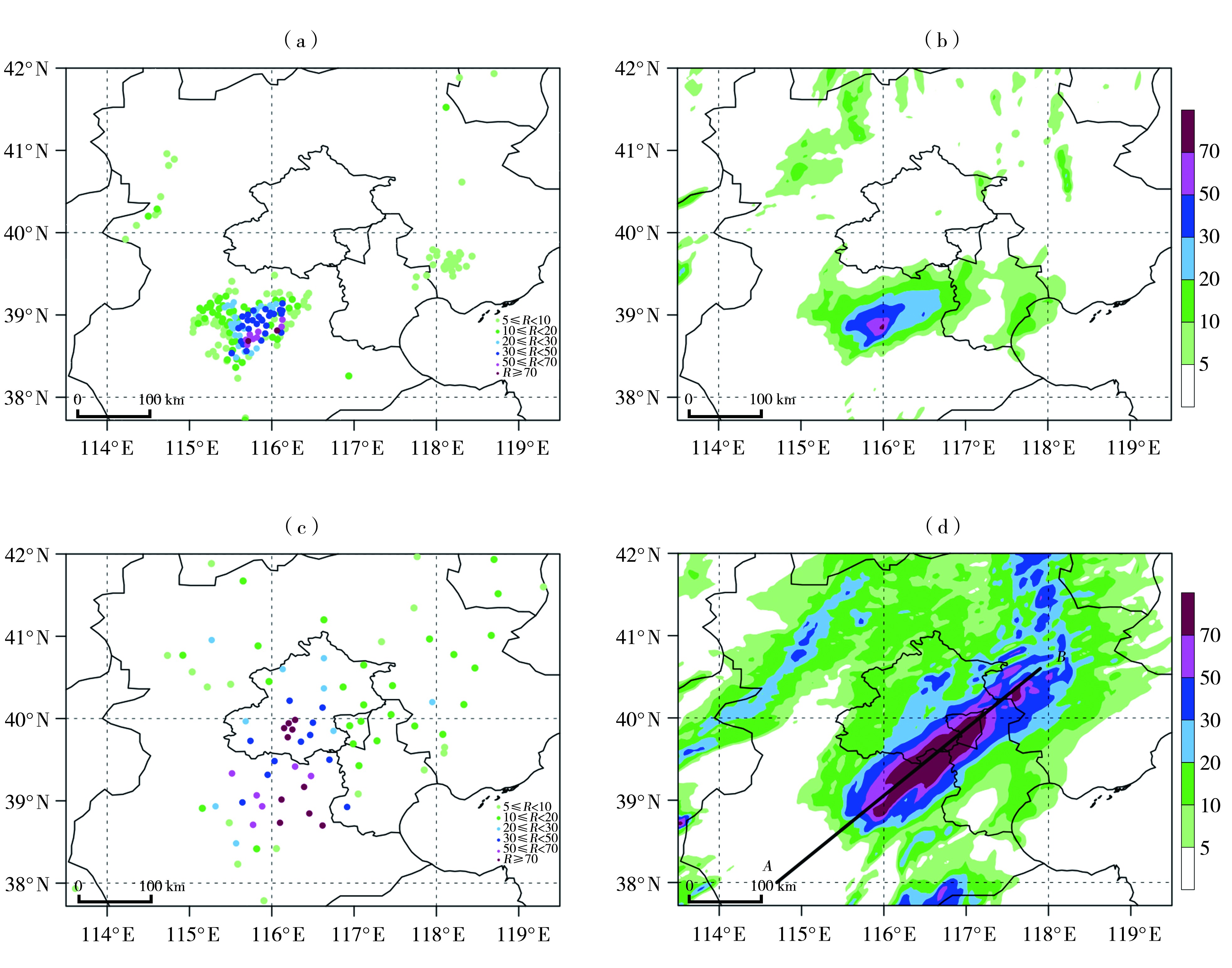
图4 2020年8月12日10:00(1 h)(a、b)和09:00—15:00(6 h)(c、d)实况(a、c)与模拟(b、d)累计降水量(单位:mm)分布 (AB线段为雨带走向6 h累计降水量大值中心区)
Fig.4 Distribution of observed (a,c) and simulated (b,d) accumulated precipitation at 10:00 (1 hour)(a,b) and from 09:00 to 15:00 (6 hours)(c,d) August 12,2020 (Unit: mm) (The AB line denotes the core region of the 6-hour accumulated precipitation maximum along the orientation of the rainfall belt)
图4 2020年8月12日10:00(1 h)(a、b)和09:00—15:00(6 h)(c、d)实况(a、c)与模拟(b、d)累计降水量(单位:mm)分布 (AB线段为雨带走向6 h累计降水量大值中心区)
Fig.4 Distribution of observed (a,c) and simulated (b,d) accumulated precipitation at 10:00 (1 hour)(a,b) and from 09:00 to 15:00 (6 hours)(c,d) August 12,2020 (Unit: mm) (The AB line denotes the core region of the 6-hour accumulated precipitation maximum along the orientation of the rainfall belt)
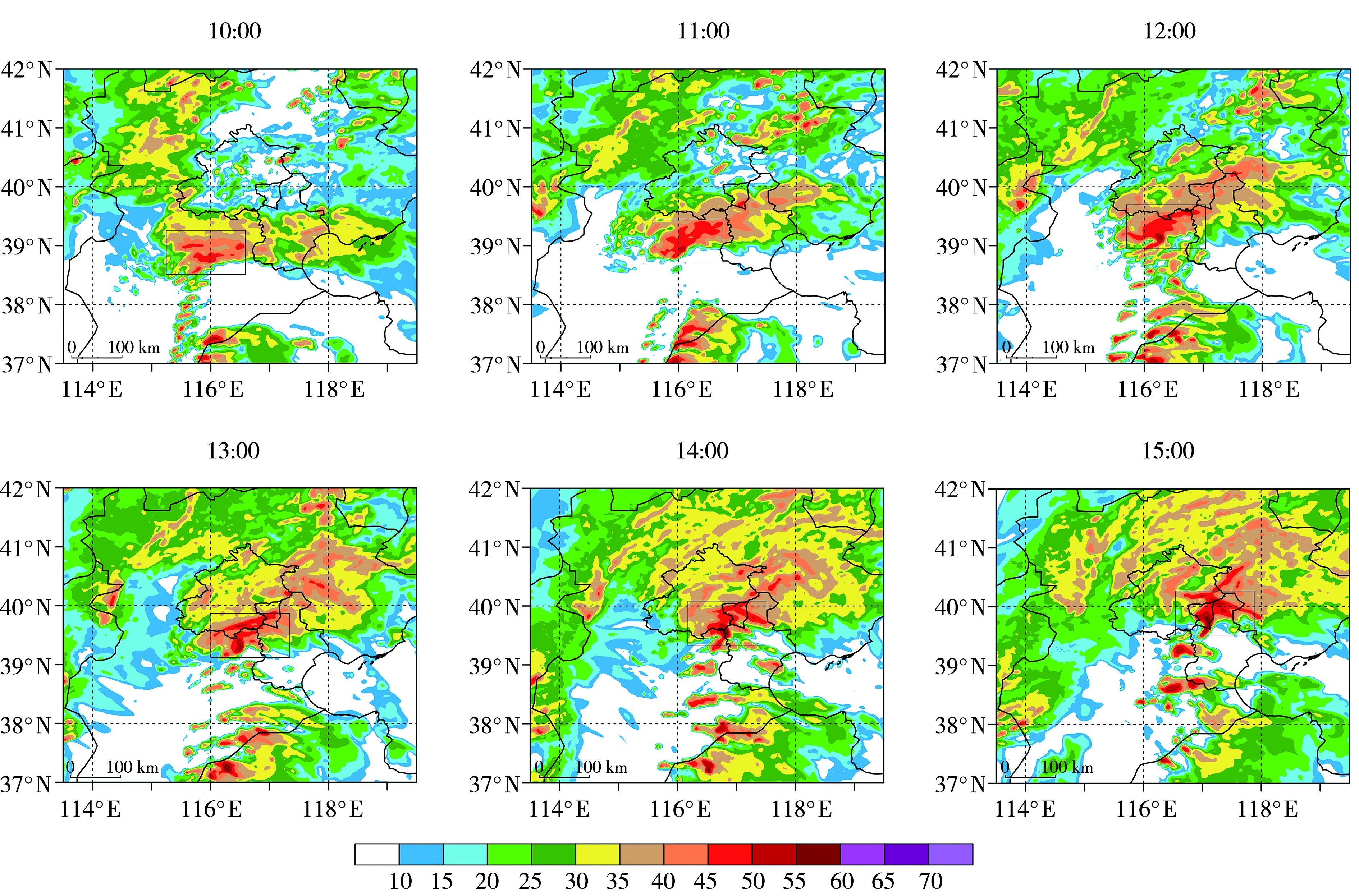
图5 2020年8月12日10:00—15:00不同预报时次模拟的最大雷达反射率(单位:dBz) (黑色方框为影响此次暴雨的中尺度对流系统)
Fig.5 Simulated maximum radar reflectivity (Unit: dBz) at different forecasting time from 10:00 to 15:00 on August 12,2020 (The black box represents the mesoscale convective system that influenced the rainstorm)
图5 2020年8月12日10:00—15:00不同预报时次模拟的最大雷达反射率(单位:dBz) (黑色方框为影响此次暴雨的中尺度对流系统)
Fig.5 Simulated maximum radar reflectivity (Unit: dBz) at different forecasting time from 10:00 to 15:00 on August 12,2020 (The black box represents the mesoscale convective system that influenced the rainstorm)
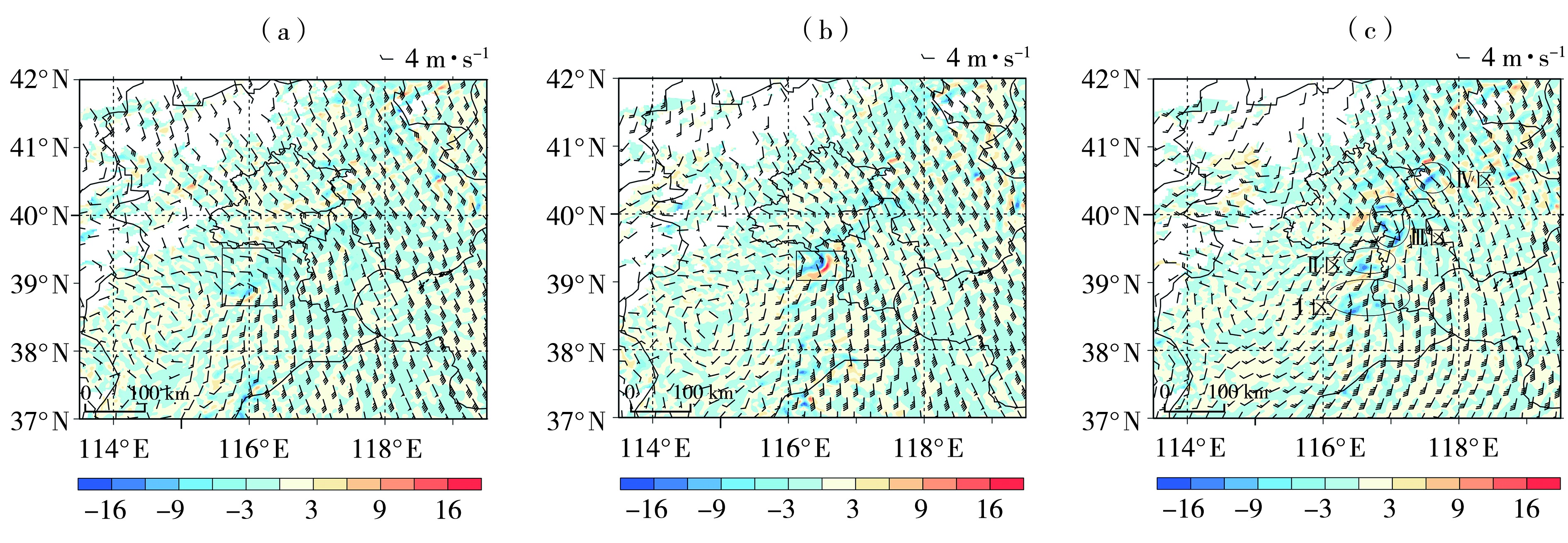
图6 2020年8月12日11:00(a)、13:00(b)、15:00(c)模拟的850 hPa风场(风矢,单位:m·s-1)及散度(填色,单位:10-4s-1) (黑色方框为强辐合区,椭圆为风场辐合处)
Fig.6 The simulated 850 hPa wind field (wind vectors,Unit: m·s-1) and divergence (the color shaded,Unit: 10-4 s-1) at 11:00 (a),13:00 (b),15:00 (c) on August 12,2020 (The black box indicates the area of strong convergence,and the ellipses represent the convergence point of the wind field)
图6 2020年8月12日11:00(a)、13:00(b)、15:00(c)模拟的850 hPa风场(风矢,单位:m·s-1)及散度(填色,单位:10-4s-1) (黑色方框为强辐合区,椭圆为风场辐合处)
Fig.6 The simulated 850 hPa wind field (wind vectors,Unit: m·s-1) and divergence (the color shaded,Unit: 10-4 s-1) at 11:00 (a),13:00 (b),15:00 (c) on August 12,2020 (The black box indicates the area of strong convergence,and the ellipses represent the convergence point of the wind field)
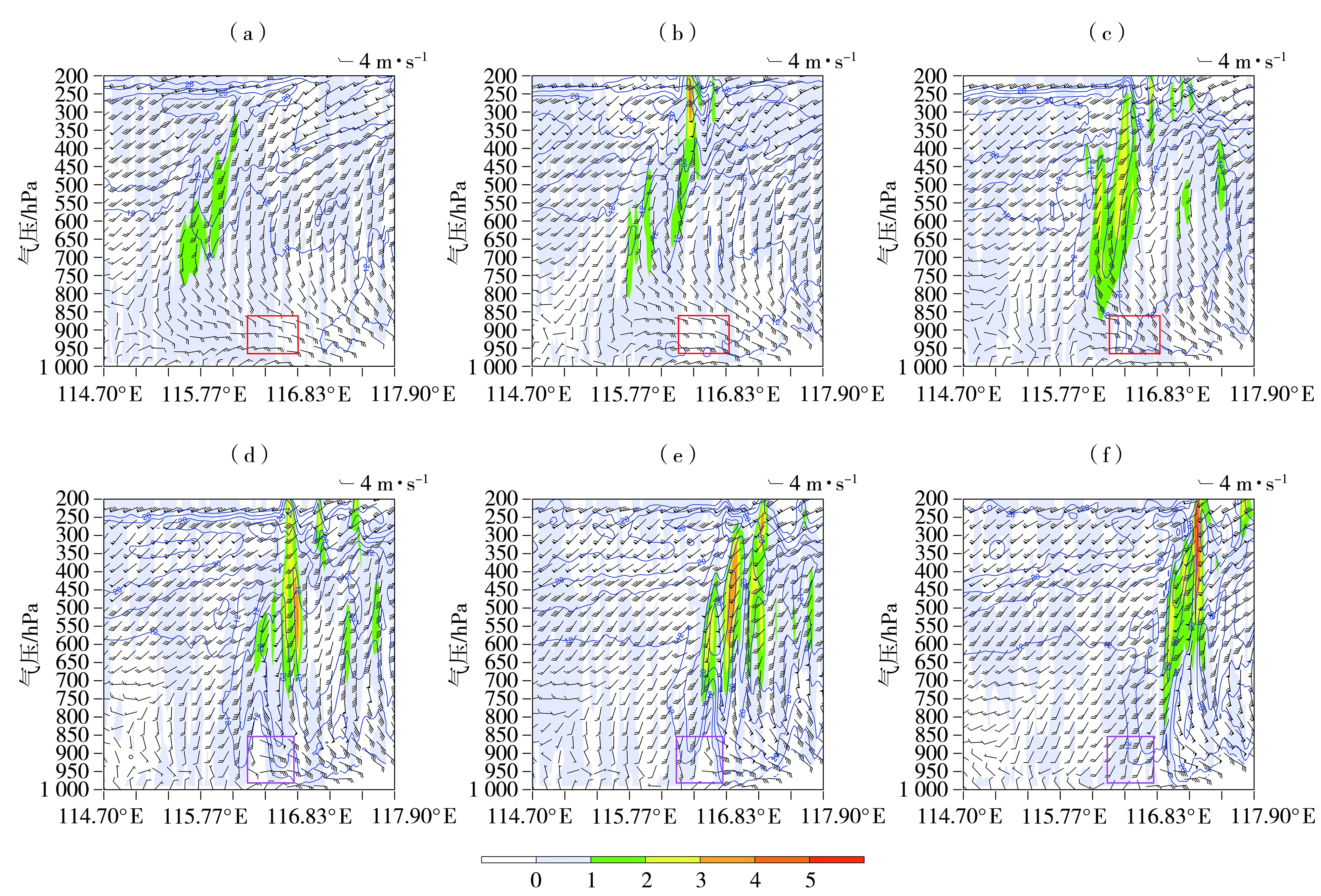
图7 2020年8月12日10:00—15:00模拟的沿图4(d)中AB线段风矢量(风矢,单位:m·s-1)、垂直速度(填色,单位:m·s-1)和风速(等值线,单位:m·s-1)的垂直剖面 (a)10:00,(b)11:00,(c)12:00,(d)13:00,(e)14:00,(f)15:00 (红色方框为低层东风逐渐增强区,紫色方框为低空急流强度脉动区)
Fig.7 The simulated vertical cross sections of wind vectors (wind vectors,Unit: m·s-1),vertical velocity (the color shaded,Unit: m·s-1) and wind velocity (isolines,Unit: m·s-1) along the AB line of the Fig.4(d) from 10:00 to 15:00 on August 12,2020 (a)10:00,(b)11:00,(c)12:00,(d)13:00,(e)14:00,(f)15:00 (The red box indicates the area where the low-level easterly wind is gradually strengthening,and the purple box indicates the intensity pulsation zone of the low-level jet)
图7 2020年8月12日10:00—15:00模拟的沿图4(d)中AB线段风矢量(风矢,单位:m·s-1)、垂直速度(填色,单位:m·s-1)和风速(等值线,单位:m·s-1)的垂直剖面 (a)10:00,(b)11:00,(c)12:00,(d)13:00,(e)14:00,(f)15:00 (红色方框为低层东风逐渐增强区,紫色方框为低空急流强度脉动区)
Fig.7 The simulated vertical cross sections of wind vectors (wind vectors,Unit: m·s-1),vertical velocity (the color shaded,Unit: m·s-1) and wind velocity (isolines,Unit: m·s-1) along the AB line of the Fig.4(d) from 10:00 to 15:00 on August 12,2020 (a)10:00,(b)11:00,(c)12:00,(d)13:00,(e)14:00,(f)15:00 (The red box indicates the area where the low-level easterly wind is gradually strengthening,and the purple box indicates the intensity pulsation zone of the low-level jet)
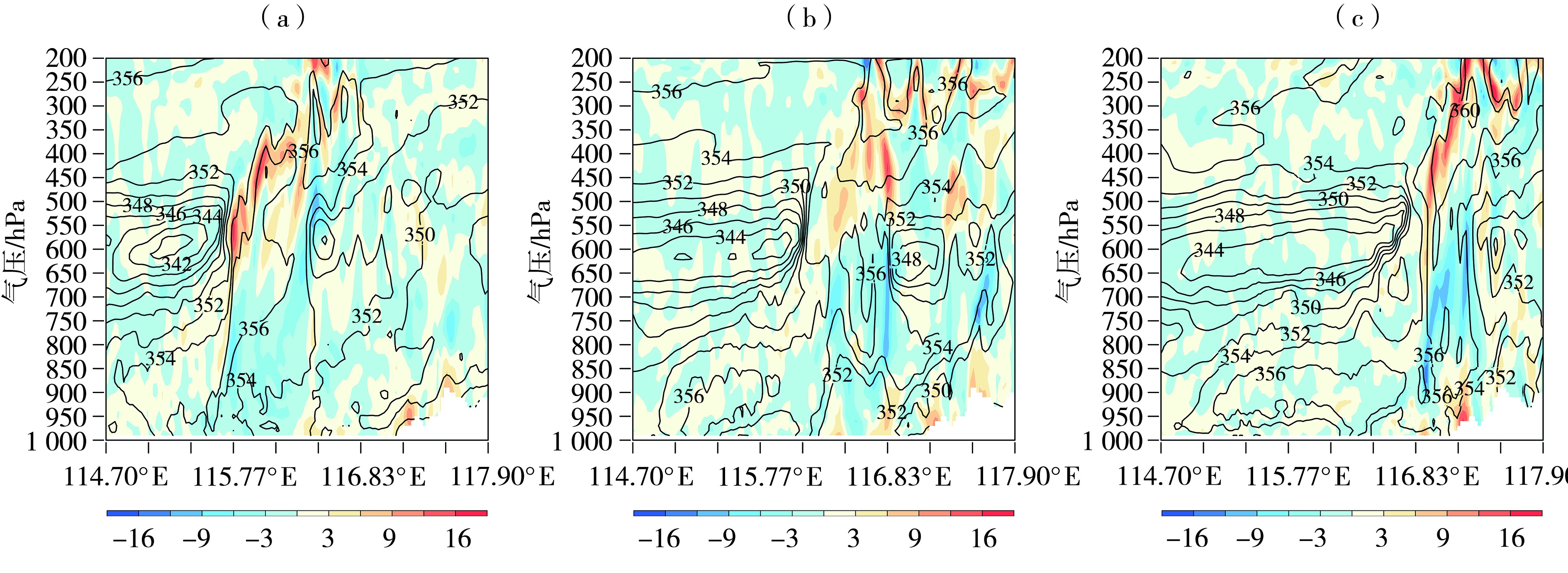
图8 2020年8月12日模拟的11:00(a)、13:00(b)、15:00(c)沿图4(d)中AB线段的假相当位温(等值线,单位:K)和散度(填色,单位:10-4s-1)的垂直剖面
Fig.8 The simulated vertical cross sections of potential pseudo-equivalent temperature (isolines,Unit: K) and divergence (the color shaded,Unit: 10-4s-1) along the AB line of the Fig.4(d) at 11:00 (a),13:00 (b),15:00 (c) on August 12,2020
图8 2020年8月12日模拟的11:00(a)、13:00(b)、15:00(c)沿图4(d)中AB线段的假相当位温(等值线,单位:K)和散度(填色,单位:10-4s-1)的垂直剖面
Fig.8 The simulated vertical cross sections of potential pseudo-equivalent temperature (isolines,Unit: K) and divergence (the color shaded,Unit: 10-4s-1) along the AB line of the Fig.4(d) at 11:00 (a),13:00 (b),15:00 (c) on August 12,2020
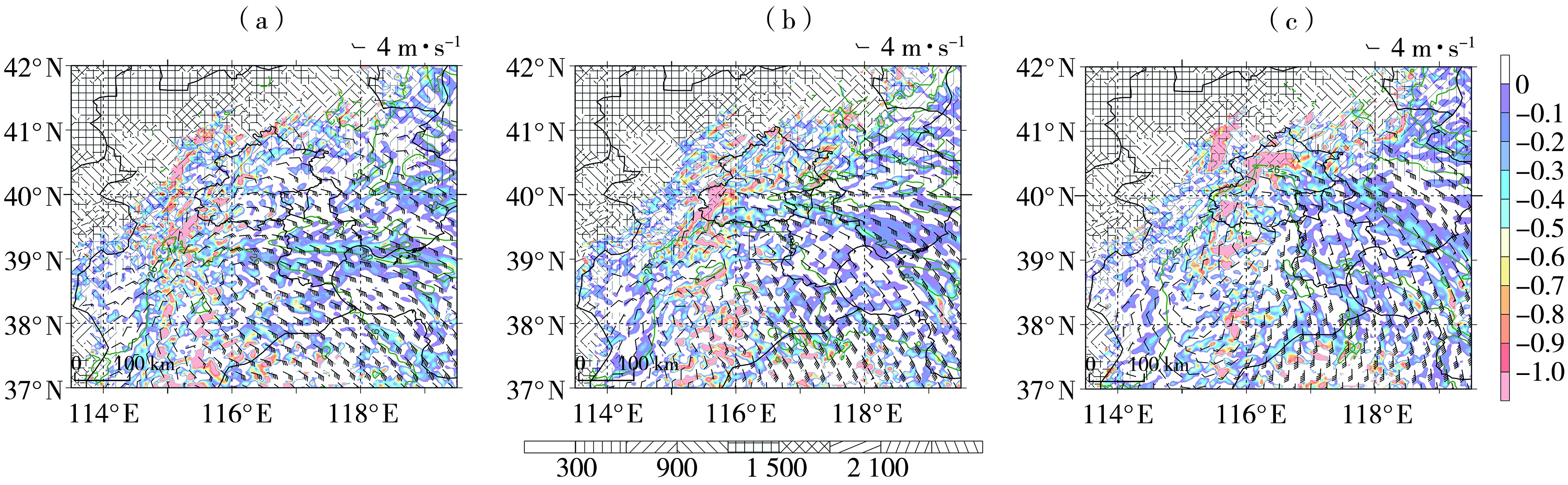
图9 2020年8月12日11:00(a)、13:00(b)、15:00(c)模拟的950 hPa水汽通量散度(填色,单位:10-6 g·cm-2·hPa-1·s-1)、风场(风矢,单位:m·s-1)、比湿(绿色等值线,单位:g·kg-1)、地形(线段填充区域,单位:m) (黑框为水汽强辐合区)
Fig.9 The simulated water vapour fux divergence (the color shaded,Unit: 10-6 g·cm-2·hPa-1·s-1),wind field (wind vectors,Unit: m·s-1),specific humidity (green isolines,Unit: g·kg-1) and terrain height (the area filled with line segments,Unit: m) at 950 hPa at 11:00 (a),13:00 (b),15:00 (c) on August 12,2020 (The black box denotes the region of intense water vapor convergence)
图9 2020年8月12日11:00(a)、13:00(b)、15:00(c)模拟的950 hPa水汽通量散度(填色,单位:10-6 g·cm-2·hPa-1·s-1)、风场(风矢,单位:m·s-1)、比湿(绿色等值线,单位:g·kg-1)、地形(线段填充区域,单位:m) (黑框为水汽强辐合区)
Fig.9 The simulated water vapour fux divergence (the color shaded,Unit: 10-6 g·cm-2·hPa-1·s-1),wind field (wind vectors,Unit: m·s-1),specific humidity (green isolines,Unit: g·kg-1) and terrain height (the area filled with line segments,Unit: m) at 950 hPa at 11:00 (a),13:00 (b),15:00 (c) on August 12,2020 (The black box denotes the region of intense water vapor convergence)
| [1] | 谌芸, 陈涛, 汪玲瑶, 等, 2019. 中国暖区暴雨的研究进展[J]. 暴雨灾害, 38(5): 483-493. |
| [2] | 谌芸, 吕伟绮, 于超, 等, 2018. 北方一次暖区大暴雨降水预报失败案例剖析[J]. 气象, 44(1): 15-25. |
| [3] | 谌芸, 孙军, 徐珺, 等, 2012. 北京721特大暴雨极端性分析及思考(一)观测分析及思考[J]. 气象, 38(10):1 255-1 266. |
| [4] | 段伯隆, 张文龙, 刘海文, 等, 2017. 北京“7·21”特大暴雨过程暖区降水和锋面降水的时空分布特征[J]. 暴雨灾害, 36(2): 108-117. |
| [5] | 段宇辉, 孙云, 刘昊野, 等, 2025. 一次华北暖区暴雨的边界层环境条件分析[J]. 暴雨灾害, 44(2): 156-166. |
| [6] | 高守亭, 周玉淑, 冉令坤, 2018. 我国暴雨形成机理及预报方法研究进展[J]. 大气科学, 42(4): 833-846. |
| [7] | 何立富, 陈涛, 孔期, 2016. 华南暖区暴雨研究进展[J]. 应用气象学报, 27(5): 559-569. |
| [8] | 黄美金, 俞小鼎, 林文, 等, 2022. 福建沿海冷锋前暖区和季风槽大暴雨环境背景与对流系统特征[J]. 气象, 48(5): 605-617. |
| [9] | 黄士松, 1986. 华南前汛期暴雨[M]. 广州: 广东科技出版社:9-10. |
| [10] | 雷蕾, 邢楠, 周璇, 等, 2020. 2018年北京“7·16”暖区特大暴雨特征及形成机制研究[J]. 气象学报, 78(1): 1-17. |
| [11] | 李向红, 庞传伟, 梁维亮, 等, 2015. 孟加拉湾旺盛对流作为广西连续暴雨的前兆信号特征分析[J]. 气象, 41(11):1 383-1 389. |
| [12] | 祁璇, 平凡, 沈新勇, 2021. 云微物理对一次吉林暖区降水过程的影响[J]. 大气科学, 45(5): 943-964. |
| [13] | 沈晓玲, 冯博, 李锋, 等, 2024. 一次弱天气背景下浙江局地暖区暴雨成因分析[J]. 气象, 50(2): 170-180. |
| [14] | 孙继松, 何娜, 王国荣, 等, 2012. “7·21”北京大暴雨系统的结构演变特征及成因初探[J]. 暴雨灾害, 31(3): 218-225. |
| [15] | 孙建华, 赵思雄, 傅慎明, 等, 2013. 2012年7月21日北京特大暴雨的多尺度特征[J]. 大气科学, 37(3): 705-718. |
| [16] | 孙密娜, 王秀明, 胡玲, 等, 2018. 华北一次暖区暴雨雷暴触发及传播机制研究[J]. 气象, 44(10):1 255-1 266. |
| [17] | 徐珺, 杨舒楠, 孙军, 等, 2014. 北方一次暖区大暴雨强降水成因探讨[J]. 气象, 40(12):1 455-1 463. |
| [18] | 杨晓亮, 杨敏, 段宇辉, 等, 2021. 京津冀一次暖区大暴雨的成因分析[J]. 暴雨灾害, 40(5): 455-465. |
| [19] | 俞小鼎, 2012. 2012年7月21日北京特大暴雨成因分析[J]. 气象, 38(11):1 313-1 329. |
| [20] | 张芹, 苏莉莉, 张秀珍, 等, 2019. 山东一次暖区暴雨的环境场特征和触发机制[J]. 干旱气象, 37(6): 933-943. |
| [21] | 张芹, 王洪明, 张秀珍, 等, 2018. 2017年山东雨季首场暖区暴雨的特征分析[J]. 高原气象, 37(6):1 696-1 704. |
| [22] | 周玉淑, 刘璐, 朱科锋, 等, 2014. 北京“7·21”特大暴雨过程中尺度系统的模拟及演变特征分析[J]. 大气科学, 38(5): 885-896. |
| [23] |
DU Y, CHEN G X, HAN B, et al, 2020. Convection initiation and growth at the coast of South China. Part II: Effects of the terrain, coastline, and cold pools[J]. Monthly Weather Review, 148(9):3 871-3 892.
DOI URL |
| [24] |
DU Y, CHEN G X, 2018. Heavy rainfall associated with double low-level jets over Southern China. Part I: Ensemble-based analysis[J]. Monthly Weather Review, 146(11):3 827-3 844.
DOI URL |
| [25] |
LUO Y L, ZHANG R H, WAN Q L, et al, 2017. The southern China monsoon rainfall experiment (SCMREX)[J]. Bulletin of the American Meteorological Society, 98(5): 999-1 013.
DOI URL |
| [26] |
MAO J H, PING F, YIN L, et al, 2018. A study of cloud microphysical processes associated with torrential rainfall event over Beijing[J]. Journal of Geophysical Research: Atmospheres, 123(16):8 768-8 791.
DOI URL |
| [27] |
MENARD R D, FRITSCH J M, 1989. A mesoscale convective complex-generated inertially stable warm core vortex[J]. Monthly Weather Review, 117(6):1 237-1 261.
DOI URL |
| [28] | SUN J H, ZHANG Y C, LIU R X, et al, 2019. A review of research on warm-sector heavy rainfall in China[J]. Advances in Atmospheric Sciences, 36: 1 299-1 307. |
| [29] | WANG H, LUO Y L, JOU B J, 2014. Initiation, maintenance, and properties of convection in an extreme rainfall event during SCMREX: Observational analysis[J]. Journal of Geophysical Research: Atmospheres, 119(23):13 206-13 232. |
| [30] |
WU M W, LUO Y L, 2016. Mesoscale observational analysis of lifting mechanism of a warm-sector convective system producing the maximal daily precipitation in China mainland during pre-summer rainy season of 2015[J]. Journal of Meteorological Research, 30(5): 719-736.
DOI URL |
| [31] |
ZENG W X, CHEN G X, DU Y, et al, 2019. Diurnal variations of low-level winds and precipitation response to large-scale circulations during a heavy rainfall event[J]. Monthly Weather Review, 147(11):3 981-4 004.
DOI URL |
| [32] | ZHANG L, MA X Y, ZHU S P, et al, 2022. Analyses and applications of the precursor signals of a kind of warm sector heavy rainfall over the coast of Guangdong, China[J]. Atmospheric Research, 280: 106425. DOI:10.1016/j.atmosres.2022.106425. |
| [33] |
ZHANG M R, MENG Z Y, 2018. Impact of synoptic-scale factors on rainfall forecast in different stages of a persistent heavy rainfall event in South China[J]. Journal of Geophysical Research: Atmospheres, 123(7):3 574-3 593.
DOI URL |
| [34] |
ZHONG L Z, MU R, ZHANG D L, et al, 2015. An observational analysis of warm-sector rain fall characteristics associated with the 21 July 2012 Beijing extreme rainfall event[J]. Journal of Geophysical Research: Atmospheres, 120(8):3 274-3 291.
DOI URL |
| [35] |
ZHOU C H, LI Y Q, 2024. Dynamic and thermodynamic characteristics of warm-sector rainstorms caused by the southwest China vortex in Sichuan basin[J]. Theoretical and Applied Climatology, 155:7 095-7 108.
DOI |
| [1] | 任丽, 卜文惠, 于震宇, 白俊杰, 李瑶. 一次伴有极端降水的东北冷涡过程分析[J]. 干旱气象, 2025, 43(6): 939-952. |
| [2] | 王文波, 李晓利, 曹云飞, 杨明, 高晓梅, 杨萌. 风廓线雷达资料在一次对流暴雨过程中的特征分析[J]. 干旱气象, 2025, 43(4): 627-636. |
| [3] | 林弘杰, 文小航, 黄晓璐, 李瑞青. 台风“安比”变性机制及其对内蒙古大暴雨影响的数值模拟研究[J]. 干旱气象, 2024, 42(4): 588-597. |
| [4] | 曼吾拉·卡德尔, 刘鑫华, 李云翔, 关文娟. 西北干旱区机场低空风切变基本特征分析[J]. 干旱气象, 2024, 42(3): 347-356. |
| [5] | 张入财, 王君, 陈超辉, 付伟基, 魏璐璐. 印度双低涡对青藏高原西部一次典型暴雪过程的影响[J]. 干旱气象, 2023, 41(3): 463-473. |
| [6] | 沙宏娥, 傅朝, 刘维成, 徐丽丽, 刘娜, 刘新雨, 马绎皓. 西北东部半干旱区一次极端特大暴雨的触发和维持机制[J]. 干旱气象, 2022, 40(6): 933-944. |
| [7] | 史月琴, 赵俊杰, 孙晶, 孙玉稳. 华北地区一次低槽冷锋云系结构和增雨条件研究[J]. 干旱气象, 2022, 40(6): 1003-1013. |
| [8] | 沈晓玲, 潘灵杰, 左骏, 桑明慧, 章丽娜. 浙江西部梅汛期两次相似落区暴雨过程对比分析[J]. 干旱气象, 2022, 40(2): 244-255. |
| [9] | 马敏劲, 陈玥, 康国强, 赵侦竹, 黄万龙, 谈昌蓉, 丁凡. 青藏高原夏季边界层再分析资料的偏差分析及订正[J]. 干旱气象, 2022, 40(1): 95-107. |
| [10] | 冯瑶, 阿依先木·尼牙孜, 热依拉·玉努斯. 新疆哈密“7·31”极端大暴雨过程成因分析[J]. 干旱气象, 2021, 39(3): 426-435. |
| [11] | 王佳津, 张琪, 张涛, 龙柯吉, 师锐, . 成都两次暴雨期间风廓线雷达观测的低空风场特征[J]. 干旱气象, 2021, 39(1): 87-95. |
| [12] | 任余龙, 张铁军, 柳媛普, 吴晶. 夏季风过渡区下垫面非均匀性对一次暴雨影响的数值模拟[J]. 干旱气象, 2020, 38(5): 755-763. |
| [13] | 齐亚杰, 陈敏, 仲跻芹, 范水勇, 刘瑞婷, 郭淳薇. RMAPS-ST耦合城市冠层模式后对华北地面气象要素的短期预报评估[J]. 干旱气象, 2020, 38(5): 859-868. |
| [14] | 杨侃, 纪晓玲, 毛璐, 张肃诏. 贺兰山两次特大致洪暴雨的数值模拟与地形影响对比[J]. 干旱气象, 2020, 38(4): 581-590. |
| [15] | 曾勇, 杨莲梅, 张迎新. 伊犁地区一次罕见特大暴雨中尺度系统的数值模拟[J]. 干旱气象, 2020, 38(2): 290-300. |
| 阅读次数 | ||||||
|
全文 |
|
|||||
|
摘要 |
|
|||||
