Journal of Arid Meteorology ›› 2026, Vol. 44 ›› Issue (3): 398-411.DOI: 10.11755/j.issn.1006-7639-2026-03-0398
• Articles • Previous Articles Next Articles
Application of machine learning in the ensemble projection of regional extreme climate indices over China
LIU Mingming1,2,3( ), XU Ying2,3()
- 1
Chinese Academy of Meteorological Sciences Beijing 100081, China
2National Climate Center ,China Meteorological Administration Beijing 100081, China
3Open Laboratory for Climate Studies ,China Meteorological Administration Beijing 100081, China
-
Received:2026-01-08Revised:2026-04-05Online:2026-06-30Published:2026-07-16
机器学习在中国区域极端气候指数集合预估中的应用
- 1
中国气象科学研究院 北京 100081
2中国气象局国家气候中心 北京 100081
3中国气象局气候研究开放实验室 北京 100081
-
通讯作者:徐影 -
作者简介:刘明铭(2000—),男,硕士研究生,主要从事气候变化未来预估研究。E-mail: 2545646576@qq.com。 -
基金资助:西藏自治区重大科技专项(XZ202402ZD0006);国家科技重大专项(2025ZD1208301);国家气候中心重点创新团队“第三极气候变化监测预估”(NCCCXTD007)

CLC Number:
Cite this article
LIU Mingming, XU Ying. Application of machine learning in the ensemble projection of regional extreme climate indices over China[J]. Journal of Arid Meteorology, 2026, 44(3): 398-411.
刘明铭, 徐影. 机器学习在中国区域极端气候指数集合预估中的应用[J]. 干旱气象, 2026, 44(3): 398-411.
share this article
Add to citation manager EndNote|Ris|BibTeX
URL: http://www.ghqx.org.cn/EN/10.11755/j.issn.1006-7639-2026-03-0398
Tab.1 Definitions of the four extreme climate indices recommended by the ETCCDI
| 指数缩写 | 指数名称 | 定义 | 单位 |
|---|---|---|---|
| TX90p | 暖昼指数 | 每月日最高气温大于基准期内90%分位值的天数百分率 | % |
| TN10p | 冷夜指数 | 每月日最低气温小于基准期内10%分位值的天数百分率 | % |
| RX5day | 5 d最大降水量 | 每月最大的连续5 d降水量 | mm |
| RX1day | 日最大降水量 | 每月最大日降水量 | mm |
Tab.1 Definitions of the four extreme climate indices recommended by the ETCCDI
| 指数缩写 | 指数名称 | 定义 | 单位 |
|---|---|---|---|
| TX90p | 暖昼指数 | 每月日最高气温大于基准期内90%分位值的天数百分率 | % |
| TN10p | 冷夜指数 | 每月日最低气温小于基准期内10%分位值的天数百分率 | % |
| RX5day | 5 d最大降水量 | 每月最大的连续5 d降水量 | mm |
| RX1day | 日最大降水量 | 每月最大日降水量 | mm |
Tab.2 Basic information of the 19 CMIP6 global climate models (GCMs)
| 序号 | 模式名称 | 模式单位(国家) | 分辨率 (经度×纬度) |
|---|---|---|---|
| 1 | ACCESS-CM2 | 澳大利亚气候科学研究中心(澳大利亚) | 1.25°×1.875° |
| 2 | ACCESS-ESM1-5 | 澳大利亚气候科学研究中心(澳大利亚) | 1.25°×1.875° |
| 3 | BCC-CSM2-MR | 北京气候中心(中国) | 1.125°×1.125° |
| 4 | CanESM5 | 加拿大气候模型与分析中心(加拿大) | 2.8°×2.8° |
| 5 | CNRM-CM6-1 | 法国国家气象研究中心(法国) | 1.4°×1.4° |
| 6 | CNRM-ESM2-1 | 法国国家气象研究中心(法国) | 1.4°×1.4° |
| 7 | EC-Earth3 | EC-Earth联盟(欧洲) | 0.7°×0.7° |
| 8 | FGOALS-g3 | 中国科学院大气物理研究所(中国) | 2.25°×2.25° |
| 9 | GFDL-ESM4 | 地球物理流体动力学实验室(美国) | 1.0°×1.25° |
| 10 | HadGEM3-GC31-LL | 英国气象局(英国) | 1.0°×1.0° |
| 11 | INM-CM4-8 | 俄罗斯数值数学研究所(俄罗斯) | 1.5°×1.5° |
| 12 | KIOST-ESM | 韩国海洋科学技术院(韩国) | 2.0°×2.0° |
| 13 | MIROC6 | 日本海洋地球科学技术研究所(日本) | 1.0°×1.0° |
| 14 | MPI-ESM1-2-HR | 马克斯·普朗克气象研究所(德国) | 1.5°×1.5° |
| 15 | MPI-ESM1-2-LR | 马克斯·普朗克气象研究所(德国) | 1.5°×1.5° |
| 16 | MRI-ESM2-0 | 气象研究所(日本) | 1.125°×1.125° |
| 17 | NESM3 | 国家气候中心(中国) | 0.75°×0.75° |
| 18 | NorESM2-LM | 挪威气候中心(挪威) | 1.25°×1.25° |
| 19 | UKESM1-0-LL | 英国气象局(英国) | 0.5°×0.5° |
Tab.2 Basic information of the 19 CMIP6 global climate models (GCMs)
| 序号 | 模式名称 | 模式单位(国家) | 分辨率 (经度×纬度) |
|---|---|---|---|
| 1 | ACCESS-CM2 | 澳大利亚气候科学研究中心(澳大利亚) | 1.25°×1.875° |
| 2 | ACCESS-ESM1-5 | 澳大利亚气候科学研究中心(澳大利亚) | 1.25°×1.875° |
| 3 | BCC-CSM2-MR | 北京气候中心(中国) | 1.125°×1.125° |
| 4 | CanESM5 | 加拿大气候模型与分析中心(加拿大) | 2.8°×2.8° |
| 5 | CNRM-CM6-1 | 法国国家气象研究中心(法国) | 1.4°×1.4° |
| 6 | CNRM-ESM2-1 | 法国国家气象研究中心(法国) | 1.4°×1.4° |
| 7 | EC-Earth3 | EC-Earth联盟(欧洲) | 0.7°×0.7° |
| 8 | FGOALS-g3 | 中国科学院大气物理研究所(中国) | 2.25°×2.25° |
| 9 | GFDL-ESM4 | 地球物理流体动力学实验室(美国) | 1.0°×1.25° |
| 10 | HadGEM3-GC31-LL | 英国气象局(英国) | 1.0°×1.0° |
| 11 | INM-CM4-8 | 俄罗斯数值数学研究所(俄罗斯) | 1.5°×1.5° |
| 12 | KIOST-ESM | 韩国海洋科学技术院(韩国) | 2.0°×2.0° |
| 13 | MIROC6 | 日本海洋地球科学技术研究所(日本) | 1.0°×1.0° |
| 14 | MPI-ESM1-2-HR | 马克斯·普朗克气象研究所(德国) | 1.5°×1.5° |
| 15 | MPI-ESM1-2-LR | 马克斯·普朗克气象研究所(德国) | 1.5°×1.5° |
| 16 | MRI-ESM2-0 | 气象研究所(日本) | 1.125°×1.125° |
| 17 | NESM3 | 国家气候中心(中国) | 0.75°×0.75° |
| 18 | NorESM2-LM | 挪威气候中心(挪威) | 1.25°×1.25° |
| 19 | UKESM1-0-LL | 英国气象局(英国) | 0.5°×0.5° |

Fig.1 Research framework
Fig.1 Research framework

Fig.2 Spatial distribution of climate state bias (simulation values minus observed values) of different schemes in various extreme climate index simulations and the corresponding TSS scores during the verification period (2005-2014) in China (The highest TSS score in each index is highlighted in red)
Fig.2 Spatial distribution of climate state bias (simulation values minus observed values) of different schemes in various extreme climate index simulations and the corresponding TSS scores during the verification period (2005-2014) in China (The highest TSS score in each index is highlighted in red)
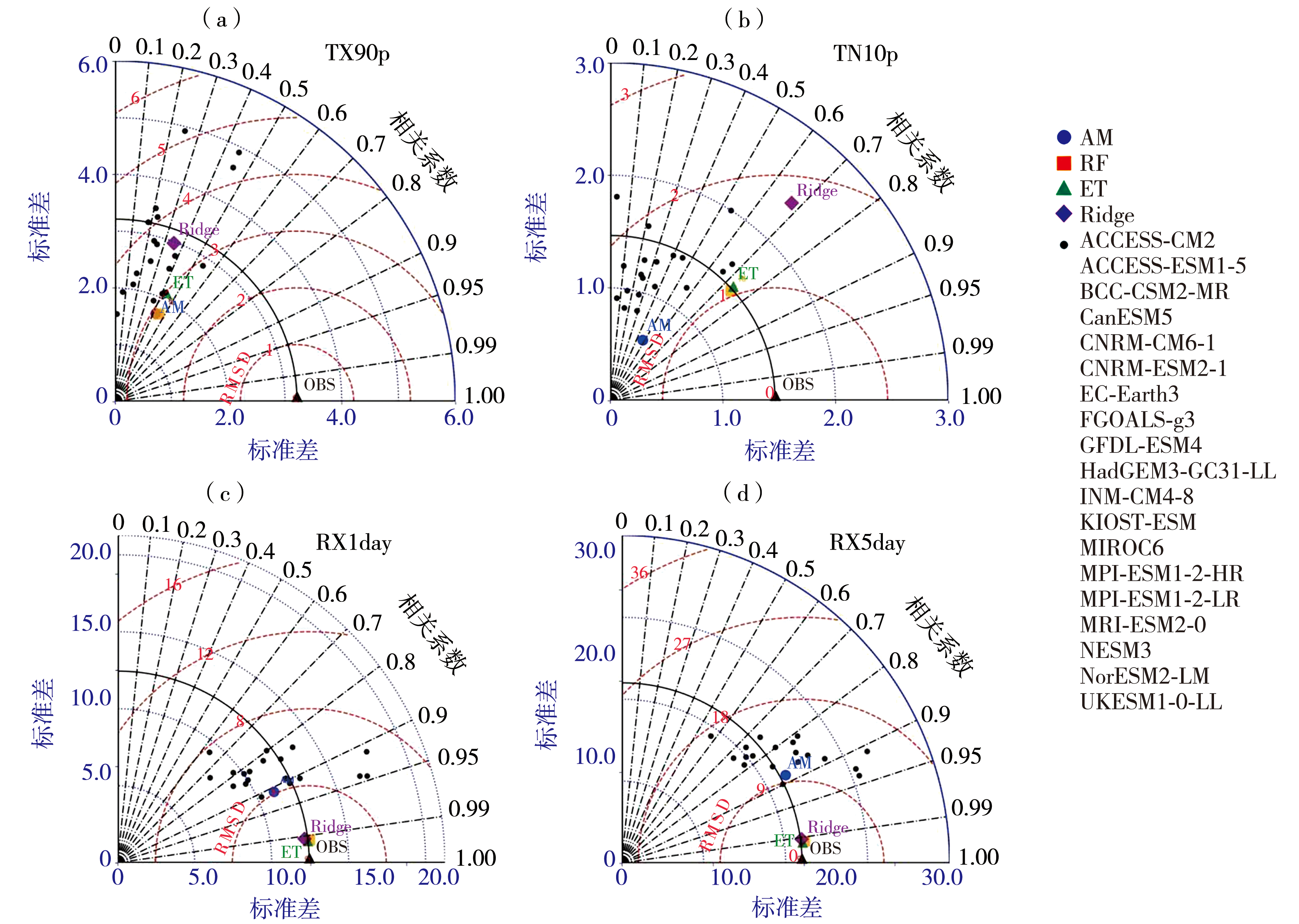
Fig.3 Taylor diagrams comparison of four extreme climate indices during the verification period (a) TX90p, (b) TN10p, (c) RX1day, (d) RX5day (Each subplot shows the distribution of spatial correlation coefficient, standard deviation, and centered root mean square error (CRMSE) (red dashed lines) for a single CMIP6 model (gray markers) and different scenarios (colored markers) compared with observations)
Fig.3 Taylor diagrams comparison of four extreme climate indices during the verification period (a) TX90p, (b) TN10p, (c) RX1day, (d) RX5day (Each subplot shows the distribution of spatial correlation coefficient, standard deviation, and centered root mean square error (CRMSE) (red dashed lines) for a single CMIP6 model (gray markers) and different scenarios (colored markers) compared with observations)
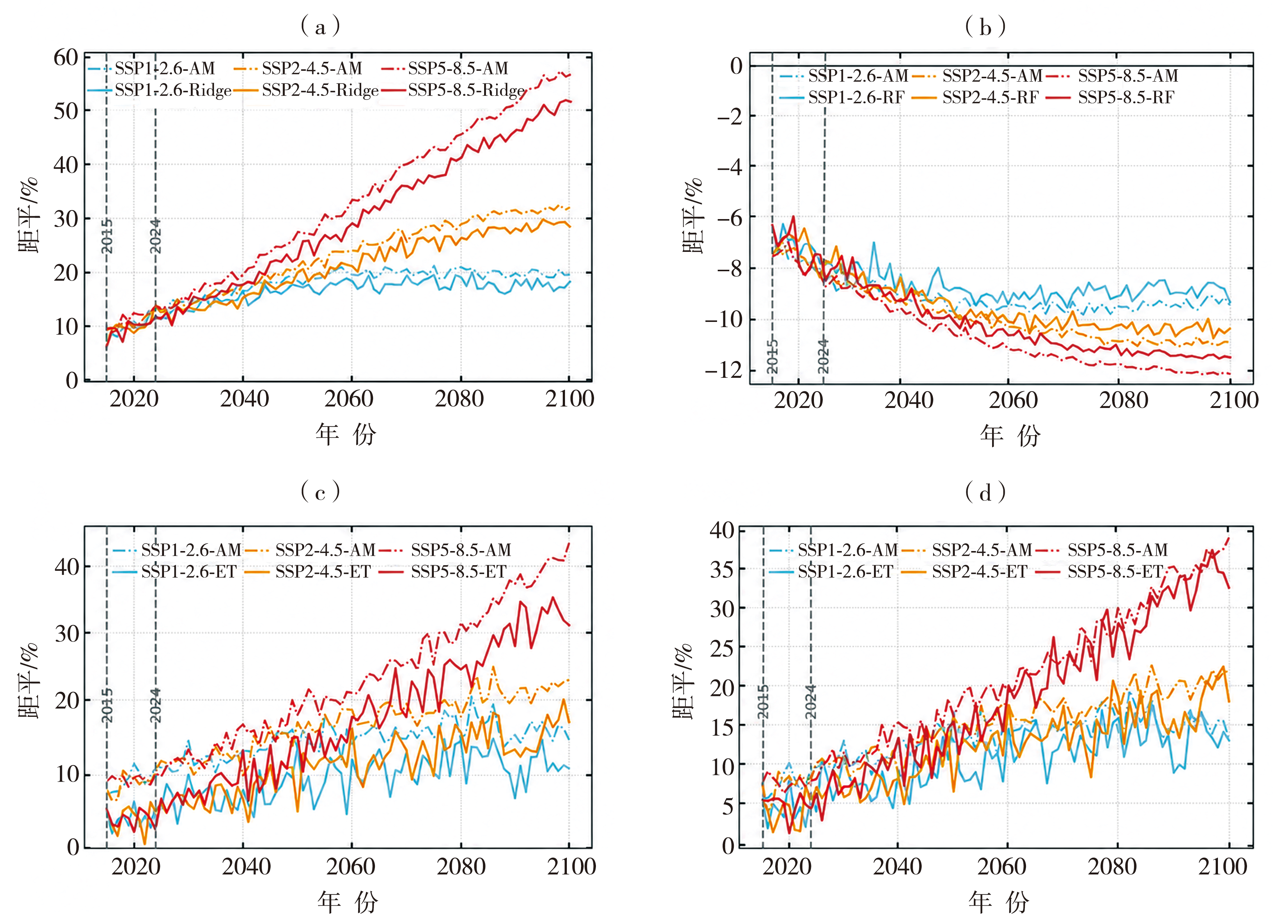
Fig.4 Temporal trends of anomalies of extreme climate indices in China under different SSP scenarios (relative to 1961-1990) (a) TX90p, (b) TN10p, (c) RX1day, (d) RX5day (The extreme temperature indices are an absolute change, while the extreme precipitation indices are a relative change)
Fig.4 Temporal trends of anomalies of extreme climate indices in China under different SSP scenarios (relative to 1961-1990) (a) TX90p, (b) TN10p, (c) RX1day, (d) RX5day (The extreme temperature indices are an absolute change, while the extreme precipitation indices are a relative change)
Tab.3 Future trends (2024-2100) of extreme climate indices over China estimated by the AM and machine learning under different emission scenarios (relative to 1961-1990)
| 指数 | 排放情景 | AM | 机器学习 |
|---|---|---|---|
| TX90p | SSP1-2.6 | +1.07 | +0.95(Ridge) |
| SSP2-4.5 | +2.86 | +2.62(Ridge) | |
| SSP5-8.5 | +6.00 | +5.49(Ridge) | |
| TN10p | SSP1-2.6 | -0.20 | -0.19(RF) |
| SSP2-4.5 | -0.42 | -0.41(RF) | |
| SSP5-8.5 | -0.56 | -0.54(RF) | |
| RX1day | SSP1-2.6 | +0.92 | +1.01(ET) |
| SSP2-4.5 | +1.75 | +1.63(ET) | |
| SSP5-8.5 | +3.90 | +3.76(ET) | |
| RX5day | SSP1-2.6 | +0.98 | +1.22(ET) |
| SSP2-4.5 | +1.71 | +1.81(ET) | |
| SSP5-8.5 | +3.73 | +3.92(ET) |
Tab.3 Future trends (2024-2100) of extreme climate indices over China estimated by the AM and machine learning under different emission scenarios (relative to 1961-1990)
| 指数 | 排放情景 | AM | 机器学习 |
|---|---|---|---|
| TX90p | SSP1-2.6 | +1.07 | +0.95(Ridge) |
| SSP2-4.5 | +2.86 | +2.62(Ridge) | |
| SSP5-8.5 | +6.00 | +5.49(Ridge) | |
| TN10p | SSP1-2.6 | -0.20 | -0.19(RF) |
| SSP2-4.5 | -0.42 | -0.41(RF) | |
| SSP5-8.5 | -0.56 | -0.54(RF) | |
| RX1day | SSP1-2.6 | +0.92 | +1.01(ET) |
| SSP2-4.5 | +1.75 | +1.63(ET) | |
| SSP5-8.5 | +3.90 | +3.76(ET) | |
| RX5day | SSP1-2.6 | +0.98 | +1.22(ET) |
| SSP2-4.5 | +1.71 | +1.81(ET) | |
| SSP5-8.5 | +3.73 | +3.92(ET) |
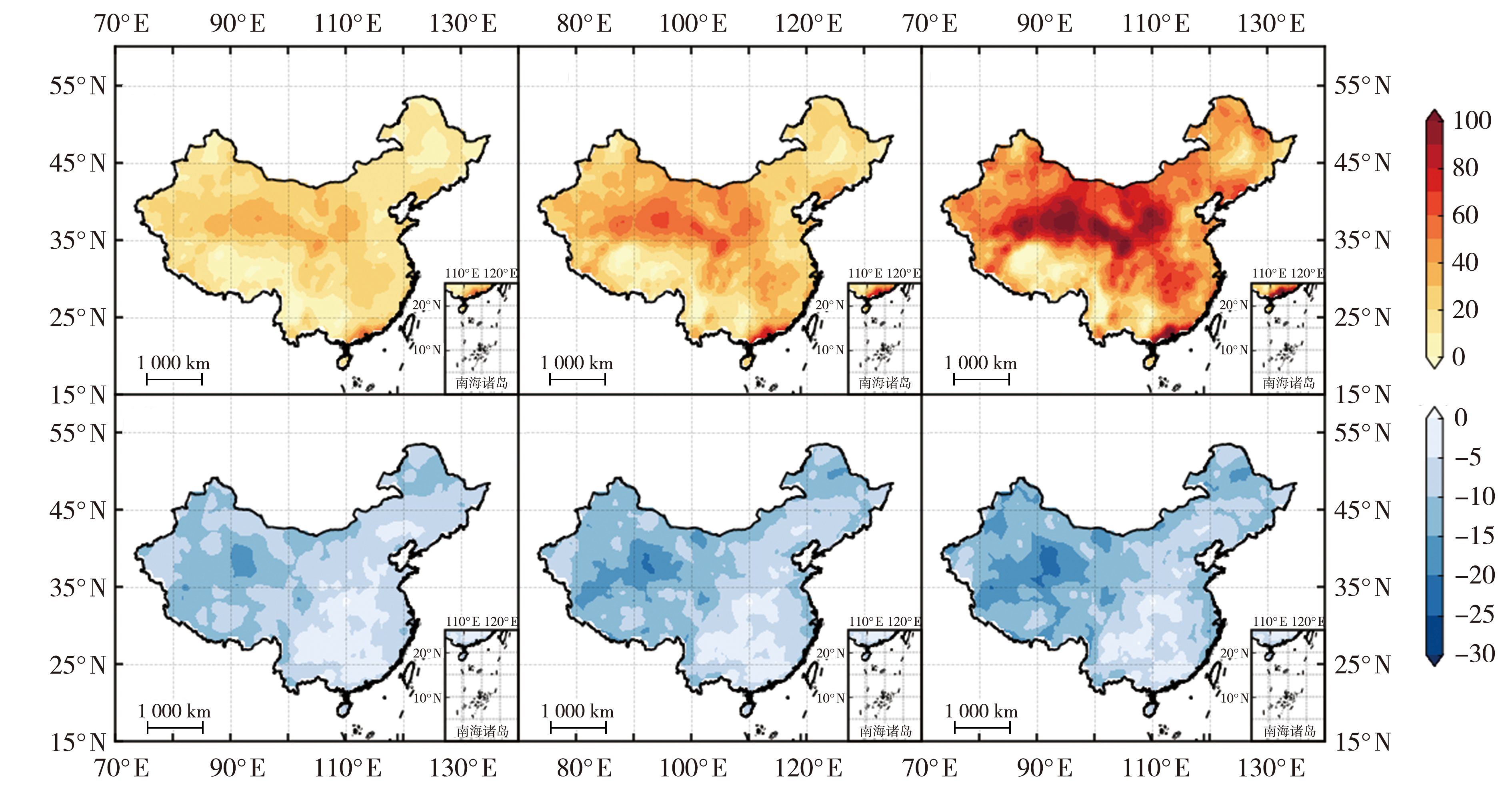
Fig.5 Spatial distribution of anomalies of the TX90p (the top, based on the Ridge model) and the TN10p (the bottom, based on the RF model) over China under SSP1-2.6 (the left), SSP2-4.5(the middle), and SSP5-8.5 (the right) scenarios for the late 21st century (2080-2099), relative to the 1961-1990 baseline (Unit: %)
Fig.5 Spatial distribution of anomalies of the TX90p (the top, based on the Ridge model) and the TN10p (the bottom, based on the RF model) over China under SSP1-2.6 (the left), SSP2-4.5(the middle), and SSP5-8.5 (the right) scenarios for the late 21st century (2080-2099), relative to the 1961-1990 baseline (Unit: %)
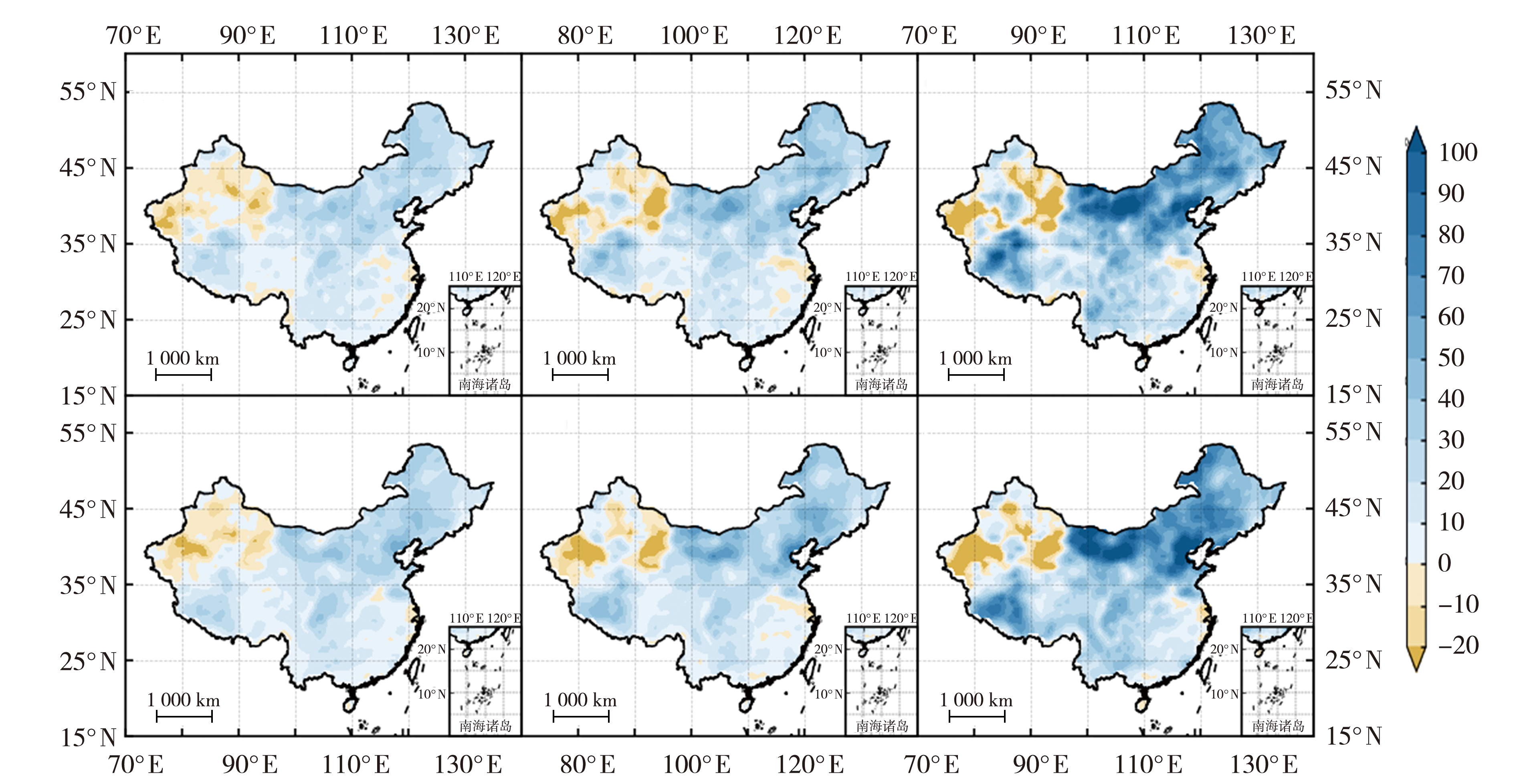
Fig.6 The spatial distribution of anomalies of the RX1day (the top) and the RX5day (the bottom) over China under SSP1-2.6 (the left), SSP2-4.5 (the middle), and SSP5-8.5 (the right) scenarios for the late 21st century (2080-2099), relative to the 1961-1990 baseline (Unit: %) (based on the ET model)
Fig.6 The spatial distribution of anomalies of the RX1day (the top) and the RX5day (the bottom) over China under SSP1-2.6 (the left), SSP2-4.5 (the middle), and SSP5-8.5 (the right) scenarios for the late 21st century (2080-2099), relative to the 1961-1990 baseline (Unit: %) (based on the ET model)
| [1] | 高学杰, 2007. 中国地区极端事件预估研究[J]. 气候变化研究进展, 3(3): 162-166. |
| [2] | 韩振宇, 童尧, 高学杰, 等, 2018. 分位数映射法在RegCM4中国气温模拟订正中的应用[J]. 气候变化研究进展, 14(4): 331-340. |
| [3] | 吉璐莹, 2021. 基于多模式集成和动力降尺度的东亚夏季降水数值预报研究[D]. 南京: 南京信息工程大学. |
| [4] | 鞠琴, 吴金雨, 王兴平, 等, 2024. 机器学习算法在降水和气温多模式集成中的应用[J]. 水资源保护, 40(3): 106-115. |
| [5] | 匡志远, 宋振亚, 董昌明, 2020. 基于机器学习订正模型的未来百年全球海表温度预估研究[J]. 气候变化研究快报, 9(4): 270-284. |
| [6] | 赖雨曈, 徐影, 2024. CMIP6全球气候模式对中国地区干旱模拟能力评估与预估[J]. 大气科学, 48(6): 2 157-2 177. |
| [7] | 刘新, 赵宁, 郭金运, 等, 2020. 基于LSTM神经网络的青藏高原月降水量预测[J]. 地球信息科学学报, 22(8): 1 617-1 629. |
| [8] | 任宏利, 吴捷, 赵崇博, 等, 2015. MJO预报研究进展[J]. 应用气象学报, 26(6): 658-668. |
| [9] | 童尧, 高学杰, 韩振宇, 等, 2017. 基于RegCM4模式的中国区域日尺度降水模拟误差订正[J]. 大气科学, 41(6):1156-1 166. |
| [10] | 王苗, 秦鹏程, 佘晨旭, 等, 2023. 基于CMIP6多模式集合的华中地区气候变化模拟与预估[J]. 气象与环境学报, 39(6): 51-60. |
| [11] | 吴佳, 高学杰, 2013. 一套格点化的中国区域逐日观测资料及与其他资料的对比[J]. 地球物理学报, 56(4): 1 102-1 111. |
| [12] | 吴佳, 周波涛, 徐影, 2015. 中国平均降水和极端降水对气候变暖的响应:CMIP5模式模拟评估和预估[J]. 地球物理学报, 58(9): 3 048-3 060. |
| [13] | 徐影, 2015. 中国未来极端气候事件变化预估图集[M]. 北京: 气象出版社:59-110. |
| [14] | 徐影, 周波涛, 吴婕, 等, 2017. 1.5-4 ℃升温阈值下亚洲地区气候变化预估[J]. 气候变化研究进展, 13(4): 306-315. |
| [15] | 朱欢欢, 2023. 中国气候未来变化的集合预估比较研究[D]. 南京: 南京信息工程大学. |
| [16] | ABDELMOATY H M, PAPALEXIOU S M, RAJULAPATI C R, et al, 2021. Biases beyond the mean in CMIP6 extreme precipitation: A global investigation[J]. Earth’s Future, 9(10): e2021EF002196. DOI: 10.1029/2021EF002196. |
| [17] |
ACHARYA N, SHRIVASTAVA N A, PANIGRAHI B K, et al, 2014. Development of an artificial neural network based multi-model ensemble to estimate the northeast monsoon rainfall over south peninsular India: An application of extreme learning machine[J]. Climate Dynamics, 43(5): 1 303-1 310.
DOI URL |
| [18] | AHMED K, SACHINDRA D A, SHAHID S, et al, 2020. Multi-model ensemble predictions of precipitation and temperature using machine learning algorithms[J]. Atmospheric Research, 236: 104806. DOI:10.1016/j.atmosres.2019.104806. |
| [19] |
BILBAO-BARRENETXEA N, MARTÍNEZ-ESPAÑA R, JIMENO-SÁEZ P, et al, 2024. Multi-model ensemble machine learning approaches to project climatic scenarios in a river basin in the Pyrenees[J]. Earth Systems and Environment, 8(4): 1 159-1 177.
DOI |
| [20] |
CHEN L, FRAUENFELD O W, 2014. A comprehensive evaluation of precipitation simulations over China based on CMIP5 multimodel ensemble projections[J]. Journal of Geophysical Research: Atmospheres, 119(10): 5 767-5 786.
DOI URL |
| [21] | COOK B I, MANKIN J S, MARVEL K, et al, 2020. Twenty-first century drought projections in the CMIP6 forcing scenarios[J]. Earth’s Future, 8(6): e2019EF001461. DOI: 10.1029/2019EF001461. |
| [22] |
CRAWFORD J, VENKATARAMAN K, BOOTH J, 2019. Developing climate model ensembles:A comparative case study[J]. Journal of Hydrology, 568: 160-173.
DOI URL |
| [23] |
DARON J, MACADAM I, KANAMARU H, et al, 2018. Providing future climate projections using multiple models and methods:Insights from the Philippines[J]. Climatic Change, 148(1): 187-203.
DOI |
| [24] |
DUNNE J P, HEWITT H T, ARBLASTER J M, 2025. An evolving Coupled Model Intercomparison Project phase 7 (CMIP7) and Fast Track in support of future climate assessment[J]. Geoscientific Model Development, 18(19): 6 671-6 700.
DOI URL |
| [25] |
EYRING V, BONY S, MEEHL G A, et al, 2016. Overview of the Coupled Model Intercomparison Project Phase 6 (CMIP6) experimental design and organization[J]. Geoscientific Model Development, 9(5): 1 937-1 958.
DOI URL |
| [26] | GLECKLER P J, TAYLOR K E, DOUTRIAUX C, 2008. Performance metrics for climate models[J]. Journal of Geophysical Research: Atmospheres, 113(D6): 2007JD008972. DOI: 10.1029/2007JD008972. |
| [27] |
GUO L Y, GAO Q, JIANG Z H, et al, 2018. Bias correction and projection of surface air temperature in LMDZ multiple simulation over central and Eastern China[J]. Advances in Climate Change Research, 9(1): 81-92.
DOI URL |
| [28] |
JOSE D M, VINCENT A M, DWARAKISH G S, 2022. Improving multiple model ensemble predictions of daily precipitation and temperature through machine learning techniques[J]. Scientific Reports, 12(1):4678. DOI:10.1038/s41598-022-08786-w.
PMID |
| [29] | KIM Y H, MIN S K, ZHANG X B, et al, 2020a. Evaluation of the CMIP6 multi-model ensemble for climate extreme indices[J]. Weather and Climate Extremes, 29:100269. DOI: 10.1016/j.wace.2020.100269. |
| [30] |
KIM Y, ROCHETA E, EVANS J P, et al, 2020b. Impact of bias correction of regional climate model boundary conditions on the simulation of precipitation extremes[J]. Climate Dynamics, 55(11): 3 507-3 526.
DOI |
| [31] | LENDERINK G, BUISHAND A, VAN DEURSEN W, 2007. Estimates of future discharges of the river Rhine using two scenario methodologies: Direct versus delta approach[J]. Hydrology and Earth System Sciences, 11(3):1145-1 159. |
| [32] | LI D W, YUAN J C, KOPP R E, 2020. Escalating global exposure to compound heat-humidity extremes with warming[J]. Environmental Research Letters, 15(6):064003. DOI:10.1088/1748-9326/ab7d04. |
| [33] |
LI Z Y, FANG H Y, 2016. Impacts of climate change on water erosion: A review[J]. Earth-Science Reviews, 163: 94-117.
DOI URL |
| [34] |
MARAUN D, 2016. Bias correcting climate change simulations: A critical review[J]. Current Climate Change Reports, 2(4): 211-220.
DOI URL |
| [35] |
MEAURIO M, ZABALETA A, BOITHIAS L, et al, 2017. Assessing the hydrological response from an ensemble of CMIP5 climate projections in the transition zone of the Atlantic region (Bay of Biscay)[J]. Journal of Hydrology, 548: 46-62.
DOI URL |
| [36] | MENAPACE A, DHAWAN P, DALLA TORRE D, et al, 2025. Review of bias correction methods for climate model outputs in hydrology[J]. Journal of Hydrology,660:133213. DOI: 10.1016/j.jhydrol.2025.133213. |
| [37] |
NGOMA H, WEN W, AYUGI B, et al, 2021. Evaluation of precipitation simulations in CMIP6 models over Uganda[J]. International Journal of Climatology, 41(9): 4 743-4 768.
DOI URL |
| [38] |
OH S G, SUH M S, 2017. Comparison of projection skills of deterministic ensemble methods using pseudo-simulation data generated from multivariate Gaussian distribution[J]. Theoretical and Applied Climatology, 129(1): 243-262.
DOI URL |
| [39] |
PATEL J, GNANASEELAN C, CHOWDARY J S, et al, 2022. A quantile mapping approach-based bias correction in Coupled Model Intercomparison Project Phase 5 models for decadal temperature predictions over India[J]. International Journal of Climatology, 42(4): 2 455-2 469.
DOI URL |
| [40] | RANASINGHE R, RUANE A C, VAUTARD R, et al, 2021. Climate change information for regional impact and for risk assessment[M]//MASSON-DELMOTTE V,ZHAI P,PIRANI A, et al. Climate Change 2021: The Physical Science Basis. Cambridge: Cambridge University Press: 1 767-1 926. |
| [41] |
REICHLER T, KIM J, 2008. How well do coupled models simulate today’s climate?[J]. Bulletin of the American Meteorological Society, 89(3): 303-312.
DOI URL |
| [42] | SCHILLING J, HERTIG E, TRAMBLAY Y, et al, 2020. Climate change vulnerability, water resources and social implications in North Africa[J]. Regional Environmental Change, 20(1):15. DOI: 10.1007/s10113-020-01597-7. |
| [43] | SEO G Y, AHN J B, 2023. Comparison of bias correction methods for summertime daily rainfall in South Korea using quantile mapping and machine learning model[J]. Atmosphere, 14(7): 1057. DOI: 10.3390/atmos14071057. |
| [44] |
SILLMANN J, KHARIN V V, ZHANG X, et al, 2013. Climate extremes indices in the CMIP5 multimodel ensemble: Part 1. Model evaluation in the present climate[J]. Journal of Geophysical Research: Atmospheres, 118(4): 1 716-1 733.
DOI URL |
| [45] | SPULER F R, WESSEL J B, JEBEILE J, et al, 2026. Bias adjustment and the question of usable climate information: Methodological assumptions and value judgements[J]. Bulletin of the American Meteorological Society, 107(1): E79-E102. |
| [46] |
TAYLOR K E, 2001. Summarizing multiple aspects of model performance in a single diagram[J]. Journal of Geophysical Research: Atmospheres, 106(D7): 7 183-7 192.
DOI URL |
| [47] |
THEMEßL M J, GOBIET A, HEINRICH G, 2012. Empirical-statistical downscaling and error correction of regional climate models and its impact on the climate change signal[J]. Climatic Change, 112(2): 449-468.
DOI URL |
| [48] | TEUTSCHBEIN C, SEIBERT J, 2012. Bias correction of regional climate model simulations for hydrological climate-change impact studies: Review and evaluation of different methods[J]. Journal of Hydrology, 456: 12-29. |
| [49] |
TONG Y, GAO X J, HAN Z Y, et al, 2021. Bias correction of temperature and precipitation over China for RCM simulations using the QM and QDM methods[J]. Climate Dynamics, 57(5): 1 425-1 443.
DOI |
| [50] |
WANG B, ZHENG L H, LIU D L, et al, 2018. Using multi-model ensembles of CMIP5 global climate models to reproduce observed monthly rainfall and temperature with machine learning methods in Australia[J]. International Journal of Climatology, 38(13): 4 891-4 902.
DOI URL |
| [51] | WANG D, LIU J H, SHAO W W, et al, 2021. Comparison of CMIP5 and CMIP6 multi-model ensemble for precipitation downscaling results and observational data: The case of Hanjiang River Basin[J]. Atmosphere, 12(7): 867. DOI: 10.3390/atmos12070867. |
| [52] |
WANG D, LIU J H, WANG H, et al, 2022. Performance evaluations of CMIP6 and CMIP5 models for precipitation simulation over the Hanjiang River Basin, China[J]. Journal of Water and Climate Change, 13(5): 2 089-2 106.
DOI URL |
| [53] |
XU Y, GAO X J, SHEN Y, et al, 2009. A daily temperature dataset over China and its application in validating a RCM simulation[J]. Advances in Atmospheric Sciences, 26(4): 763-772.
DOI URL |
| [54] | YUE Y L, YAN D, YUE Q, et al, 2021. Future changes in precipitation and temperature over the Yangtze River Basin in China based on CMIP6 GCMs[J]. Atmospheric Research, 264: 105828. DOI: 10.1016/j.atmosres.2021.105828. |
| [55] | ZHANG S X, HARROP B, LEUNG L R, et al, 2024. A machine learning bias correction on large-scale environment of high-impact weather systems in E3SM atmosphere model[J]. Journal of Advances in Modeling Earth Systems, 16(8): e2023MS004138. DOI: 10.1029/2023MS004138. |
| [56] |
ZHANG X D, REN G Y, YANG Y D, et al, 2022. Extreme historical droughts and floods in the Hanjiang River Basin, China, since 1426[J]. Climate of the Past, 18(8): 1 775-1 796.
DOI URL |
| [57] | ZHAO X, MA X W, CHEN B Y, et al, 2022. Challenges toward carbon neutrality in China: Strategies and countermeasures[J]. Resources,Conservation and Recycling,176: 105959. DOI: 10.1016/j.resconrec.2021.105959. |
| [58] |
ZHENG H X, CHIEW F H S, CHARLES S, et al, 2018. Future climate and runoff projections across South Asia from CMIP5 global climate models and hydrological modelling[J]. Journal of Hydrology: Regional Studies, 18: 92-109.
DOI URL |
| [59] | ZHU H H, YANG J N, 2026. Evaluation of extreme precipitation over East China in CMIP6 models[J]. Atmosphere, 17(2): 136. DOI: 10.3390/atmos17020136. |
| [1] | GUO Nan, CHEN Xing, ZHANG Feimin, WANG Chenghai. Climate risks of future wind and solar resource development in the Gobi desert region of China within the arid zone [J]. Journal of Arid Meteorology, 2026, 44(3): 387-397. |
| [2] | WANG Juanmin, SUN Xian, ZHI Shiqun, CHENG Lu, LIU Aijun. Impact of extreme climate on the spatiotemporal changes of vegetation productivity in Shaanxi Province [J]. Journal of Arid Meteorology, 2026, 44(3): 470-478. |
| [3] | YANG Yang, WANG Lijuan, WANG Rong, MA Teng, HAN Hui. Variation characteristics and future projection of evapotranspiration across the Yellow River Basin based on CMIP6 models [J]. Journal of Arid Meteorology, 2026, 44(1): 71-83. |
| [4] | LI Xiaoyue, WEN Jun, CHEN Yixuan, WANG Zhuoyuan, ZHONG Xuemin. Runoff simulation and projection in the source region of the Yellow River based on multiple models [J]. Journal of Arid Meteorology, 2026, 44(1): 84-94. |
| [5] | WU Xinhua, WANG Sichen, WANG Feifei, WANG Tianhe, DU Yuan, CHEN Tao, NIU Liangliang, ZHAO Huaiyu, ZHANG Haotian. Spatiotemporal distribution of surface solar radiation in Gansu Province based on machine learning correction of ERA5 [J]. Journal of Arid Meteorology, 2026, 44(1): 103-114. |
| [6] | LIU Zongrui, WAN Ziyue, ZHAO Yuhan, LIU Weiping, WANG Ruoan, MA Yuxia. Research on circulation classification and atmospheric pollution mechanisms in Gansu based on machine learning [J]. Journal of Arid Meteorology, 2025, 43(4): 563-575. |
| [7] | WANG Yajun, LUO Juying, CHENG Liehai, LI Wei. Construction and validation of summer drought prediction model in Hubei Province based on machine learning algorithms [J]. Journal of Arid Meteorology, 2024, 42(5): 661-670. |
| [8] | WANG Yuetong, HE Dongpo, LI Zhongyan, WANG Shuo, CHEN Zaoyang. Analysis of two meteorological drought events in Guizhou Province and establishment of drought prediction model based on machine learning [J]. Journal of Arid Meteorology, 2024, 42(5): 671-682. |
| [9] | SU Hongmei, ZHANG Nan, RAN Xinmin, KANG Chao. Machine learning flood early warning model for small and medium watersheds in arid and semi-arid regions and its application [J]. Journal of Arid Meteorology, 2024, 42(5): 683-693. |
| [10] | FENG Liangmin, ZHOU Qiuxue, CAO Pingping, WANG Jiajin. Study of 2 m temperature variation correction during transitional processes of temperature in Sichuan [J]. Journal of Arid Meteorology, 2023, 41(1): 164-172. |
| [11] | ZHANG Feimin, WANG Chenghai, XIE Guohui, KONG Weizheng. Projection of Global Wind and Solar Energy over Land Under Different Climate Change Scenarios During 2020-2030 [J]. Journal of Arid Meteorology, 2018, 36(5): 725-732. |
| Viewed | ||||||
|
Full text |
|
|||||
|
Abstract |
|
|||||