干旱气象 ›› 2026, Vol. 44 ›› Issue (1): 71-83.DOI: 10.11755/j.issn.1006-7639-2026-01-0071
基于CMIP6多模式的黄河流域蒸散变化特征及未来预估
- 中国气象局兰州干旱气象研究所,甘肃省干旱气候变化与减灾重点实验室,中国气象局干旱气候变化与减灾重点实验室,甘肃 兰州 730020
-
收稿日期:2025-11-03修回日期:2026-01-04出版日期:2026-02-28发布日期:2026-03-25 -
通讯作者:王丽娟(1986—),女,四川广安人,研究员,主要从事干旱监测与遥感应用研究。E-mail: wanglj@iamcma.cn。
-
作者简介:杨扬(1988—),女,甘肃民乐人,副研究员,主要从事陆气相互作用研究。E-mail: yangy@iamcma.cn。 -
基金资助:甘肃省自然科学基金面上项目(24JRRA1183);甘肃省自然科学基金面上项目(24JRRA723);甘肃省自然科学基金面上项目(22JR5RA748);联合科研基金项目(25JRRA1110);中国气象局创新发展专项项目(CXFZ2026J006);中国气象局创新发展专项项目(CXFZ2026J129);甘肃省气象局气象科研项目(人才专项)(2425rczx-C-QNBJRC-03);中国气象局兰州干旱气象研究所攻关项目(JYGG202307)
Variation characteristics and future projection of evapotranspiration across the Yellow River Basin based on CMIP6 models
YANG Yang( ), WANG Lijuan(), WANG Rong, MA Teng, HAN Hui
- Institute of Arid Meteorology,China Meteorological Administration,Key Laboratory of Arid Climate Change and Reducing Disaster of Gansu Province,Key Laboratory of Arid Climate Change and Reducing Disaster of CMA,Lanzhou 730020,China
-
Received:2025-11-03Revised:2026-01-04Online:2026-02-28Published:2026-03-25

摘要:
蒸散是陆地水循环和能量循环过程的关键环节,同时也是连接土壤、植被、大气过程的纽带。开展蒸散变化研究,对科学管理水资源、应对气候变化挑战、保障区域生态水文安全具有重要科学意义。本文分别在黄河源区、河套和下游地区选取一个代表性站点(分别为海北、兰州大学半干旱气候与环境观测站及禹城站),利用站点观测资料评估第六次国际耦合模式比较计划(Coupled Model Intercomparison Project Phase 6,CMIP6)对黄河流域不同区域蒸散的模拟能力。在此基础上,基于多模式集合平均结果,分析黄河流域不同区域历史(1980—2014年)和未来(2026—2100年)不同排放情景下蒸散的时空变化。结果表明,CMIP6多模式集合平均蒸散在黄河源区、河套和下游地区的相关性较好,泰勒评分较高,模拟得到的蒸散更为合理,适用于蒸散时空分布研究。CMIP6多模式集合平均年蒸散呈增加趋势,其中黄河源区变化速率最大[3.45 mm·(10 a)-1],河套和下游地区增加速率相对较缓。春季和冬季蒸散呈增加趋势,但夏季和秋季蒸散变化趋势存在差异,其中黄河源区蒸散呈增加趋势,而河套和下游区域蒸散呈减少趋势,下游减小趋势明显[夏季和秋季减少速率分别为1.13、0.73 mm·(10 a)-1]。在所有未来情景下,黄河源区、河套和下游地区蒸散均呈持续上升趋势,并预计于2100年达到峰值。随着人为排放量的增加,蒸散上升速率也将进一步加快,其中下游区域蒸散增加趋势最显著。
中图分类号:
引用本文
杨扬, 王丽娟, 王蓉, 马腾, 韩晖. 基于CMIP6多模式的黄河流域蒸散变化特征及未来预估[J]. 干旱气象, 2026, 44(1): 71-83.
YANG Yang, WANG Lijuan, WANG Rong, MA Teng, HAN Hui. Variation characteristics and future projection of evapotranspiration across the Yellow River Basin based on CMIP6 models[J]. Journal of Arid Meteorology, 2026, 44(1): 71-83.
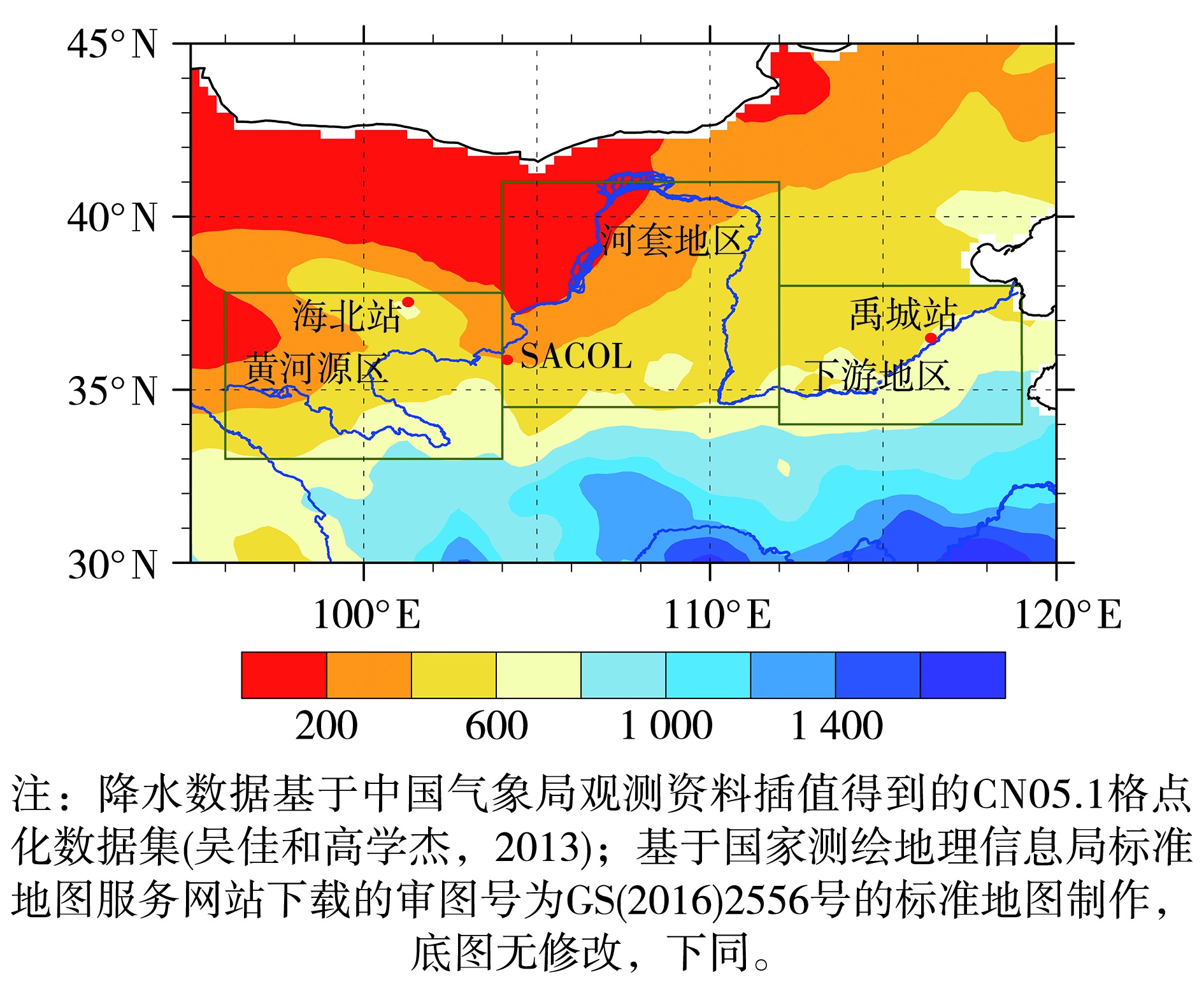
图1 黄河流域划分范围(绿色框)、代表性站点位置(红点)及1980—2021年平均降水量空间分布(填色,单位:mm) (蓝色实线代表黄河,下同)
Fig.1 The regional division (green boxes),the locations of representative stations (red dots) of the Yellow River Basin and spatial distribution of average annual precipitation during 1980-2021 (the color shaded,Unit: mm) (The blue solid line represents the Yellow River,the same as below)
图1 黄河流域划分范围(绿色框)、代表性站点位置(红点)及1980—2021年平均降水量空间分布(填色,单位:mm) (蓝色实线代表黄河,下同)
Fig.1 The regional division (green boxes),the locations of representative stations (red dots) of the Yellow River Basin and spatial distribution of average annual precipitation during 1980-2021 (the color shaded,Unit: mm) (The blue solid line represents the Yellow River,the same as below)
表1 基于CMIP6全强迫试验和未来情景预估试验的蒸散模式信息
Tab.1 Model information of evapotranspiration based on CMIP6 all forcing and future scenario projection experiments
| 模式 | Lat | Lon | 陆面模式 | 机构 | 简称 |
|---|---|---|---|---|---|
| ACCESS-CM2 | 144 | 192 | CABLE | 澳大利亚CSIRO-ARCCSS | ACM |
| ACCESS-ESM1-5 | 145 | 192 | CABLE | 澳大利亚CSIRO | AEM |
| AWI-CM-1-1-MR | 96 | 192 | JSBACH | 德国AWI | AWI |
| BCC-CSM2-MR | 160 | 320 | BCC-AVIM2 | 中国BCC | BCC |
| CAMS-CSM1-0 | 160 | 320 | CoLM | 中国CAMS | CAMS |
| CAS-ESM2-0 | 128 | 256 | CoLM+AVIM2 | 中国CAS | CAS |
| CMCC-CM2-SR5 | 192 | 288 | CLM4.5 | 意大利CMCC | CMC |
| CMCC-ESM2 | 192 | 288 | CLM4.5 | 意大利CMCC | CME |
| FGOALS-g3 | 80 | 180 | CAS-LSM | 中国LASG | FGg |
| FIO-ESM-2-0 | 192 | 288 | CLM4.5 | 中国FIO | FIO |
| IITM-ESM | 192 | 320 | NOAH | 印度IITM | IITM |
| MIROC6 | 128 | 256 | MATSIRO | 日本MIROC | MIR |
| MPI-ESM1-2-HR | 192 | 384 | JSBACH | 德国MPI-M | MPIH |
| MPI-ESM1-2-LR | 96 | 192 | JSBACH | 德国MPI-M | MPIL |
| MRI-ESM2-0 | 160 | 320 | AGCM | 日本MRI | MRI |
| NESM3 | 96 | 192 | JSBACH | 中国NUIST | NES |
| NorESM2-LM | 96 | 144 | CLM5 | 挪威NCC | NorL |
| NorESM2-MM | 192 | 288 | CLM5 | 挪威NCC | NorM |
| TaiESM1 | 192 | 288 | CLM4.5 | 中国台湾RCEC-AS | Tai |
表1 基于CMIP6全强迫试验和未来情景预估试验的蒸散模式信息
Tab.1 Model information of evapotranspiration based on CMIP6 all forcing and future scenario projection experiments
| 模式 | Lat | Lon | 陆面模式 | 机构 | 简称 |
|---|---|---|---|---|---|
| ACCESS-CM2 | 144 | 192 | CABLE | 澳大利亚CSIRO-ARCCSS | ACM |
| ACCESS-ESM1-5 | 145 | 192 | CABLE | 澳大利亚CSIRO | AEM |
| AWI-CM-1-1-MR | 96 | 192 | JSBACH | 德国AWI | AWI |
| BCC-CSM2-MR | 160 | 320 | BCC-AVIM2 | 中国BCC | BCC |
| CAMS-CSM1-0 | 160 | 320 | CoLM | 中国CAMS | CAMS |
| CAS-ESM2-0 | 128 | 256 | CoLM+AVIM2 | 中国CAS | CAS |
| CMCC-CM2-SR5 | 192 | 288 | CLM4.5 | 意大利CMCC | CMC |
| CMCC-ESM2 | 192 | 288 | CLM4.5 | 意大利CMCC | CME |
| FGOALS-g3 | 80 | 180 | CAS-LSM | 中国LASG | FGg |
| FIO-ESM-2-0 | 192 | 288 | CLM4.5 | 中国FIO | FIO |
| IITM-ESM | 192 | 320 | NOAH | 印度IITM | IITM |
| MIROC6 | 128 | 256 | MATSIRO | 日本MIROC | MIR |
| MPI-ESM1-2-HR | 192 | 384 | JSBACH | 德国MPI-M | MPIH |
| MPI-ESM1-2-LR | 96 | 192 | JSBACH | 德国MPI-M | MPIL |
| MRI-ESM2-0 | 160 | 320 | AGCM | 日本MRI | MRI |
| NESM3 | 96 | 192 | JSBACH | 中国NUIST | NES |
| NorESM2-LM | 96 | 144 | CLM5 | 挪威NCC | NorL |
| NorESM2-MM | 192 | 288 | CLM5 | 挪威NCC | NorM |
| TaiESM1 | 192 | 288 | CLM4.5 | 中国台湾RCEC-AS | Tai |
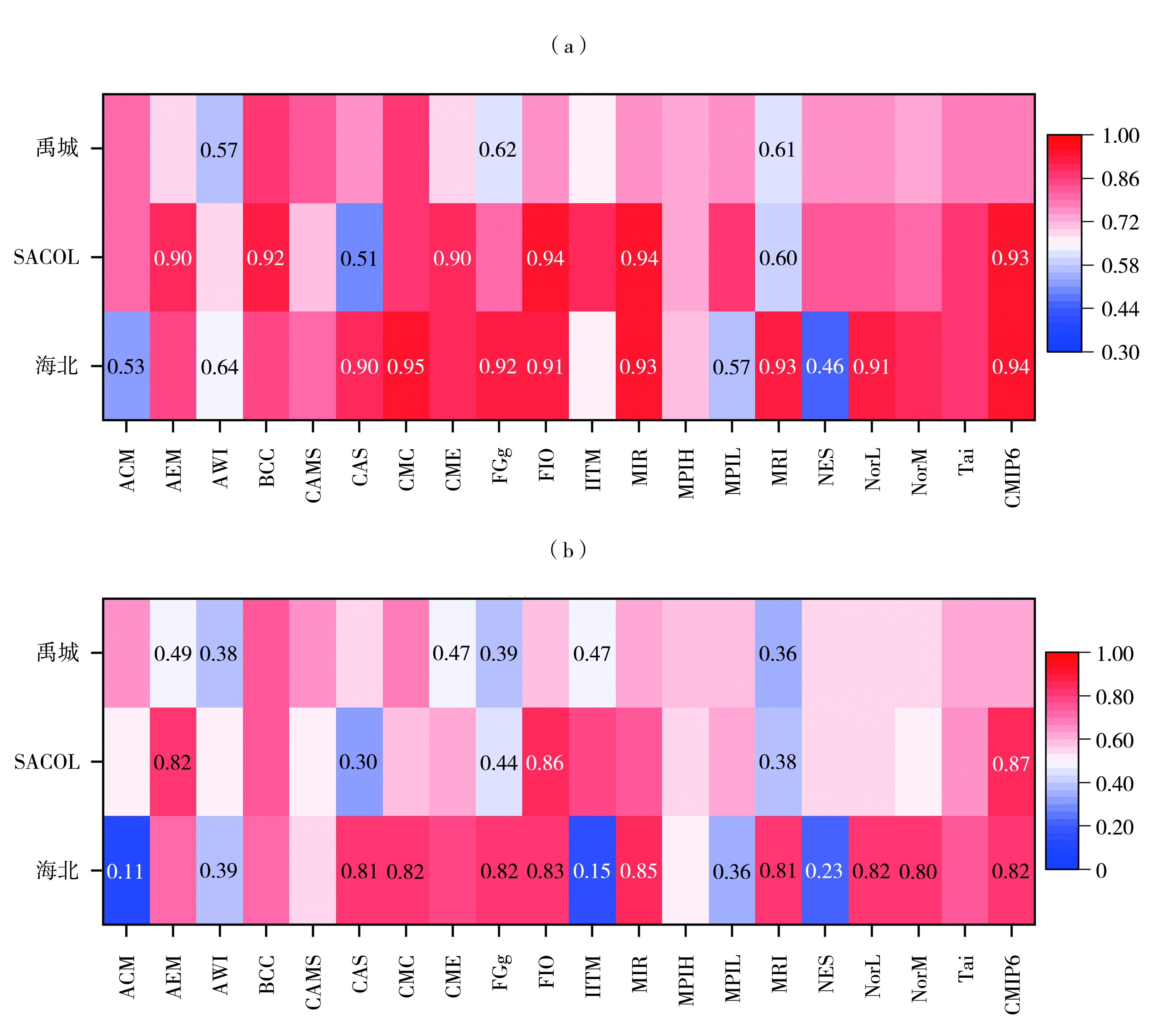
图2 海北、SACOL和禹城站蒸散观测值与CMIP6多模式集合平均及各模式模拟结果的相关系数(a)和泰勒评分(b)
Fig.2 The correlation coefficients (a) and TSS (b) between the observed evapotranspiration at Haibei,SACOL,and Yucheng stations and the results simulated by the CMIP6 multi-model ensemble mean as well as individual models
图2 海北、SACOL和禹城站蒸散观测值与CMIP6多模式集合平均及各模式模拟结果的相关系数(a)和泰勒评分(b)
Fig.2 The correlation coefficients (a) and TSS (b) between the observed evapotranspiration at Haibei,SACOL,and Yucheng stations and the results simulated by the CMIP6 multi-model ensemble mean as well as individual models
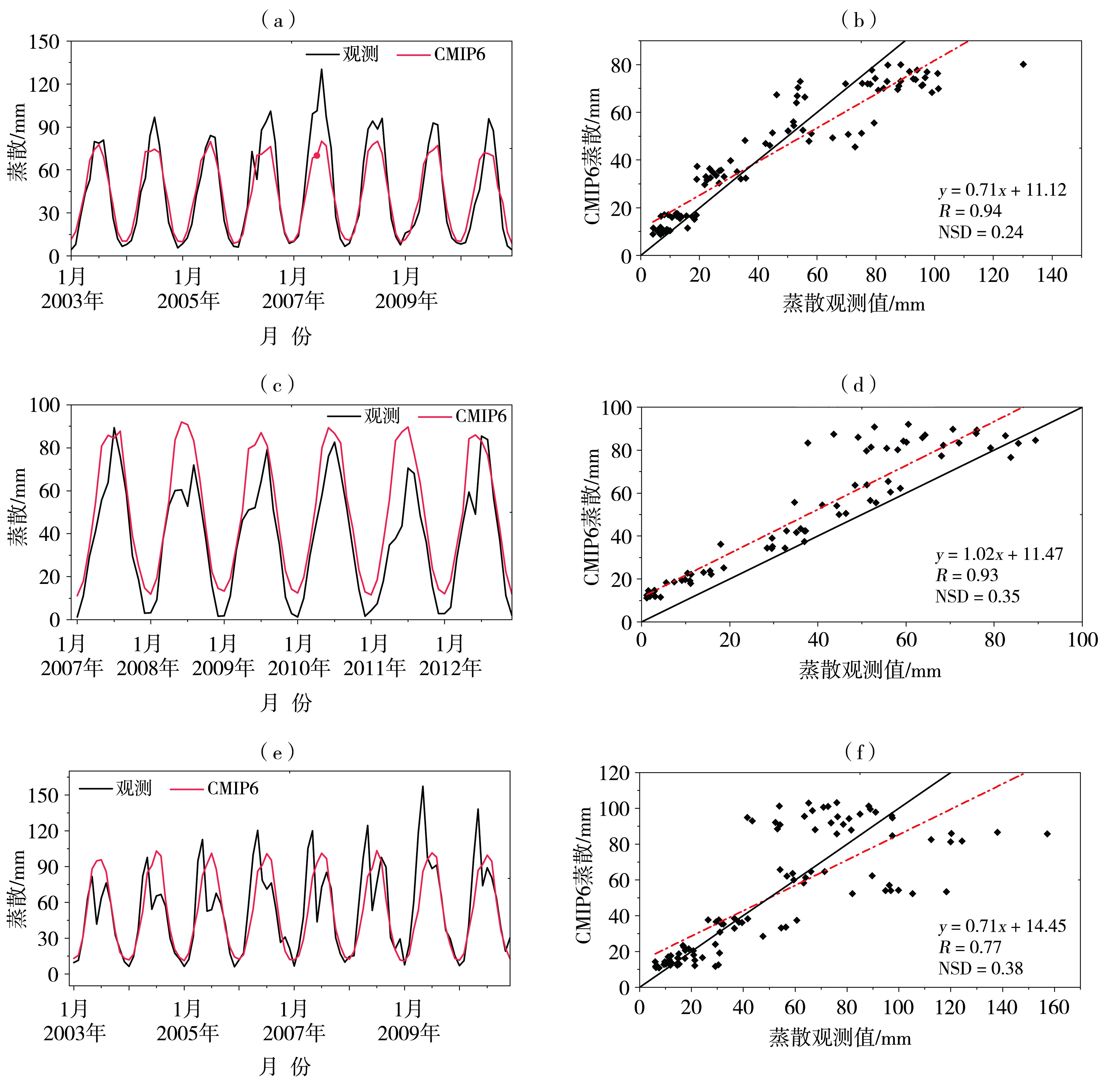
图3 2003年1月—2010年12月海北(a、b)和禹城(e、f)站、2007年1月—2012年12月SACOL站(c、d)蒸散观测值与CMIP6多模式集合平均的逐月变化(a、c、e)及散点图(b、d、f) (红色虚线表示拟合线)
Fig.3 Monthly variation (a,c,e) and scatter plots (b,d,f) of evapotranspiration between CMIP6 multi-model ensemble mean and Haibei (a,b) and Yucheng (e,f) stations from January 2003 to December 2010,SACOL Station (c,d) from January 2007 to December 2012 (The red dashed line represents the fitted line)
图3 2003年1月—2010年12月海北(a、b)和禹城(e、f)站、2007年1月—2012年12月SACOL站(c、d)蒸散观测值与CMIP6多模式集合平均的逐月变化(a、c、e)及散点图(b、d、f) (红色虚线表示拟合线)
Fig.3 Monthly variation (a,c,e) and scatter plots (b,d,f) of evapotranspiration between CMIP6 multi-model ensemble mean and Haibei (a,b) and Yucheng (e,f) stations from January 2003 to December 2010,SACOL Station (c,d) from January 2007 to December 2012 (The red dashed line represents the fitted line)
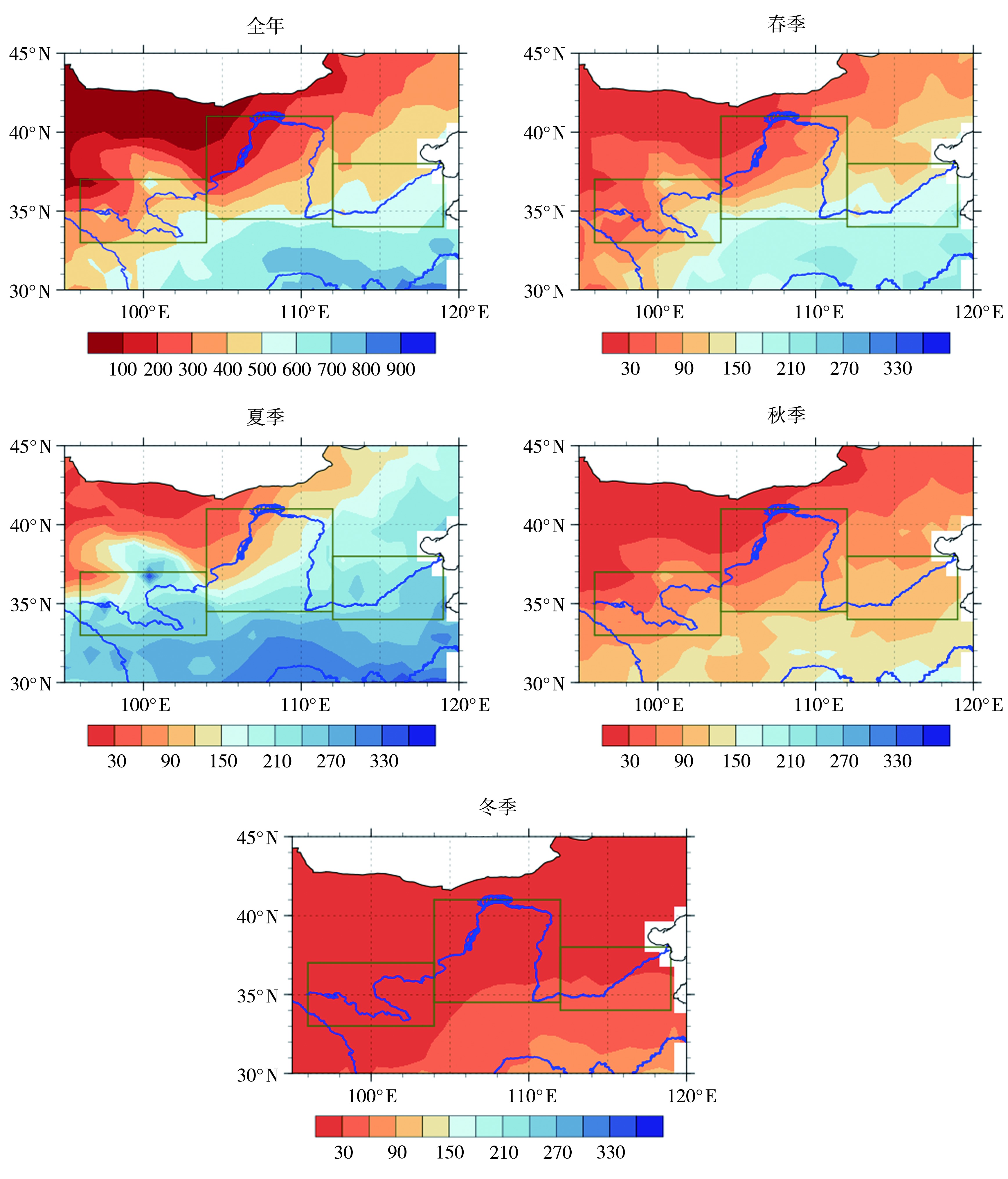
图4 基于CMIP6多模式集合平均的1980—2014年黄河流域年和季节蒸散空间分布(单位:mm)
Fig.4 The spatial distribution of annual and seasonal evapotranspiration based on the CMIP6 multi-model ensemble mean in the Yellow River Basin during 1980-2014 (Unit: mm)
图4 基于CMIP6多模式集合平均的1980—2014年黄河流域年和季节蒸散空间分布(单位:mm)
Fig.4 The spatial distribution of annual and seasonal evapotranspiration based on the CMIP6 multi-model ensemble mean in the Yellow River Basin during 1980-2014 (Unit: mm)
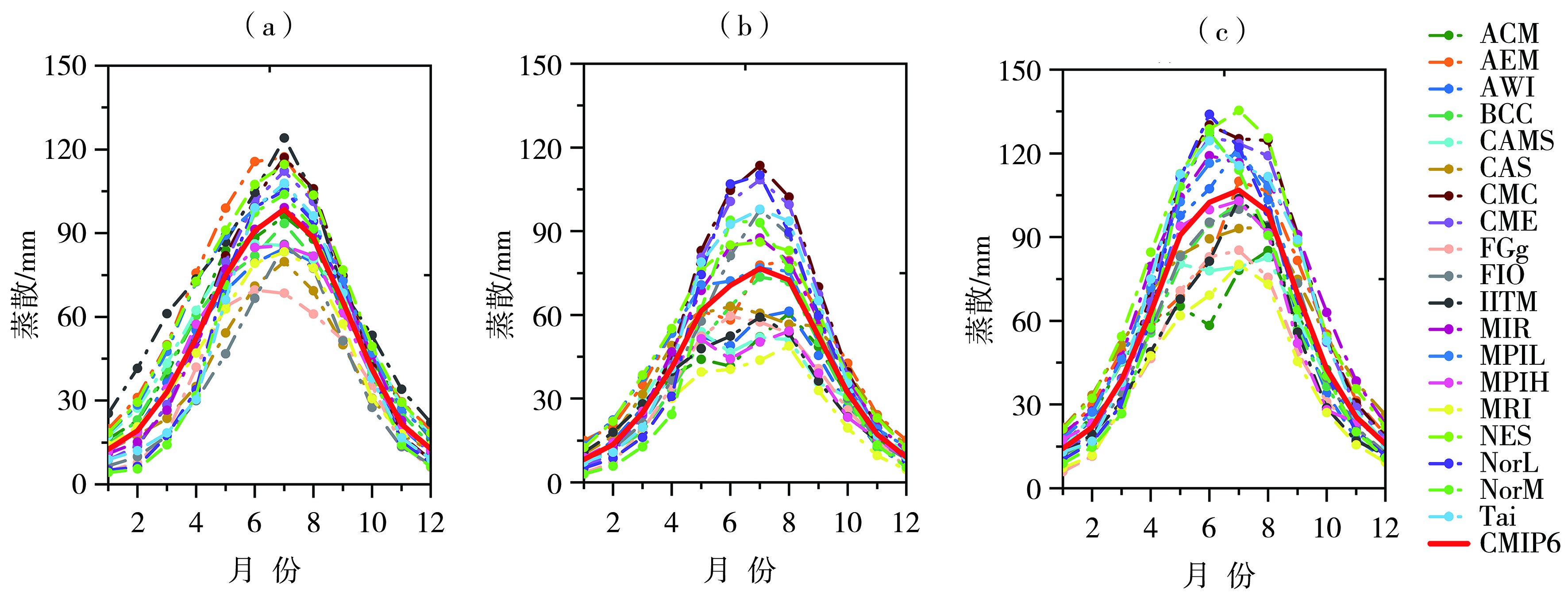
图5 基于CMIP6多模式集合平均及各模式模拟结果的1980—2014年黄河流域源区(a)、河套(b)和下游(c)地区蒸散的月际变化
Fig.5 The monthly variations of evapotranspiration over the source region (a),Hetao region (b),and lower reaches (c) of the Yellow River Basin during 1980-2014 based on the CMIP6 multi-model ensemble mean as well as the simulated results of individual models
图5 基于CMIP6多模式集合平均及各模式模拟结果的1980—2014年黄河流域源区(a)、河套(b)和下游(c)地区蒸散的月际变化
Fig.5 The monthly variations of evapotranspiration over the source region (a),Hetao region (b),and lower reaches (c) of the Yellow River Basin during 1980-2014 based on the CMIP6 multi-model ensemble mean as well as the simulated results of individual models
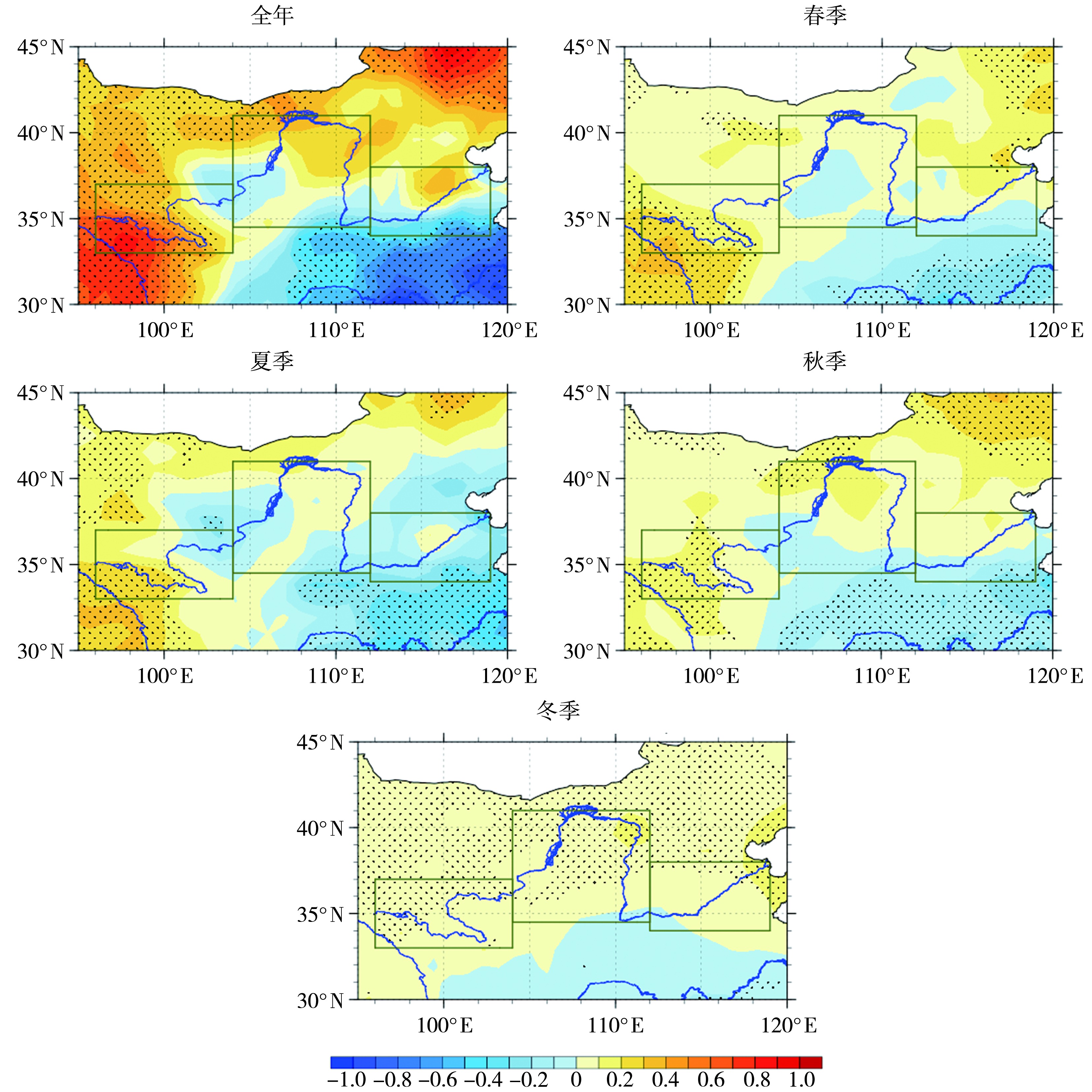
图6 基于CMIP6多模式集合平均的1980—2014年黄河流域年和季节蒸散变化趋势空间分布(单位:mm·a-1) (黑点区域表示通过置信水平为95%的显著性检验)
Fig.6 The spatial distribution of annual and seasonal evapotranspiration variation trend based on the CMIP6 multi-model ensemble mean in the Yellow River Basin during1980-2014 (Unit: mm·a-1) (The black spot areas indicate that they passed the significance test at the 95% confidence level)
图6 基于CMIP6多模式集合平均的1980—2014年黄河流域年和季节蒸散变化趋势空间分布(单位:mm·a-1) (黑点区域表示通过置信水平为95%的显著性检验)
Fig.6 The spatial distribution of annual and seasonal evapotranspiration variation trend based on the CMIP6 multi-model ensemble mean in the Yellow River Basin during1980-2014 (Unit: mm·a-1) (The black spot areas indicate that they passed the significance test at the 95% confidence level)
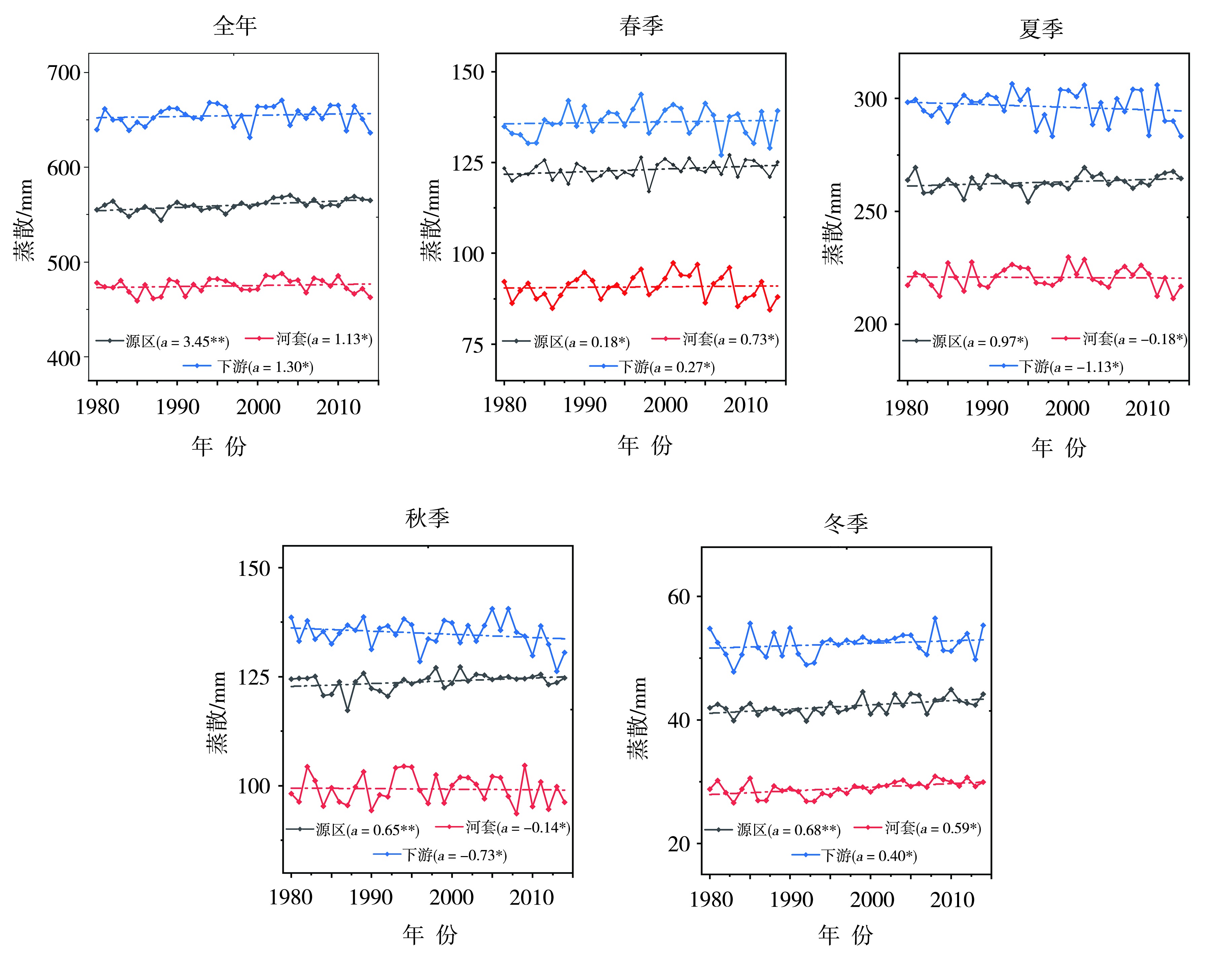
图7 基于CMIP6多模式集合平均的1980—2014年黄河源区、河套地区和下游地区全年和不同季节蒸散年际变化 [ a表示变化速率,单位: mm·(10 a)-1;**、*分别表示变化趋势通过置信水平为95%、90%的显著性检验,下同]
Fig.7 The inter-annual variation of annual and seasonal evapotranspiration based on the CMIP6 multi-model over the source region,Hetao region,and lower reaches of the Yellow River Basin during1980-2014 ( a represents the variation rate,Unit: mm·(10 a)-1; **,* indicate the variation trends passed the significance test at the 95% and 90% confidence level,respectively,the same as below)
图7 基于CMIP6多模式集合平均的1980—2014年黄河源区、河套地区和下游地区全年和不同季节蒸散年际变化 [ a表示变化速率,单位: mm·(10 a)-1;**、*分别表示变化趋势通过置信水平为95%、90%的显著性检验,下同]
Fig.7 The inter-annual variation of annual and seasonal evapotranspiration based on the CMIP6 multi-model over the source region,Hetao region,and lower reaches of the Yellow River Basin during1980-2014 ( a represents the variation rate,Unit: mm·(10 a)-1; **,* indicate the variation trends passed the significance test at the 95% and 90% confidence level,respectively,the same as below)
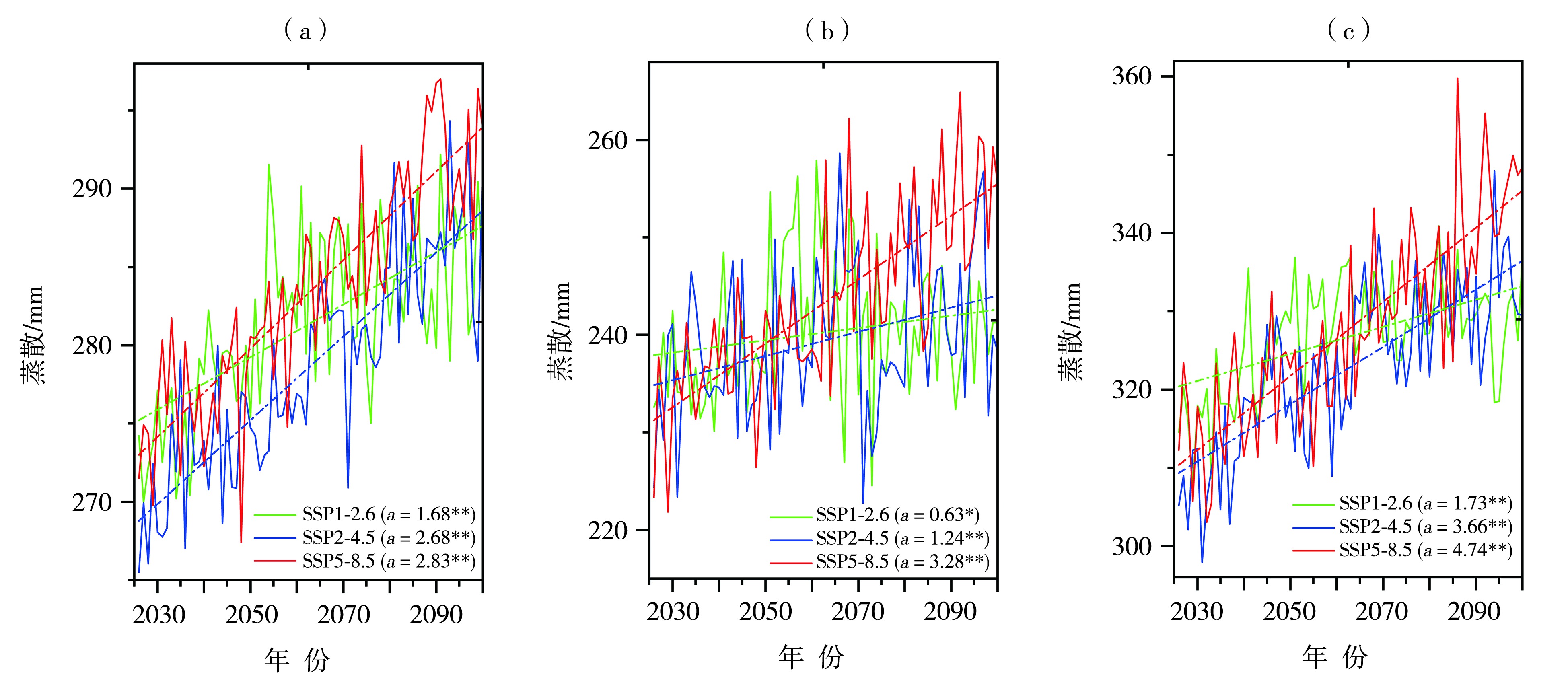
图8 不同排放情景下基于CMIP6多模式集合平均的2026—2100年夏季黄河源区(a)、河套地区(b)和下游地区(c)蒸散的年际变化
Fig.8 The inter-annual variation of evapotranspiration over the source region (a),Hetao region (b),and lower reaches (c) of the Yellow River Basin in summer during 2026-2100 based on the CMIP6 multi-model ensemble mean under different emission scenarios
图8 不同排放情景下基于CMIP6多模式集合平均的2026—2100年夏季黄河源区(a)、河套地区(b)和下游地区(c)蒸散的年际变化
Fig.8 The inter-annual variation of evapotranspiration over the source region (a),Hetao region (b),and lower reaches (c) of the Yellow River Basin in summer during 2026-2100 based on the CMIP6 multi-model ensemble mean under different emission scenarios
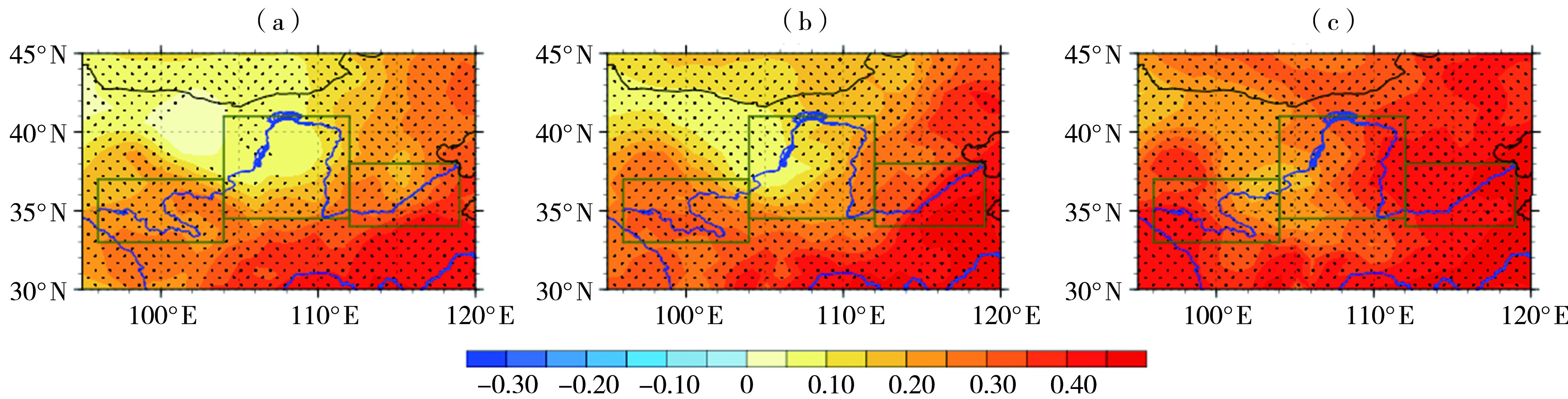
图9 SSP1-2.6(a)、SSP2-4.5(b)和SSP5-8.5(c)排放情景下基于CMIP6多模式集合平均的2026—2100年夏季黄河流域蒸散变化趋势的空间分布(单位:mm·a-1)
Fig.9 Spatial distributions of evapotranspiration variation trend over the Yellow River Basin in summer during 2026-2100 based on the CMIP6 multi-model ensemble mean under the SSP1-2.6 (a),SSP2-4.5 (b),and SSP5-8.5 (c) emission scenarios (Unit:mm·a-1)
图9 SSP1-2.6(a)、SSP2-4.5(b)和SSP5-8.5(c)排放情景下基于CMIP6多模式集合平均的2026—2100年夏季黄河流域蒸散变化趋势的空间分布(单位:mm·a-1)
Fig.9 Spatial distributions of evapotranspiration variation trend over the Yellow River Basin in summer during 2026-2100 based on the CMIP6 multi-model ensemble mean under the SSP1-2.6 (a),SSP2-4.5 (b),and SSP5-8.5 (c) emission scenarios (Unit:mm·a-1)
| [1] |
丁一汇, 柳艳菊, 徐影, 等, 2023. 全球气候变化的区域响应:中国西北地区气候“暖湿化”趋势、成因及预估研究进展与展望[J]. 地球科学进展, 38(6):551-562.
DOI |
| [2] |
刘煜, 刘蓉, 王欣, 等, 2022. 黄河源区干湿演变条件下的水汽输送特征研究[J]. 高原气象, 41(1):47-57.
DOI |
| [3] |
马阳, 崔洋, 张雯, 等, 2023. 基于CMIP6模式的黄河流域宁夏段未来气温变化预估研究[J]. 干旱气象, 41(1):43-53.
DOI |
| [4] | 乔梁, 2022. 全球土壤湿度变化的检测、归因、预估及相关陆气耦合对全球变暖的影响[D]. 上海: 复旦大学. |
| [5] |
王澄海, 吴永萍, 崔洋, 2009. CMIP研究计划的进展及其在中国地区的检验和应用前景[J]. 地球科学进展, 24(5):461-468.
DOI |
| [6] |
王澄海, 杨金涛, 杨凯, 等, 2022. 过去近60 a黄河流域降水时空变化特征及未来30 a变化趋势[J]. 干旱区研究, 39(3):708-722.
DOI |
| [7] | 王丽娟, 2022. 蒸散及其关键参数的多源卫星遥感反演与应用研究[D]. 兰州: 兰州大学. |
| [8] | 吴佳, 高学杰, 2013. 一套格点化的中国区域逐日观测资料及与其他资料的对比[J]. 地球物理学报, 56(4):1 102-1 111. |
| [9] | 杨金虎, 张强, 杨博成, 等, 2023. 黄河上游暖湿化的多时间尺度特征及对生态植被的影响[J]. 高原气象, 42(4):1 018-1 030. |
| [10] |
杨扬, 王丽娟, 黄小燕, 等, 2023. 基于ERA5-Land产品的黄河流域蒸散时空变化特征[J]. 干旱气象, 41(3):390-402.
DOI |
| [11] | 杨扬, 杨启东, 王芝兰, 等, 2021. 中国区域陆气耦合强度的时空分布特征[J]. 干旱气象, 39(3): 374-385. |
| [12] | 叶培龙, 张强, 王莺, 等, 2020. 1980—2018年黄河上游气候变化及其对生态植被和径流量的影响[J]. 大气科学学报, 43(6):967-979. |
| [13] | 詹明月, 王国杰, 陆姣, 等, 2020. 基于CMIP6多模式的长江流域蒸散发预估及影响因素[J]. 大气科学学报, 43(6):1 115-1 126. |
| [14] | 张丽霞, 陈晓龙, 辛晓歌, 2019. CMIP6情景模式比较计划(ScenarioMIP)概况与评述[J]. 气候变化研究进展, 15(5):519-525. |
| [15] | 张强, 林婧婧, 刘维成, 等, 2019. 西北地区东部与西部汛期降水跷跷板变化现象及其形成机制[J]. 中国科学:地球科学, 49(12):2 064-2 078. |
| [16] | 张强, 杨金虎, 王朋岭, 等, 2023. 西北地区气候暖湿化的研究进展与展望[J]. 科学通报, 68(14):1 814-1 828. |
| [17] | 张强, 杨泽粟, 郝小翠, 等, 2018. 北方蒸散对气候变暖响应随降水类型转换特征[J]. 科学通报, 63(11):1 035-1 049. |
| [18] | 赵宗慈, 罗勇, 黄建斌, 2018. 从检验CMIP5气候模式看CMIP6地球系统模式的发展[J]. 气候变化研究进展, 14(6):643-648. |
| [19] | 郑子彦, 吕美霞, 马柱国, 2020. 黄河源区气候水文和植被覆盖变化及面临问题的对策建议[J]. 中国科学院院刊, 35(1): 61-72. |
| [20] | 周天军, 陈梓明, 邹立维, 等, 2020. 中国地球气候系统模式的发展及其模拟和预估[J]. 气象学报, 78(3):332-350. |
| [21] | 周天军, 邹立维, 陈晓龙, 2019. 第六次国际耦合模式比较计划(CMIP6)评述[J]. 气候变化研究进展, 15(5):445-456. |
| [22] | 朱永泰, 2023. 基于CMIP6多模式的中国陆地蒸散发及其组分的模拟评估与预估[D]. 兰州: 兰州大学. |
| [23] |
BAO Q, LIU Y M, WU G X, et al, 2020. CAS FGOALS-f3-H and CAS FGOALS-f3-L outputs for the high-resolution model intercomparison project simulation of CMIP6[J]. Atmospheric and Oceanic Science Letters, 13(6): 576-581.
DOI URL |
| [24] |
CHEN C, PARK T, WANG X H, et al, 2019. China and India lead in greening of the world through land-use management[J]. Nature Sustainability, 2(2):122-129.
DOI PMID |
| [25] |
EYRING V, COX P M, FLATO G M, et al, 2019. Taking climate model evaluation to the next level[J]. Nature Climate Change, 9(2):102-110.
DOI |
| [26] |
FISHER J B, MELTON F, MIDDLETON E, et al, 2017. The future of evapotranspiration: Global requirements for ecosystem functioning, carbon and climate feedbacks, agricultural management, and water resources[J]. Water Resources Research, 53(4):2 618-2 626.
DOI URL |
| [27] | GAO G, CHEN D L, XU C Y, et al, 2007. Trend of estimated actual evapotranspiration over China during 1960-2002[J]. Journal of Geophysical Research: Atmospheres, 112(D11): 2006JD008010. DOI:10.1029/2006JD008010. |
| [28] |
LI C, ZWIERS F W, ZHANG X B, et al, 2021. Changes in annual extremes of daily temperature and precipitation in CMIP6 Models[J]. Journal of Climate, 34(9):3 441-3 460.
DOI URL |
| [29] |
SENEVIRATNE S I, CORTI T, DAVIN E L, et al, 2010. Investigating soil moisture-climate interactions in a changing climate: A review[J]. Earth-Science Reviews, 99(3/4):125-161.
DOI URL |
| [30] |
TAYLOR K E, 2001. Summarizing multiple aspects of model performance in a single diagram[J]. Journal of Geophysical Research:Atmospheres, 106(D7):7 183-7 192.
DOI URL |
| [31] | WANG K C, DICKINSON R E, 2012. A review of global terrestrial evapotranspiration: Observation, modeling, climatology, and climatic variability[J]. Reviews of Geophysics, 50(2): 2011RG000373. DOI:10.1029/2011RG000373. |
| [32] |
WANG Z Z, ZHAN C S, NING L K, et al, 2021. Evaluation of global terrestrial evapotranspiration in CMIP6 models[J]. Theoretical and Applied Climatology, 143(1): 521-531.
DOI |
| [33] |
WU P, DING Y H, LIU Y J, et al, 2019. The characteristics of moisture recycling and its impact on regional precipitation against the background of climate warming over Northwest China[J]. International Journal of Climatology, 39(14):5 241-5 255.
DOI URL |
| [34] | YANG Q D, DAN L, LV M Z, et al, 2021a. Quantitative assessment of the parameterization sensitivity of the Noah-MP land surface model with dynamic vegetation using ChinaFLUX data[J]. Agricultural and Forest Meteorology, 307: 108542. DOI:10.1016/j.agrformet.2021.108542. |
| [35] |
YANG X L, ZHOU B T, XU Y, et al, 2021b. CMIP6 evaluation and projection of temperature and precipitation over China[J]. Advances in Atmospheric Sciences, 38(5): 817-830.
DOI |
| [36] |
YANG Z S, ZHANG Q, HAO X C, et al, 2019. Changes in evapotranspiration over global semiarid regions 1984-2013[J]. Journal of Geophysical Research: Atmospheres, 124(6):2 946-2 963.
DOI URL |
| [37] | YAO J Q, CHEN Y N, ZHAO Y, et al, 2020. Climatic and associated atmospheric water cycle changes over the Xinjiang, China[J]. Journal of Hydrology, 585: 124823. DOI:10.1016/j.jhydrol.2020.124823. |
| [38] | YE P L, ZHANG Q, WANG J S, et al, 2025. Interdecadal shifts and associated atmospheric circulation anomalies of heavy precipitation during the warm-season in the Upper Yellow River Basin over the past 40 years[J]. Atmospheric Research, 314:10780. DOI:10.1016/j.atmosres.2024.107801. |
| [1] | 苗婷, 安俊宝, 武艳娟, 苏荣醒, 李菲, 王金龙, 甘泽良, 郑琼, 姜睿, 刘晓蒙. 2000—2020年黄河流域白银段植被生态质量时空变化特征[J]. 干旱气象, 2026, 44(1): 95-102. |
| [2] | 赵斯楠, 赵海燕, 代潭龙, 李睿, 邵丽芳, 张强. 高温和干旱对美国加利福尼亚州山火的影响[J]. 干旱气象, 2025, 43(5): 689-700. |
| [3] | 张峰, 李云鹏, 李海燕, 司瑶冰. 基于FY-3G的黄河流域内蒙古段一次暴雨云团结构特征分析[J]. 干旱气象, 2025, 43(5): 701-712. |
| [4] | 彭记永, 李树岩, 杜子璇, 邹春辉, 李军玲, 方文松. 夏玉米乳熟期倒伏对群体水分利用效率及产量的影响[J]. 干旱气象, 2025, 43(5): 782-789. |
| [5] | 苏天鑫, 孟宪红, 杨显玉, 安颖颖, 赵采玲. 1963—2022年西北地区中西部干旱演变特征及植被响应研究[J]. 干旱气象, 2025, 43(2): 163-175. |
| [6] | 田国珍, 任玉欢, 杨茜, 黄小燕, 赵斯楠, 左小瑞, 李智才. 三种遥感干旱监测指数在黄土高原东部的适用性研究[J]. 干旱气象, 2024, 42(3): 338-346. |
| [7] | 杨英杰, 曹倩, 税玥. 中亚复合高温干旱事件识别与特征分析[J]. 干旱气象, 2024, 42(1): 19-26. |
| [8] | 董靖玮, 文莉娟, 于涛, 杨永顺, 罗颖, 王梦晓, 牛瑞佳. 青海湖湖温预估研究[J]. 干旱气象, 2024, 42(1): 64-74. |
| [9] | 朱丽, 吕潇雨, 郭浩, 孟翔晨, 田芸菲. ERA5-Land降水产品在黄河流域干旱监测中的适用性研究[J]. 干旱气象, 2023, 41(5): 677-687. |
| [10] | 赵惠珍, 何涛, 郭瑞霞, 王成福, 张艳荣, 李琪. 基于SPEI的甘南高原气象干旱变化特征[J]. 干旱气象, 2023, 41(5): 688-696. |
| [11] | 姚彦伶, 王悦, 陈权亮, 廖雨静. 青藏高原中东部极端降水的时空变化特征[J]. 干旱气象, 2023, 41(5): 714-722. |
| [12] | 杨扬, 王丽娟, 黄小燕, 齐月, 谢蕊. 基于ERA5-Land产品的黄河流域蒸散时空变化特征[J]. 干旱气象, 2023, 41(3): 390-402. |
| [13] | 李慧, 郑旭程, 苏立娟, 辛悦, 张杰. 基于毫米波云雷达的黄河流域内蒙古段云宏观特征分析[J]. 干旱气象, 2023, 41(3): 434-441. |
| [14] | 马阳, 崔洋, 张雯, 李欣. 基于CMIP6模式的黄河流域宁夏段未来气温变化预估研究[J]. 干旱气象, 2023, 41(1): 43-53. |
| [15] | 王晓晨, 马雪晴, 和骅芸, 任思琪, 唐书玥, 赵金媛, 潘志华, 王靖, 潘学标, 胡琦. 1961—2020年中国北方向日葵种植区干湿变化特征及其成因分析[J]. 干旱气象, 2022, 40(6): 1033-1041. |
| 阅读次数 | ||||||
|
全文 |
|
|||||
|
摘要 |
|
|||||
