干旱气象 ›› 2026, Vol. 44 ›› Issue (1): 103-114.DOI: 10.11755/j.issn.1006-7639-2026-01-0103
基于机器学习订正ERA5的甘肃省地表太阳辐射时空分布
吴欣华1( ), 王思晨2, 王菲菲3, 王天河2(), 杜源1, 陈涛1, 牛亮亮1, 赵怀宇1, 张昊天1
- 1.甘肃省交通投资管理有限公司,甘肃 兰州 730000
2.兰州大学大气科学学院,甘肃 兰州 730000
3.甘肃省水利水电勘测设计研究院有限责任公司,甘肃 兰州 730000
-
收稿日期:2025-09-01修回日期:2025-11-19出版日期:2026-02-28发布日期:2026-03-25 -
通讯作者:王天河(1980—),男,甘肃静宁人,博士,教授,主要从事大气遥感、气溶胶-云-气候相互作用等研究。E-mail: wangth@lzu.edu.cn。
-
作者简介:吴欣华(1978—),男,甘肃武威人,高级工程师,主要从事交通运输与绿色能源研究。E-mail: 18551810@qq.com。 -
基金资助:甘肃省交通运输厅科技项目(2022-56);中国气象局青年创新团队(CMA2024QN13);天池英才引进计划(2024)
Spatiotemporal distribution of surface solar radiation in Gansu Province based on machine learning correction of ERA5
WU Xinhua1(), WANG Sichen2, WANG Feifei3, WANG Tianhe2(), DU Yuan1, CHEN Tao1, NIU Liangliang1, ZHAO Huaiyu1, ZHANG Haotian1
- 1. Gansu Communication Investment Management Company Limited,Lanzhou 730000,China
2. College of Atmospheric Sciences,Lanzhou University,Lanzhou 730000,China
3. Gansu Water Resources and Hydropower Survey Design and Research Institute Company Limited,Lanzhou 730000,China
-
Received:2025-09-01Revised:2025-11-19Online:2026-02-28Published:2026-03-25

摘要:
准确掌握地表太阳辐射的时空分布特征,对太阳能资源评估与区域新能源规划具有重要意义。以甘肃省地基辐射站点观测数据为基准,构建机器学习模型,对欧洲中期天气预报中心第五代再分析资料(ERA5)的逐小时地表下行太阳辐射进行偏差订正,在此基础上系统分析了2000—2024年甘肃省地表下行太阳辐射的时空变化特征,并统计了各地级行政区年总辐射量。结果表明:机器学习订正方法显著提升ERA5数据精度,订正后数据与地基观测值的相关系数(0.93)提高12.04%,均方根误差(106.2 W·m-2)降低36.45%;与中国科学院空天信息创新研究院发布的CARE(Cloud Remote Sensing,Atmospheric Radiation and Renewal Energy Application)卫星遥感产品对比,二者相关系数达0.87,偏差主要分布在青藏高原东北侧。研究期内,甘肃省地表下行太阳辐射年均值为206.73 W·m-2,折合年累计总辐射量为1 659.60 kWh·m-2,高于全国平均水平,空间上呈“西北高、东南低”的分布格局,其中酒泉地区可达1 828.44 kWh·m-2,具备优越的太阳能开发潜力,且全省未呈现明显的年际波动趋势。
中图分类号:
引用本文
吴欣华, 王思晨, 王菲菲, 王天河, 杜源, 陈涛, 牛亮亮, 赵怀宇, 张昊天. 基于机器学习订正ERA5的甘肃省地表太阳辐射时空分布[J]. 干旱气象, 2026, 44(1): 103-114.
WU Xinhua, WANG Sichen, WANG Feifei, WANG Tianhe, DU Yuan, CHEN Tao, NIU Liangliang, ZHAO Huaiyu, ZHANG Haotian. Spatiotemporal distribution of surface solar radiation in Gansu Province based on machine learning correction of ERA5[J]. Journal of Arid Meteorology, 2026, 44(1): 103-114.
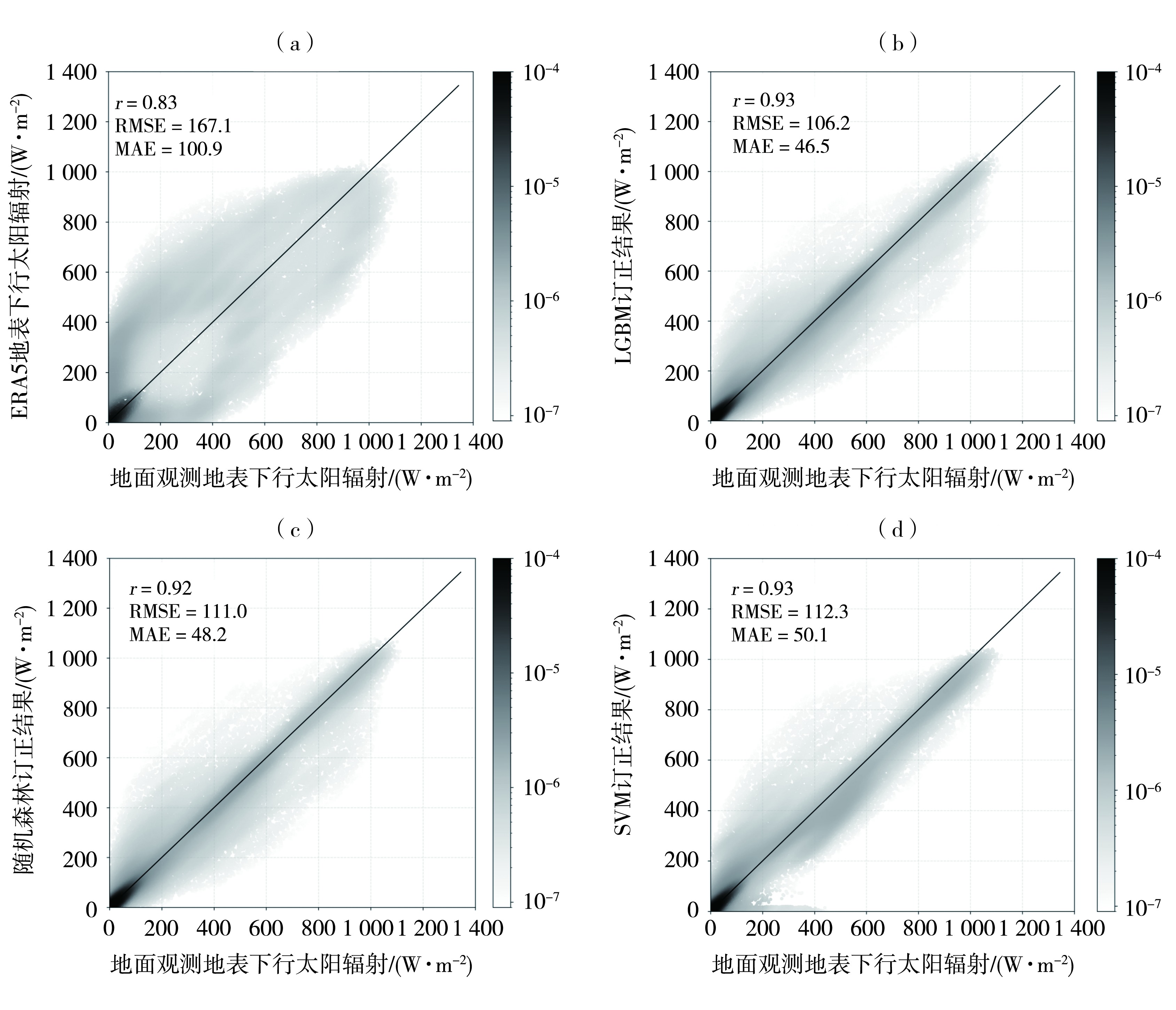
图1 未订正及不同机器学习方法订正的2022—2024年ERA5逐小时地表下行太阳辐射与地面站点观测值的散点图 (a)未订正,(b)LGBM订正,(c)RF订正,(d)SVM订正 (黑色实线为1∶1基准线,灰色阴影表示高斯核密度估计值)
Fig.1 Scatter plots of hourly ERA5 surface downward solar radiation against in-situ observations before correction and corrected by different machine learning methods during 2022-2024 (a) Uncorrected,(b) LGBM-corrected,(c) RF-corrected,(d) SVM-corrected (The black solid line indicates the 1∶1 reference line,and the gray shading represents the gaussian kernel density estimate)
图1 未订正及不同机器学习方法订正的2022—2024年ERA5逐小时地表下行太阳辐射与地面站点观测值的散点图 (a)未订正,(b)LGBM订正,(c)RF订正,(d)SVM订正 (黑色实线为1∶1基准线,灰色阴影表示高斯核密度估计值)
Fig.1 Scatter plots of hourly ERA5 surface downward solar radiation against in-situ observations before correction and corrected by different machine learning methods during 2022-2024 (a) Uncorrected,(b) LGBM-corrected,(c) RF-corrected,(d) SVM-corrected (The black solid line indicates the 1∶1 reference line,and the gray shading represents the gaussian kernel density estimate)
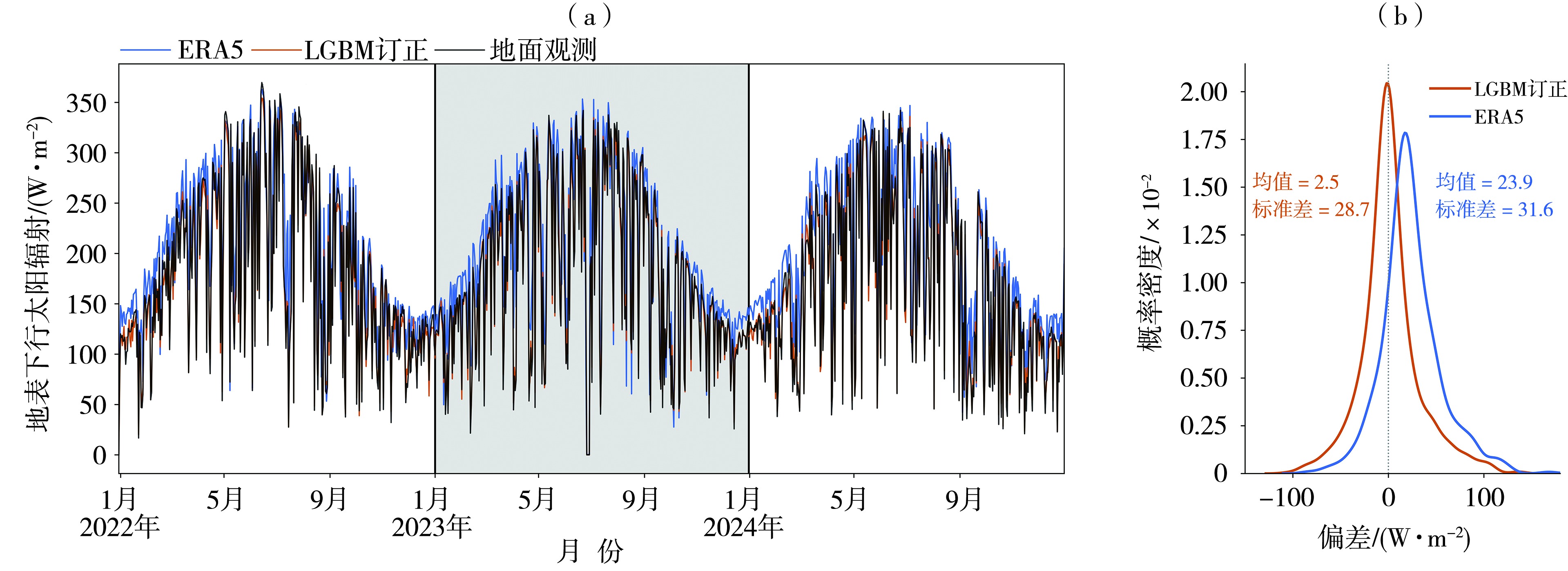
图2 2022—2024年LGBM订正前后的ERA5地表下行太阳辐射与地面观测值逐日变化(a)及测试集偏差(订正前后的ERA5数据减去地面观测)概率密度分布(b)
Fig.2 Daily variations of ERA5 surface downward solar radiation before and after LGBM correction with ground observations during 2022-2024 (a) and probability density distribution of test dataset biases (ERA5 data before and after correction minus ground observations)(b)
图2 2022—2024年LGBM订正前后的ERA5地表下行太阳辐射与地面观测值逐日变化(a)及测试集偏差(订正前后的ERA5数据减去地面观测)概率密度分布(b)
Fig.2 Daily variations of ERA5 surface downward solar radiation before and after LGBM correction with ground observations during 2022-2024 (a) and probability density distribution of test dataset biases (ERA5 data before and after correction minus ground observations)(b)
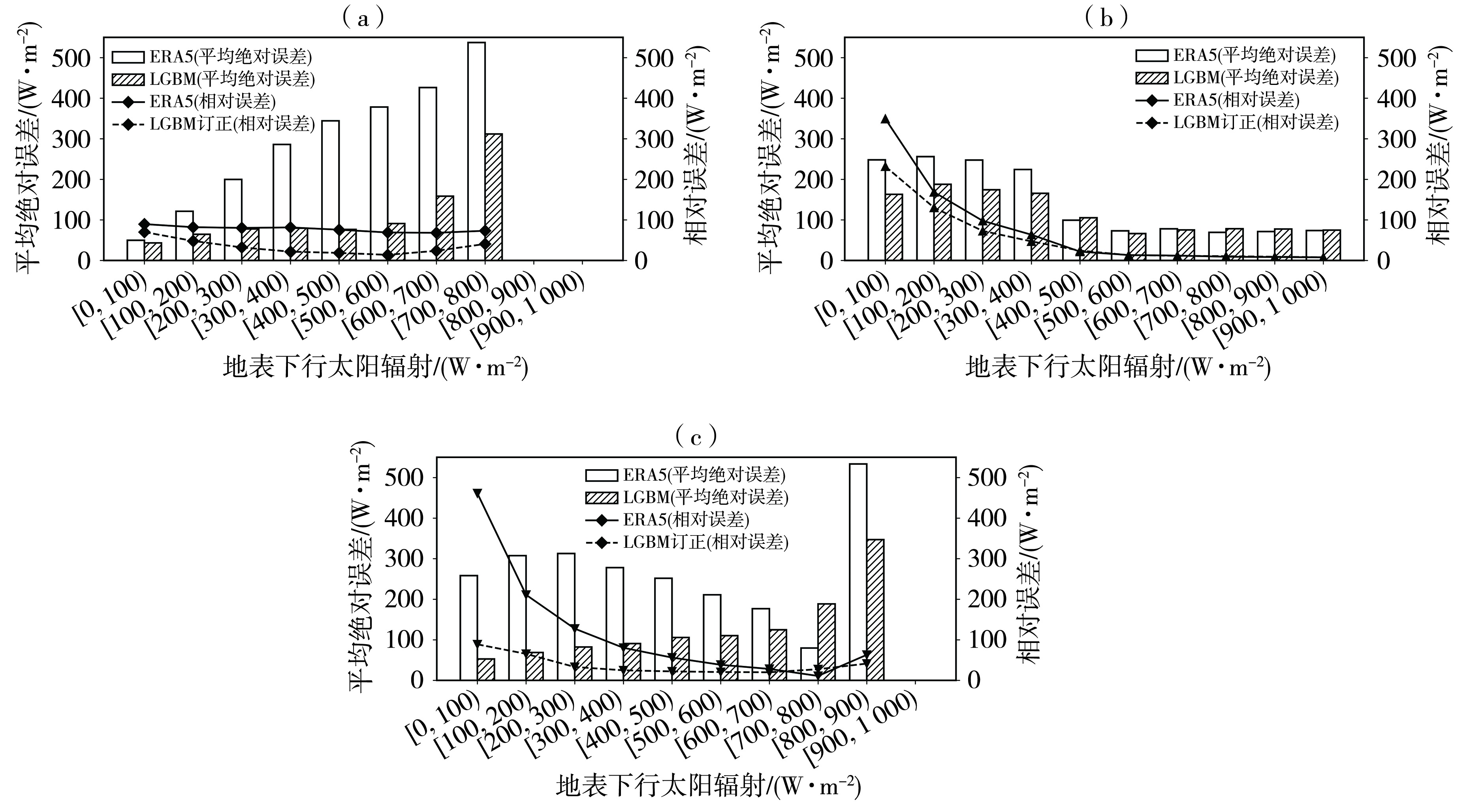
图3 不同时刻、不同辐射区间ERA5与LGBM订正的地表下行太阳辐射相较于观测值的平均绝对误差和相对误差 (a) 08:00,(b)12:00,(c)16:00
Fig.3 Mean absolute error and relative error of surface downward solar radiation from ERA5 and LGBM correction compared with observations at different times and different radiation intervals (a) 08:00,(b) 12:00,(c) 16:00
图3 不同时刻、不同辐射区间ERA5与LGBM订正的地表下行太阳辐射相较于观测值的平均绝对误差和相对误差 (a) 08:00,(b)12:00,(c)16:00
Fig.3 Mean absolute error and relative error of surface downward solar radiation from ERA5 and LGBM correction compared with observations at different times and different radiation intervals (a) 08:00,(b) 12:00,(c) 16:00
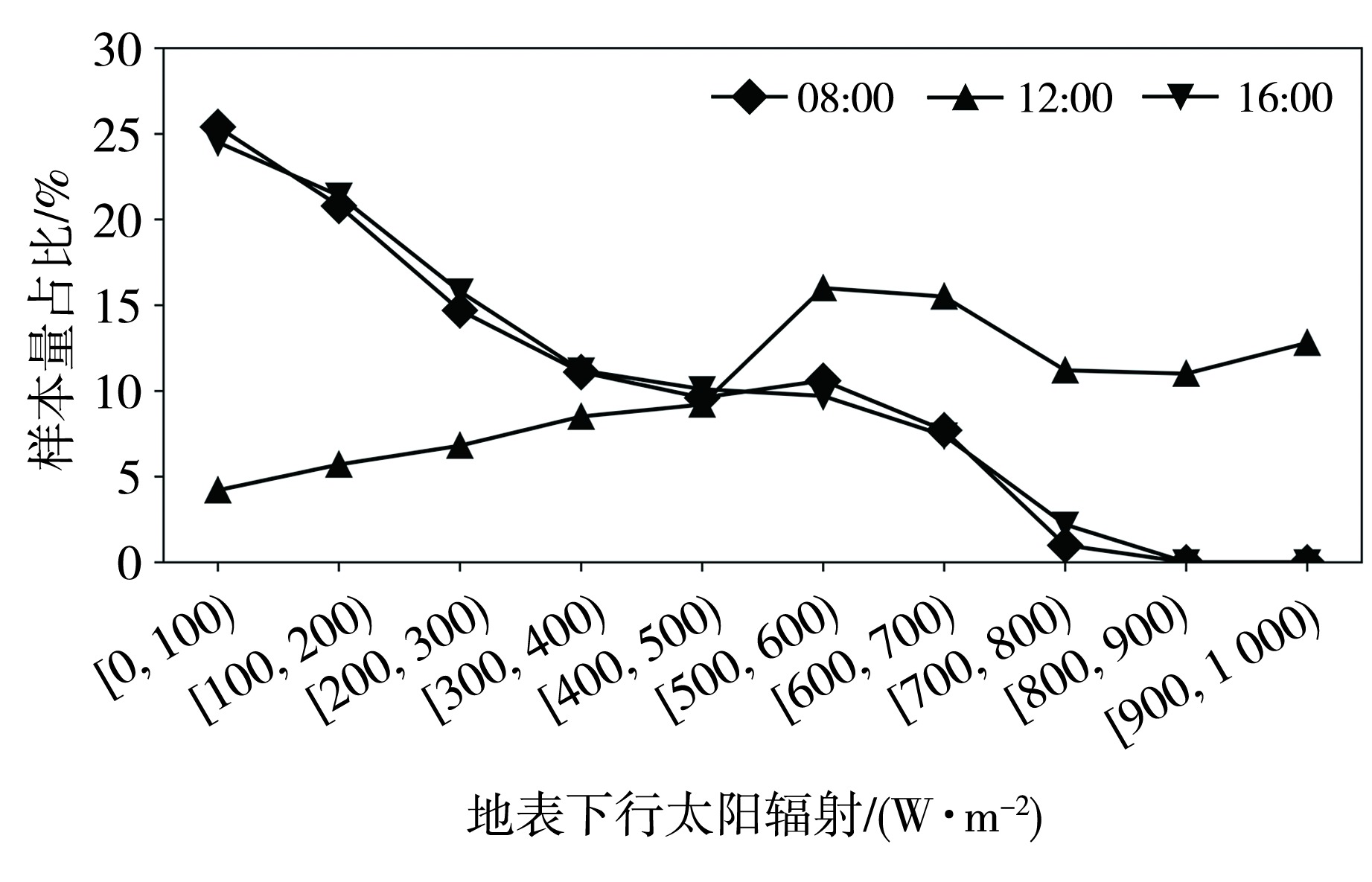
图4 不同时刻、不同辐射区间的样本量占比
Fig.4 Percentage of samples in each radiation interval at different times
图4 不同时刻、不同辐射区间的样本量占比
Fig.4 Percentage of samples in each radiation interval at different times
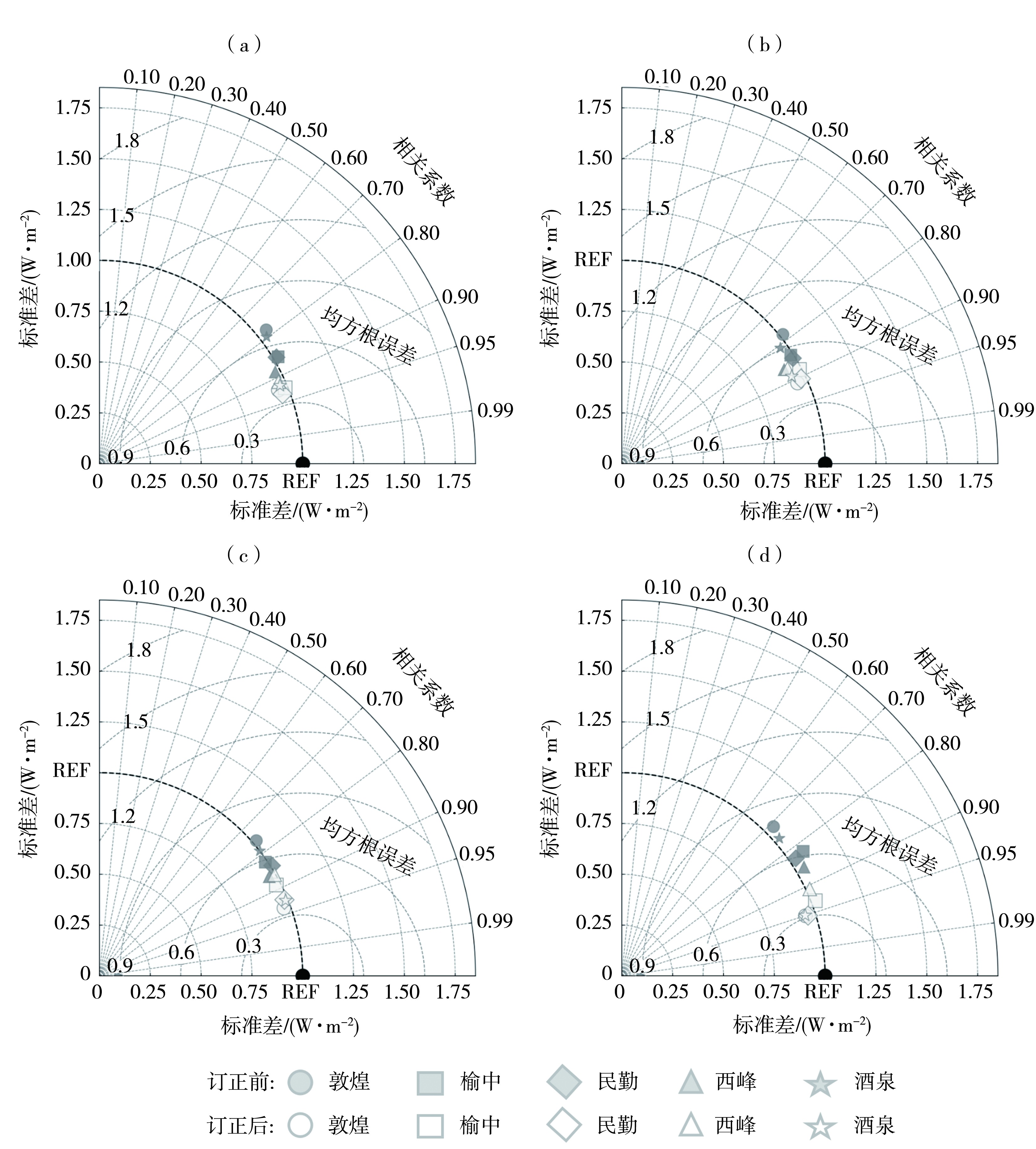
图5 不同地面站点、不同季节订正前后的地表下行太阳辐射精度对比 (a)春季,(b)夏季,(c)秋季,(d)冬季
Fig.5 Comparison of the accuracy of surface downward solar radiation before and after correction across different ground stations and different seasons (a) spring,(b) summer,(c) autumn,(d) winter
图5 不同地面站点、不同季节订正前后的地表下行太阳辐射精度对比 (a)春季,(b)夏季,(c)秋季,(d)冬季
Fig.5 Comparison of the accuracy of surface downward solar radiation before and after correction across different ground stations and different seasons (a) spring,(b) summer,(c) autumn,(d) winter
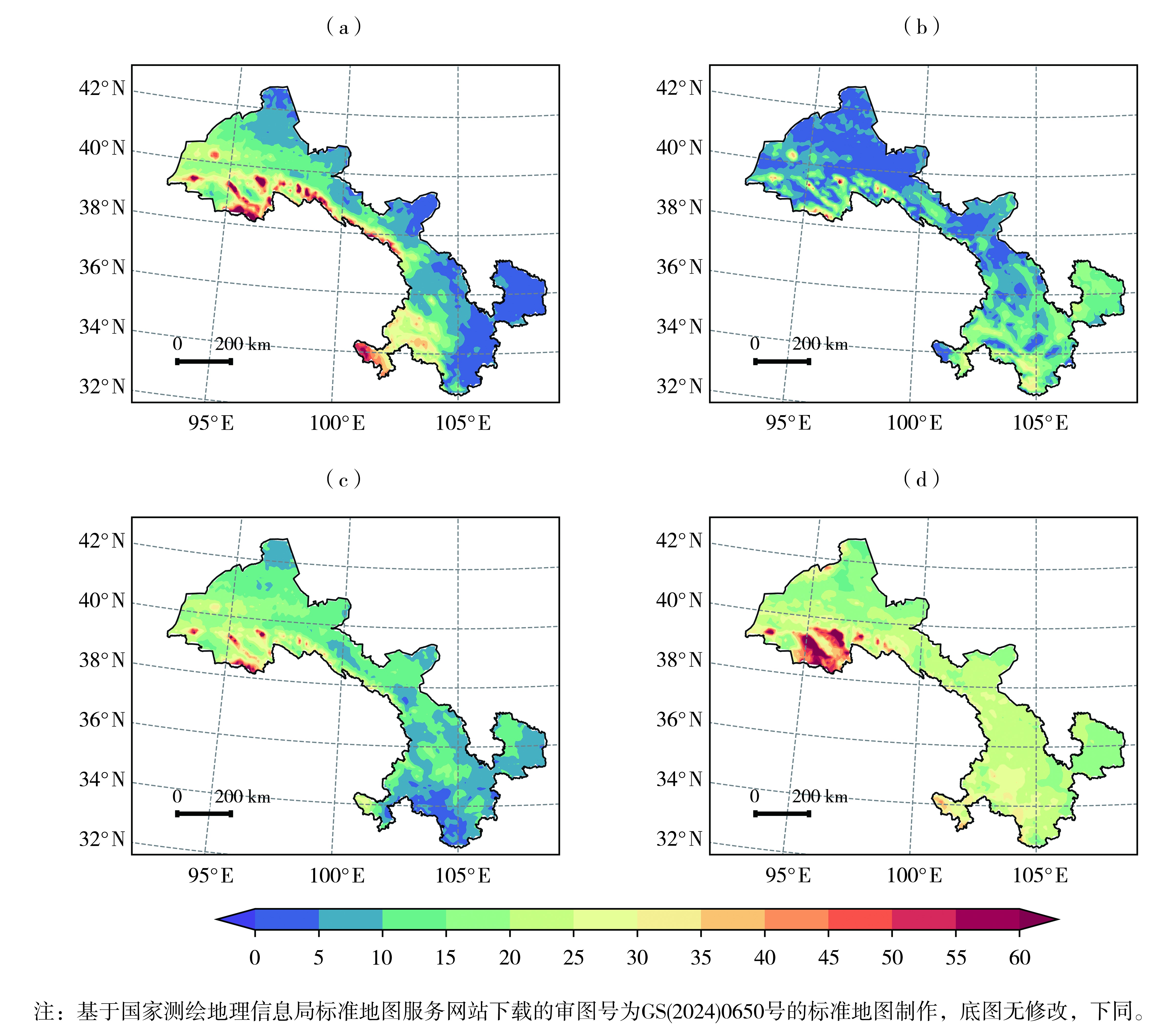
图6 不同季节LGBM订正数据相较于CARE卫星遥感产品的地表下行太阳辐射的平均绝对误差空间分布(单位:W·m-2) (a)春季,(b)夏季,(d)秋季,(d)冬季
Fig.6 Spatial distribution of mean absolute error of surface downward solar radiation between LGBM-corrected data and CARE satellite remote sensing products in different seasons (Unit: W·m-2) (a) spring,(b) summer,(c) autumn,(d) winter
图6 不同季节LGBM订正数据相较于CARE卫星遥感产品的地表下行太阳辐射的平均绝对误差空间分布(单位:W·m-2) (a)春季,(b)夏季,(d)秋季,(d)冬季
Fig.6 Spatial distribution of mean absolute error of surface downward solar radiation between LGBM-corrected data and CARE satellite remote sensing products in different seasons (Unit: W·m-2) (a) spring,(b) summer,(c) autumn,(d) winter
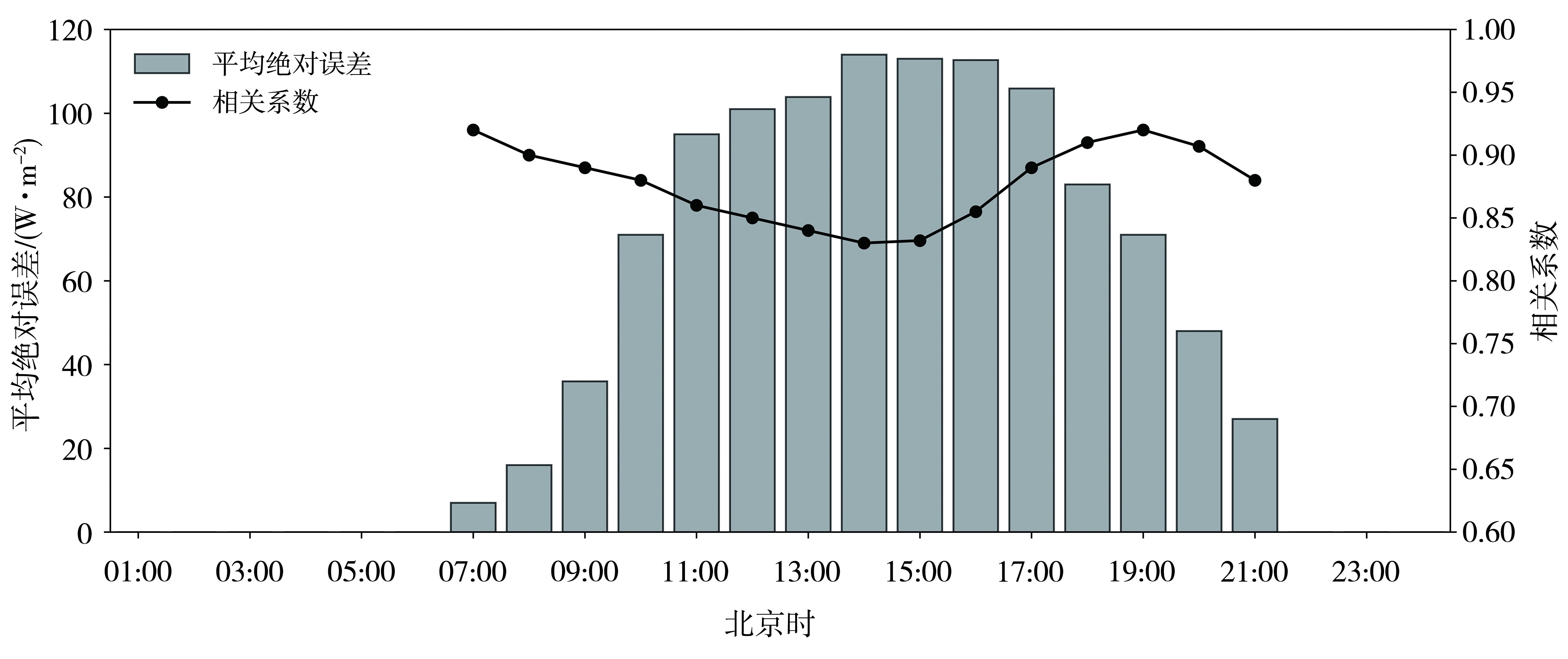
图7 LGBM订正数据相较于CARE卫星遥感产品的地表下行太阳辐射数据的平均绝对误差及相关系数逐时变化
Fig.7 Hourly variation of mean absolute error and correlation coefficient of surface downward solar radiation between LGBM-corrected data and CARE products
图7 LGBM订正数据相较于CARE卫星遥感产品的地表下行太阳辐射数据的平均绝对误差及相关系数逐时变化
Fig.7 Hourly variation of mean absolute error and correlation coefficient of surface downward solar radiation between LGBM-corrected data and CARE products
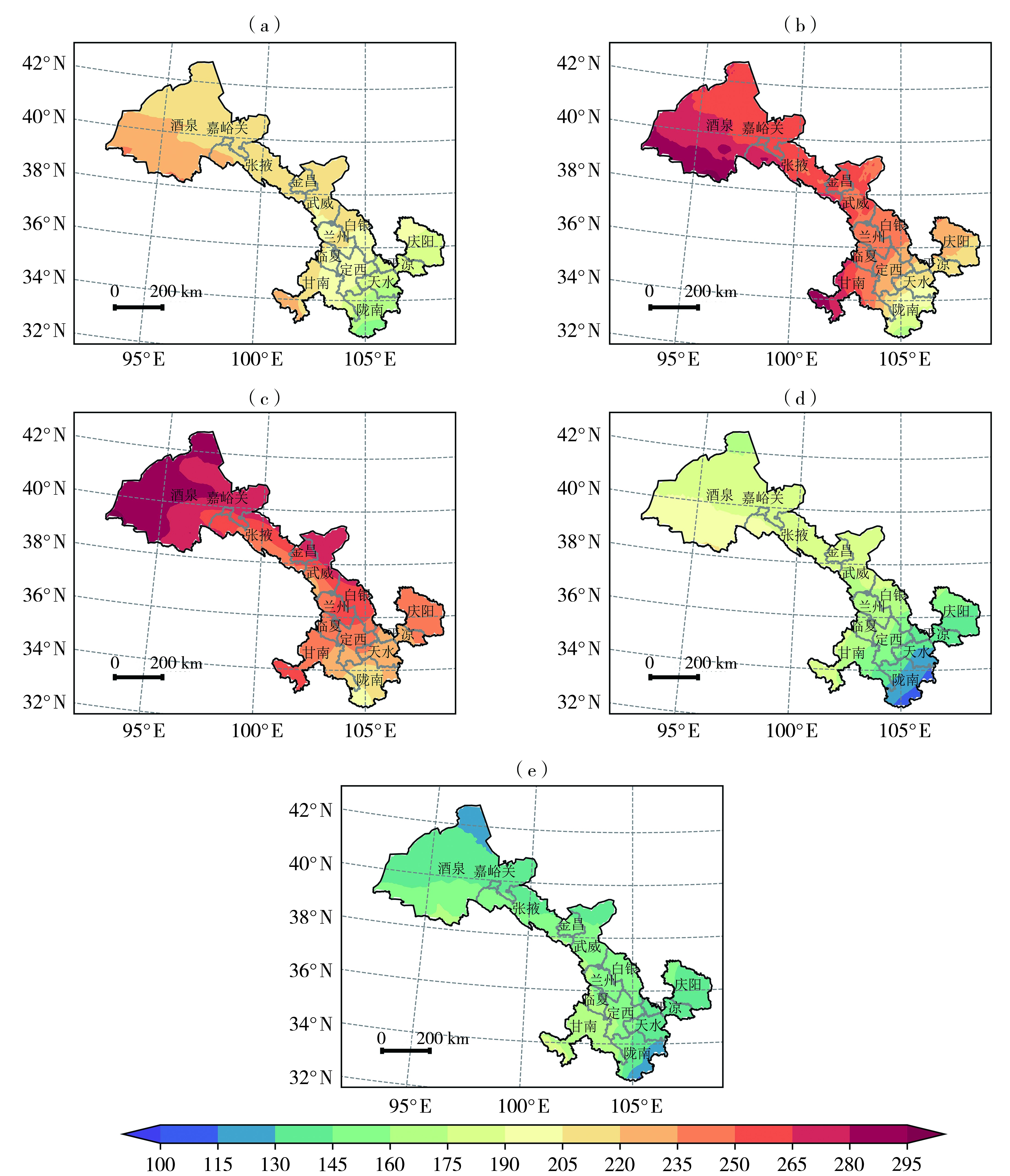
图8 2000—2024年甘肃省全年及不同季节平均的地表下行太阳辐射空间分布(单位:W·m-2) (a)全年,(b)春季,(c)夏季,(d)秋季,(e)冬季
Fig.8 Spatial distribution of annual and seasonal mean surface downward solar radiation in Gansu Province during 2000-2024 (Unit: W·m-2) (a) annual,(b) spring,(c) summer,(d) autumn,(e) winter
图8 2000—2024年甘肃省全年及不同季节平均的地表下行太阳辐射空间分布(单位:W·m-2) (a)全年,(b)春季,(c)夏季,(d)秋季,(e)冬季
Fig.8 Spatial distribution of annual and seasonal mean surface downward solar radiation in Gansu Province during 2000-2024 (Unit: W·m-2) (a) annual,(b) spring,(c) summer,(d) autumn,(e) winter
表1 2000—2024年甘肃省各市(州)全年及不同季节地表下行太阳总辐射量单位:kWh·m-2
Tab.1 The surface downward total solar radiation in each city (prefecture) of Gansu Province in whole year and different seasons during 2000-2024
| 市(州) | 春季 | 夏季 | 秋季 | 冬季 | 全年 |
|---|---|---|---|---|---|
| 嘉峪关市 | 530.86 | 555.83 | 374.93 | 284.03 | 1 745.65 |
| 金昌市 | 524.35 | 555.25 | 376.99 | 306.91 | 1 763.50 |
| 临夏回族自治州 | 511.13 | 518.52 | 338.51 | 334.59 | 1 702.75 |
| 白银市 | 499.43 | 542.63 | 343.37 | 309.58 | 1 695.01 |
| 庆阳市 | 464.68 | 508.55 | 297.32 | 292.76 | 1 563.31 |
| 兰州市 | 507.33 | 526.08 | 345.87 | 324.13 | 1 703.41 |
| 天水市 | 433.09 | 479.82 | 267.35 | 289.55 | 1 469.81 |
| 平凉市 | 452.73 | 489.65 | 278.09 | 291.37 | 1 511.84 |
| 陇南市 | 398.67 | 449.72 | 249.65 | 281.17 | 1 379.21 |
| 定西市 | 481.20 | 504.87 | 316.65 | 322.11 | 1 624.83 |
| 酒泉市 | 562.73 | 592.70 | 384.13 | 288.88 | 1 828.44 |
| 张掖市 | 542.64 | 535.29 | 381.44 | 307.50 | 1 766.87 |
| 武威市 | 523.34 | 550.84 | 370.08 | 307.49 | 1 751.75 |
| 甘南藏族自治州 | 537.07 | 506.06 | 337.43 | 347.40 | 1 727.96 |
表1 2000—2024年甘肃省各市(州)全年及不同季节地表下行太阳总辐射量单位:kWh·m-2
Tab.1 The surface downward total solar radiation in each city (prefecture) of Gansu Province in whole year and different seasons during 2000-2024
| 市(州) | 春季 | 夏季 | 秋季 | 冬季 | 全年 |
|---|---|---|---|---|---|
| 嘉峪关市 | 530.86 | 555.83 | 374.93 | 284.03 | 1 745.65 |
| 金昌市 | 524.35 | 555.25 | 376.99 | 306.91 | 1 763.50 |
| 临夏回族自治州 | 511.13 | 518.52 | 338.51 | 334.59 | 1 702.75 |
| 白银市 | 499.43 | 542.63 | 343.37 | 309.58 | 1 695.01 |
| 庆阳市 | 464.68 | 508.55 | 297.32 | 292.76 | 1 563.31 |
| 兰州市 | 507.33 | 526.08 | 345.87 | 324.13 | 1 703.41 |
| 天水市 | 433.09 | 479.82 | 267.35 | 289.55 | 1 469.81 |
| 平凉市 | 452.73 | 489.65 | 278.09 | 291.37 | 1 511.84 |
| 陇南市 | 398.67 | 449.72 | 249.65 | 281.17 | 1 379.21 |
| 定西市 | 481.20 | 504.87 | 316.65 | 322.11 | 1 624.83 |
| 酒泉市 | 562.73 | 592.70 | 384.13 | 288.88 | 1 828.44 |
| 张掖市 | 542.64 | 535.29 | 381.44 | 307.50 | 1 766.87 |
| 武威市 | 523.34 | 550.84 | 370.08 | 307.49 | 1 751.75 |
| 甘南藏族自治州 | 537.07 | 506.06 | 337.43 | 347.40 | 1 727.96 |
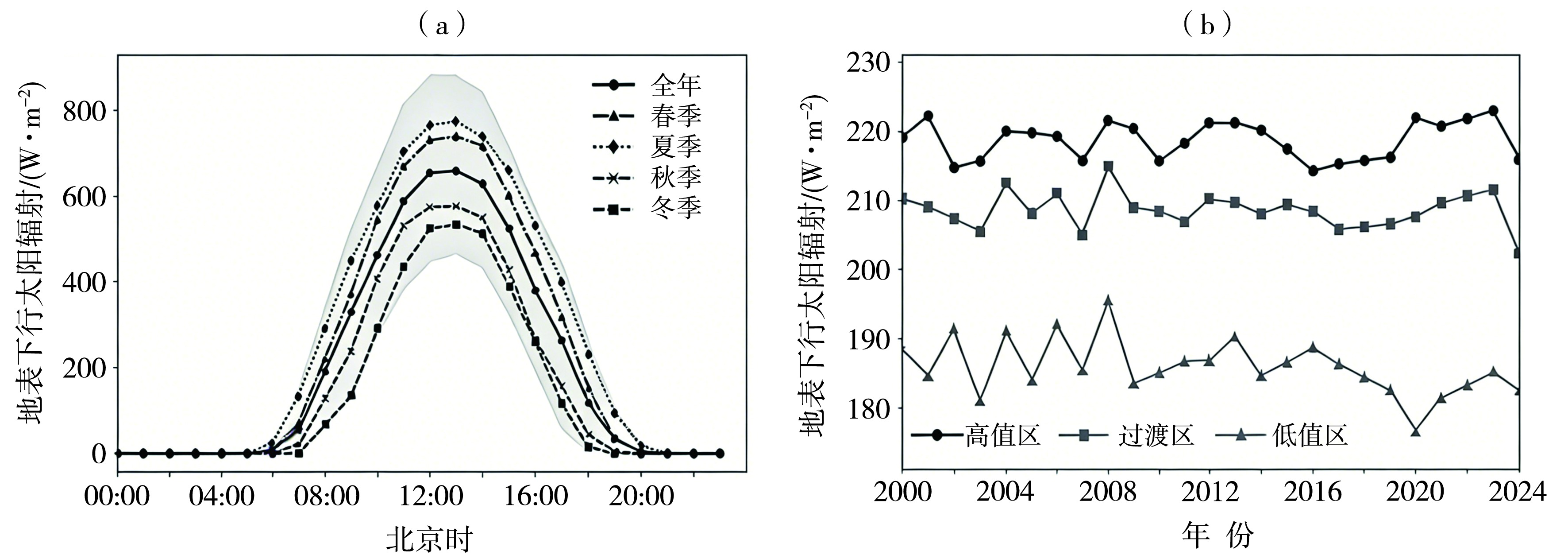
图9 2000—2024年甘肃省地表下行太阳辐射日变化(a)和年际变化(b) (灰色阴影部分为全部数据的上下四分位数区间)
Fig.9 Diurnal variation (a) and inter-annual variation (b) of surface downward solar radiation in Gansu during 2000-2024 (The gray shaded areas represent the interquartile range of the full dataset)
图9 2000—2024年甘肃省地表下行太阳辐射日变化(a)和年际变化(b) (灰色阴影部分为全部数据的上下四分位数区间)
Fig.9 Diurnal variation (a) and inter-annual variation (b) of surface downward solar radiation in Gansu during 2000-2024 (The gray shaded areas represent the interquartile range of the full dataset)
| [1] | 陈虹杏, 靳奎峰, 赵玮, 2025. 基于地面常规气象观测数据的ERA5地面向下太阳总辐照度的订正技术[J]. 沙漠与绿洲气象, 19(2): 92-99. |
| [2] |
顾婷婷, 潘娅英, 张加易, 2022. 浙江省中尺度数值预报系统的地表太阳辐射预报订正方法[J]. 干旱气象, 40(2): 327-332.
DOI |
| [3] |
韩自奋, 颜鹏程, 李扬, 等, 2022. 基于短期历史资料的河西地区太阳辐射预报订正研究[J]. 干旱气象, 40(1): 125-134.
DOI |
| [4] | 胡斯勒图, 马润, 2022. 东亚—太平洋地表光合有效辐射、紫外辐射、短波辐射数据集(2016—2020)[DS]. 国家青藏高原科学数据中. https://cstr.cn/18406.11.Atmos.tpdc.272820. |
| [5] | 黄春林, 2024. 基于国产卫星数据的太阳能资源自主评估及短临预报技术研究[D]. 哈尔滨: 哈尔滨工业大学. |
| [6] | 黄家敏, 2015. 基于卫星遥感的新疆地面太阳辐射的时空变化分析[D]. 上海: 东华大学. |
| [7] | 焦铂洋, 苏昱丞, 李庆祥, 2025. 地表太阳辐射数据及长期变化[J]. 气象学报, 83(4):1 026-1 042. |
| [8] |
李净, 温松楠, 2020. 基于3种机器学习法的太阳辐射模拟研究[J]. 遥感技术与应用, 35(3): 615-622.
DOI |
| [9] | 李晓文, 李维亮, 周秀骥, 1998. 中国近30年太阳辐射状况研究[J]. 应用气象学报, 9(1): 24-31. |
| [10] | 刘佳, 何清, 刘蕊, 等, 2008. 新疆太阳辐射特征及其太阳能资源状况[J]. 干旱气象, 26(4): 61-66. |
| [11] | 刘丽莹, 郑峰, 张国玉, 等, 2018. 基于精密太阳光谱辐射计的气象辐射观测[J]. 光谱学与光谱分析, 38(12):3 663-3 672. |
| [12] | 刘孝敏, 刘叶瑞, 谢伟雪, 等, 2012. 甘肃省太阳能资源特征及光热应用潜力分析[J]. 安徽农业科学, 40(27):13529-13 530. |
| [13] | 彭晓敏, 2019. 全球太阳辐射再分析产品误差及影响因子分析[D]. 南京: 南京大学. |
| [14] | 石广玉, 王标, 张华, 等, 2008. 大气气溶胶的辐射与气候效应[J]. 大气科学, 32(4): 826-840. |
| [15] | 汪治, 张福贵, 2025. 基于风云四号气象卫星数据的太阳能光伏发电预测研究[J]. 电子元器件与信息技术, 9(3): 12-14. |
| [16] | 王博, 李玲萍, 夏权, 等, 2023. 河西走廊太阳辐射时空分布特征及太阳能资源评估研究[J]. 沙漠与绿洲气象, 17(6): 147-153. |
| [17] |
王传辉, 申彦波, 姚锦烽, 等, 2022. 3种再分析资料在太阳能资源评估中的适用性[J]. 太阳能学报, 43(8): 164-173.
DOI |
| [18] | 王丹, 盛立芳, 石广玉, 等, 2012. 中国地表太阳辐射再分析数据与观测的比较[J]. 应用气象学报, 23(6): 729-738. |
| [19] | 王雪洁, 施国萍, 周子钦, 等, 2022. 基于随机森林算法对ERA5太阳辐射产品的订正[J]. 自然资源遥感, 34(2): 105-111. |
| [20] | 杨帆, 罗敬, 张东海, 等, 2024. FY-4A辐射产品在贵州山区的检验与订正[J]. 沙漠与绿洲气象, 18(1): 134-140. |
| [21] |
姚玉璧, 郑绍忠, 杨扬, 等, 2022. 中国太阳能资源评估及其利用效率研究进展与展望[J]. 太阳能学报, 43(10): 524-535.
DOI |
| [22] | 张俊兵, 2019. CLDAS2.0长序列辐射驱动数据研制与分析评估[D]. 南京: 南京信息工程大学. |
| [23] |
张星星, 吕宁, 姚凌, 等, 2018. ECMWF地表太阳辐射数据在我国的误差及成因分析[J]. 地球信息科学学报, 20(2): 254-267.
DOI |
| [24] | 中国气象局风能太阳能中心, 2024. 2023年中国风能太阳能资源年景公报[EB/OL]. (2024-02-22)[2026-01-27]. https://www.cma.gov.cn/zfxxgk/gknr/qxbg/202402/t20240222_6082082.html. |
| [25] | AJITH M, MARTÍNEZ-RAMÓN M, 2023. Deep learning algorithms for very short term solar irradiance forecasting: A survey[J]. Renewable and Sustainable Energy Reviews, 182: 113362. DOI:10.1016/j.rser.2023.113362. |
| [26] | CAO Q M, LIU Y, SUN X, et al, 2022. Country-level evaluation of solar radiation data sets using ground measurements in China[J]. Energy, 241: 122938. DOI:10.1016/j.energy.2021.122938. |
| [27] |
HERSBACH H, BELL B, BERRISFORD P, et al, 2020. The ERA5 global reanalysis[J]. Quarterly Journal of the Royal Meteorological Society, 146(730):1 999-2 049.
DOI URL |
| [28] | KE G, MENG Q, FINLEY T, et al, 2017. LightGBM: A highly efficient gradient boosting decision tree[C]// Advances in Neural Information Processing Systems (NeurIPS 2017), LongBeach, CA, USA. |
| [29] |
MA R, LETU H, YANG K, et al, 2020. Estimation of surface shortwave radiation from himawari-8 satellite data based on a combination of radiative transfer and deep neural network[J]. IEEE Transactions on Geoscience and Remote Sensing, 58(8):5 304-5 316.
DOI URL |
| [30] | MACHADO M R, KARRAY S, DE SOUSA I T, 2019. LightGBM: An effective decision tree gradient boosting method to predict customer loyalty in the finance industry[C]// 2019 14th International Conference on Computer Science & Education (ICCSE), Toronto, ON, Canada:1 111-1 116. |
| [31] | MUSLEH Y J K, RAHMAN T, 2024. Predictive models for photosynthetic active radiation irradiance in temperate climates[J]. Renewable and Sustainable Energy Reviews, 200: 114599. DOI:10.1016/j.rser.2024.114599. |
| [32] | SHAO C K, YANG K, JIANG Y Z, et al, 2024. Data augmentation-based estimation of solar radiation components without referring to local ground truth in China[J]. Journal of Remote Sensing, 4: 0111. DOI:10.34133/remotesensing.0111. |
| [33] | SHAO C K, YANG K, TANG W J, et al, 2022. Convolutional neural network-based homogenization for constructing a long-term global surface solar radiation dataset[J]. Renewable and Sustainable Energy Reviews, 169: 112952. DOI:10.1016/j.rser.2022.112952. |
| [34] | SHI C, LETU H, NAKAJIMA T Y, et al, 2025. Near-global monitoring of surface solar radiation through the construction of a geostationary satellite network observation system[J]. The Innovation, 6(5): 100876. DOI:10.1016/j.xinn.2025.100876. |
| [35] | VANLALCHHUANAWMI C, USTUN T S, 2025. Solar radiation prediction: A multi-model machine learning and deep learning approach[J]. AIP Advances, 15(5): 055201. DOI:10.1063/5.0237246. |
| [36] | WEYLL A L C, KITAGAWA Y K L, ARAUJO M L S, et al, 2024. Medium-term forecasting of global horizontal solar radiation in Brazil using machine learning-based methods[J]. Energy, 300: 131549.DOI:10.1016/j.energy.2024.131549. |
| [1] | 尹晔, 张慧, 王汉涛, 宋云帆. 基于卫星遥感数据的青藏高原东部积雪覆盖时空变化分析[J]. 干旱气象, 2026, 44(1): 56-70. |
| [2] | 李晓玥, 文军, 陈怡璇, 王卓元, 钟学敏. 基于多种模型的黄河源区径流模拟及预估研究[J]. 干旱气象, 2026, 44(1): 84-94. |
| [3] | 崔慧慧, 李荣, 孙存永. 郑州短时强降水精细时空分布特征及地形影响[J]. 干旱气象, 2025, 43(6): 920-930. |
| [4] | 袁瑞瑞, 王坤, 高睿娜. FY-4A云覆盖率产品在宁夏的检验评估及订正[J]. 干旱气象, 2025, 43(5): 799-809. |
| [5] | 刘宗瑞, 万紫悦, 赵宇瀚, 刘卫平, 王若安, 马玉霞. 基于机器学习的环流分型与甘肃大气污染机制研究[J]. 干旱气象, 2025, 43(4): 563-575. |
| [6] | 任至涵, 倪长健, 石荞语, 陈宁. 基于最优概率分布函数的成都市近63 a干旱特征分析[J]. 干旱气象, 2024, 42(6): 844-853. |
| [7] | 王雅君, 罗菊英, 程烈海, 李伟. 基于机器学习的湖北省夏季干旱预测模型构建与检验[J]. 干旱气象, 2024, 42(5): 661-670. |
| [8] | 王玥彤, 何东坡, 李忠燕, 王烁, 陈早阳. 贵州省两次气象干旱对比分析及基于机器学习的干旱预测模型建立[J]. 干旱气象, 2024, 42(5): 671-682. |
| [9] | 苏宏梅, 张楠, 冉新民, 康超. 干旱半干旱区中小流域洪水机器学习预警模型及其应用[J]. 干旱气象, 2024, 42(5): 683-693. |
| [10] | 鲍丽丽, 程鹏, 王小勇, 何金梅, 闫昕旸, 尹春, 李晓琴, 赵文婧. 基于Logistic回归和神经网络的甘肃省道路结冰预警模型研究[J]. 干旱气象, 2024, 42(1): 137-145. |
| [11] | 唐永兰, 徐桂荣, 王晓芳, 肖艳姣, 祁海霞, 冷亮. 1992—2021年三峡库区夏季小时强降水时空分布特征[J]. 干旱气象, 2023, 41(4): 589-598. |
| [12] | 把黎, 奚立宗, 蔡迪花, 庞朝云, 张鑫海, 尹春. 基于微波辐射计资料的祁连山东段大气水汽和液态水时空变化特征[J]. 干旱气象, 2023, 41(1): 64-72. |
| [13] | 冯良敏, 周秋雪, 曹萍萍, 王佳津. 四川地区气温转折过程2 m温度变化订正研究[J]. 干旱气象, 2023, 41(1): 164-172. |
| [14] | 杨丽杰, 曹彦超, 刘维成, 徐丽丽, 张洪芬, 孙子茱. 陇东黄土高原旱区短时强降水的时空分布特征及地形影响研究[J]. 干旱气象, 2022, 40(6): 945-953. |
| [15] | 罗喜平, 廖波, 张小娟, 崔蕾, 罗雄. 1961—2020年贵州冰雹气候特征[J]. 干旱气象, 2022, 40(6): 1024-1032. |
| 阅读次数 | ||||||
|
全文 |
|
|||||
|
摘要 |
|
|||||
