Journal of Arid Meteorology ›› 2026, Vol. 44 ›› Issue (1): 115-125.DOI: 10.11755/j.issn.1006-7639-2026-01-0115
• Articles • Previous Articles Next Articles
Causes analysis of an extreme warm-sector rainstorm in Beijing-Tianjin-Hebei region
DONG Qiru1,2( ), WANG Ying3, LI Yinghua1(), YANG Xu4, LIANG Kangzhuang1
- 1. Tianjin Key Laboratory for Oceanic Meteorology,Tianjin Institute of Meteorological Science,Tianjin 300074,China
2. China Meteorological Administration Hydro-Meteorology Key Laboratory,Beijing 100081,China
3. Tianjin Meteorological Observatory,Tianjin 300074,China
4. Tianjin Environmental Meteorological Center,Tianjin 300074,China
-
Received:2025-04-27Revised:2025-05-28Online:2026-02-28Published:2026-03-25
京津冀地区一次极端暖区暴雨成因分析
董琪如1,2(), 王莹3, 李英华1(), 杨旭4, 梁康壮1
- 1.天津市海洋气象重点实验室,天津市气象科学研究所,天津 300074
2.中国气象局水文气象重点开放实验室,北京 100081
3.天津市气象台,天津 300074
4.天津市环境气象中心,天津 300074
-
通讯作者:李英华 -
作者简介:董琪如(1992—),女,高级工程师,主要从事资料同化技术及灾害性天气分析研究。E-mail: dongqiru77@163.com。 -
基金资助:灾害天气科学与技术全国重点实验室开放课题(2025KFA19);天津市科技重大专项(25ZXSFSN00060);中国气象局水文气象重点开放实验室开放研究课题(23SWQXM004);海河流域气象科技创新项目(HHXM-TD202504);天津市海洋气象重点实验室开放基金项目(2023TKLOM02);湖南省气象局创新发展专项(CXFZ2025-MSXM68)

CLC Number:
Cite this article
DONG Qiru, WANG Ying, LI Yinghua, YANG Xu, LIANG Kangzhuang. Causes analysis of an extreme warm-sector rainstorm in Beijing-Tianjin-Hebei region[J]. Journal of Arid Meteorology, 2026, 44(1): 115-125.
董琪如, 王莹, 李英华, 杨旭, 梁康壮. 京津冀地区一次极端暖区暴雨成因分析[J]. 干旱气象, 2026, 44(1): 115-125.
share this article
Add to citation manager EndNote|Ris|BibTeX
URL: http://www.ghqx.org.cn/EN/10.11755/j.issn.1006-7639-2026-01-0115
Tab.1 Main parameterization schemes of the model
| 物理方案 | 选项设置 |
|---|---|
| 微物理方案 | 新Tompson |
| 近地面方案 | MM5相似理论 |
| 陆面方案 | Noah |
| 行星边界层方案 | ACM2 PBL |
| 积云参数化方案 | Kain-Fritsch(d02区无) |
| 长波辐射方案 | RRTM |
| 短波辐射方案 | Dudhia |
Tab.1 Main parameterization schemes of the model
| 物理方案 | 选项设置 |
|---|---|
| 微物理方案 | 新Tompson |
| 近地面方案 | MM5相似理论 |
| 陆面方案 | Noah |
| 行星边界层方案 | ACM2 PBL |
| 积云参数化方案 | Kain-Fritsch(d02区无) |
| 长波辐射方案 | RRTM |
| 短波辐射方案 | Dudhia |
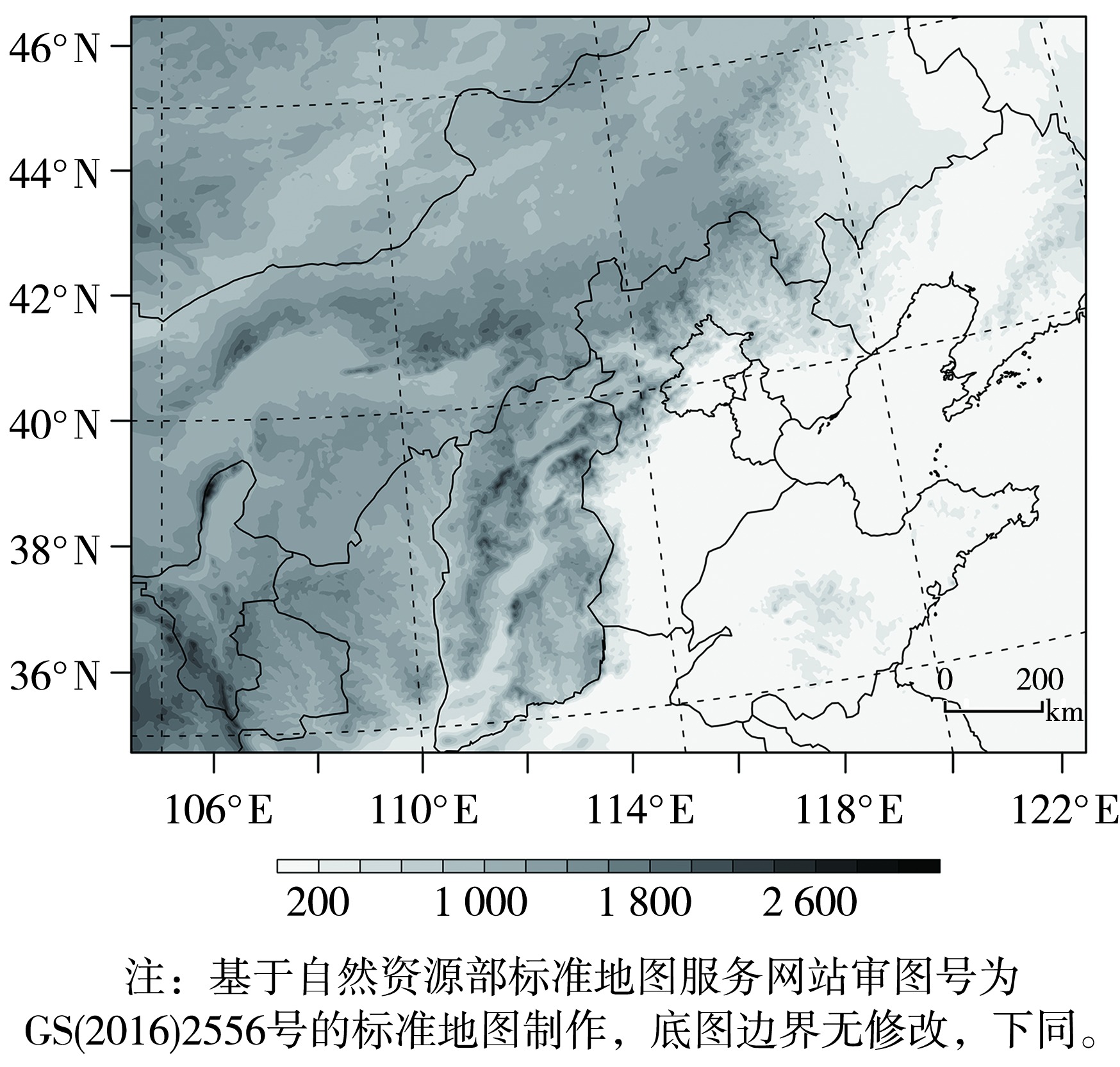
Fig.1 The 3 km inner forecast area of rapid update assimilation system (The shaded for terrain height,Unit: m)
Fig.1 The 3 km inner forecast area of rapid update assimilation system (The shaded for terrain height,Unit: m)
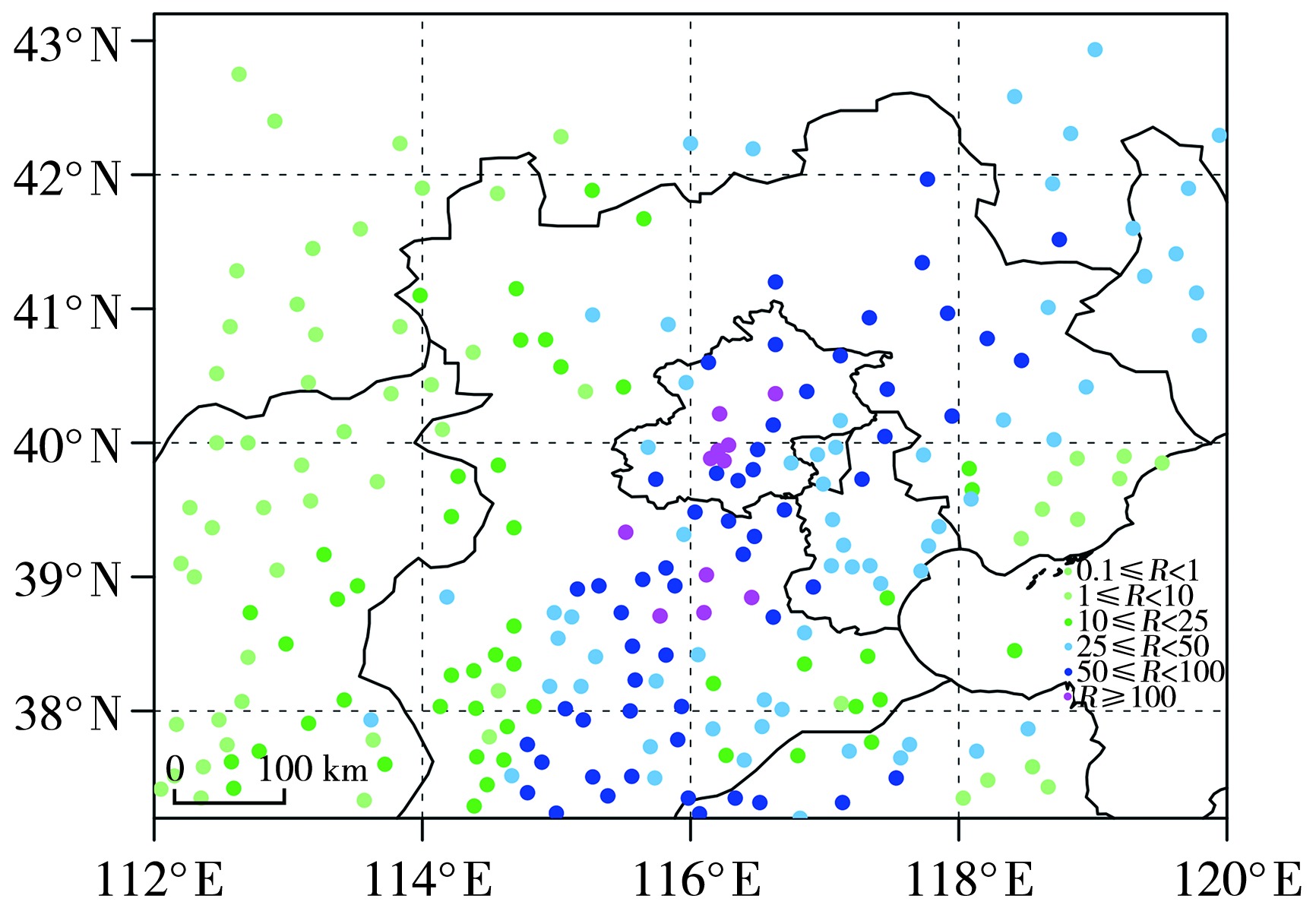
Fig.2 The 24 h accumulative precipitation (R) from 00:00 August 12 to 00:00 August 13,2020 (Unit: mm)
Fig.2 The 24 h accumulative precipitation (R) from 00:00 August 12 to 00:00 August 13,2020 (Unit: mm)
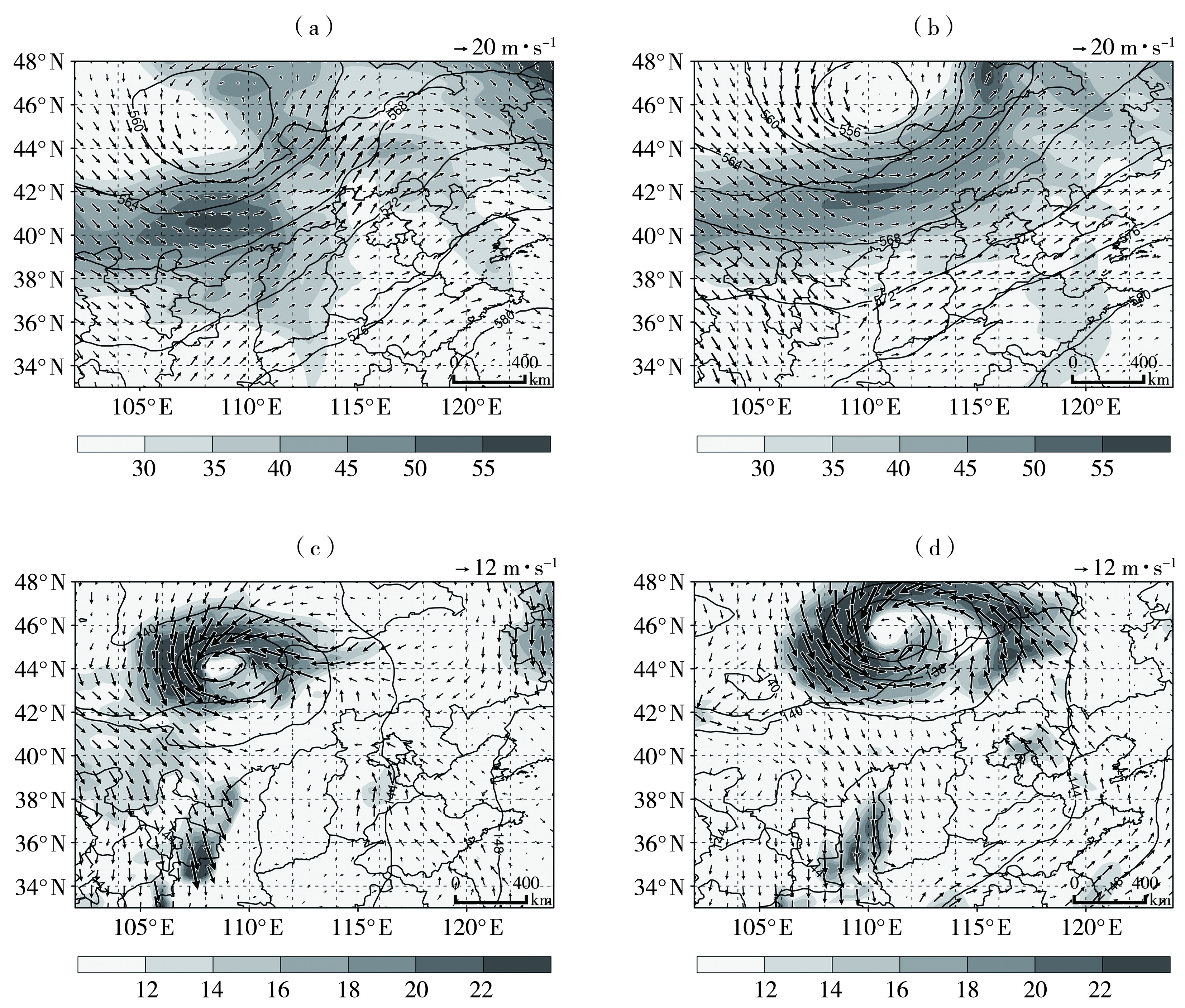
Fig.3 The 500 hPa geopotential height (contour lines,Unit: dagpm),wind field (arrow vectors,Unit: m·s-1) and 200 hPa high-level jet (the shaded,Unit: m·s-1)(a,b),and 850 hPa geopotential height (contour lines,Unit: dagpm),wind field (arrow vectors,Unit: m·s-1),and low-level jet ( the shaded,Unit: m·s-1)(c,d) at 06:00 (a,c) and 15:00 (b,d) August 12,2020
Fig.3 The 500 hPa geopotential height (contour lines,Unit: dagpm),wind field (arrow vectors,Unit: m·s-1) and 200 hPa high-level jet (the shaded,Unit: m·s-1)(a,b),and 850 hPa geopotential height (contour lines,Unit: dagpm),wind field (arrow vectors,Unit: m·s-1),and low-level jet ( the shaded,Unit: m·s-1)(c,d) at 06:00 (a,c) and 15:00 (b,d) August 12,2020
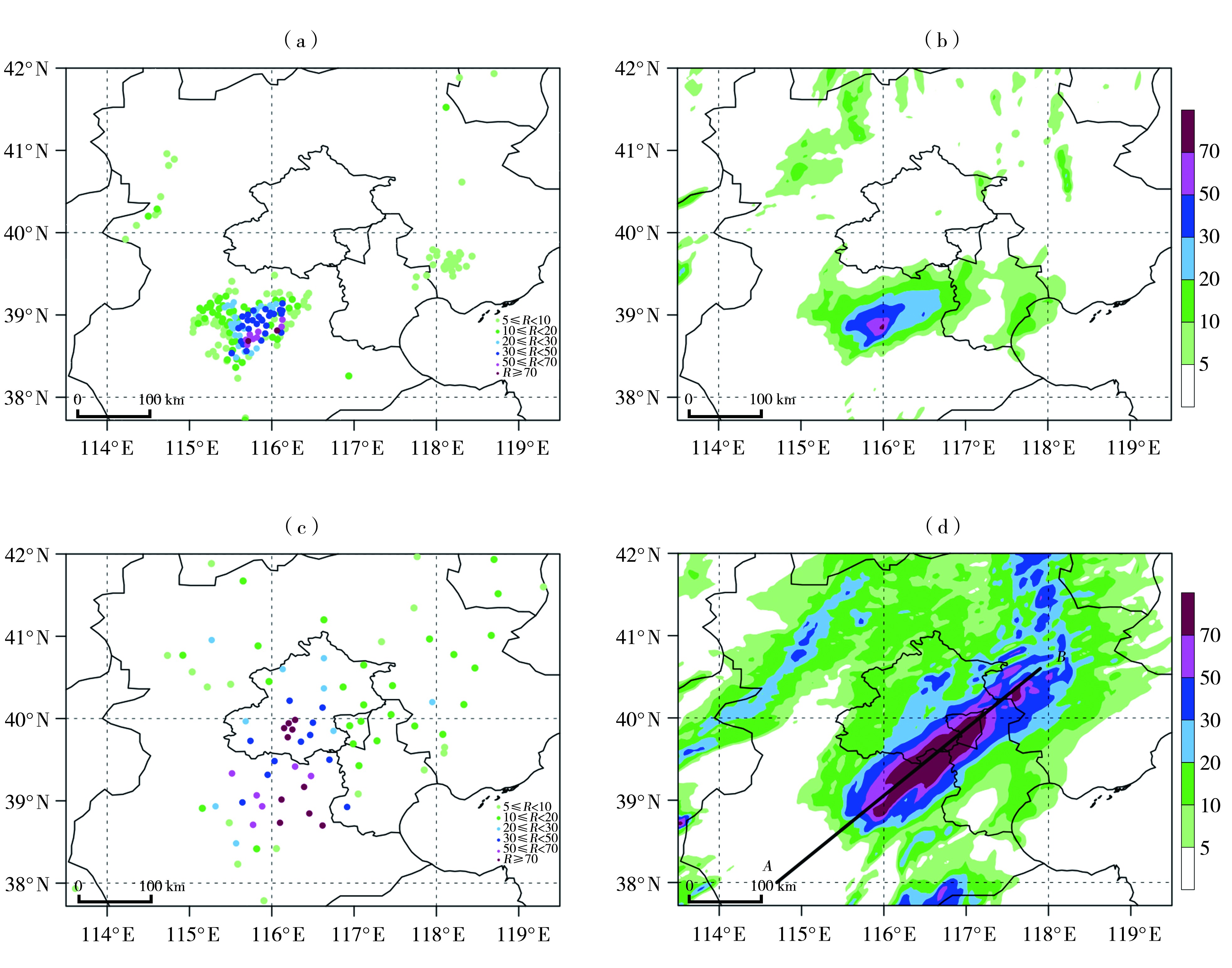
Fig.4 Distribution of observed (a,c) and simulated (b,d) accumulated precipitation at 10:00 (1 hour)(a,b) and from 09:00 to 15:00 (6 hours)(c,d) August 12,2020 (Unit: mm) (The AB line denotes the core region of the 6-hour accumulated precipitation maximum along the orientation of the rainfall belt)
Fig.4 Distribution of observed (a,c) and simulated (b,d) accumulated precipitation at 10:00 (1 hour)(a,b) and from 09:00 to 15:00 (6 hours)(c,d) August 12,2020 (Unit: mm) (The AB line denotes the core region of the 6-hour accumulated precipitation maximum along the orientation of the rainfall belt)
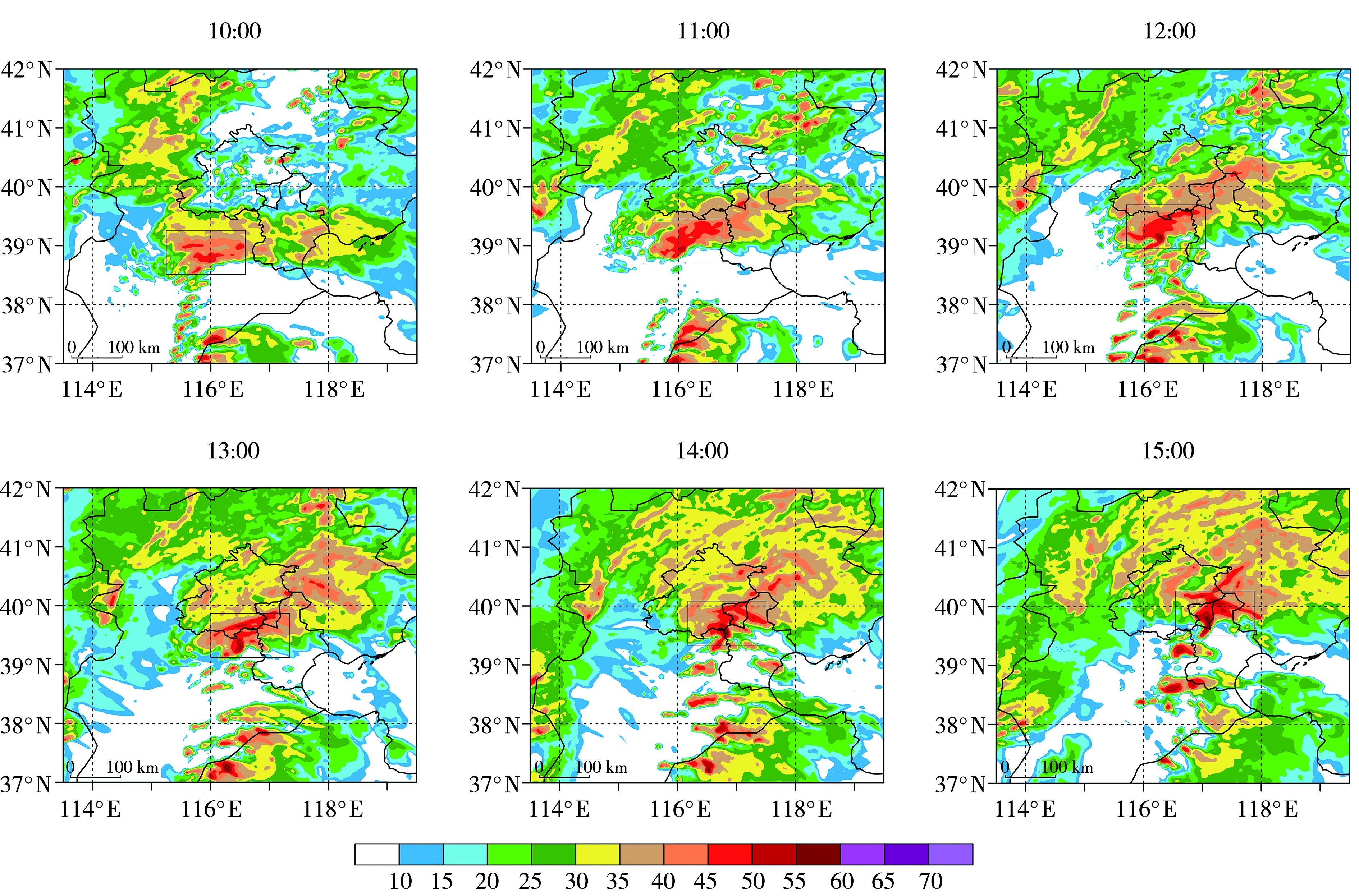
Fig.5 Simulated maximum radar reflectivity (Unit: dBz) at different forecasting time from 10:00 to 15:00 on August 12,2020 (The black box represents the mesoscale convective system that influenced the rainstorm)
Fig.5 Simulated maximum radar reflectivity (Unit: dBz) at different forecasting time from 10:00 to 15:00 on August 12,2020 (The black box represents the mesoscale convective system that influenced the rainstorm)
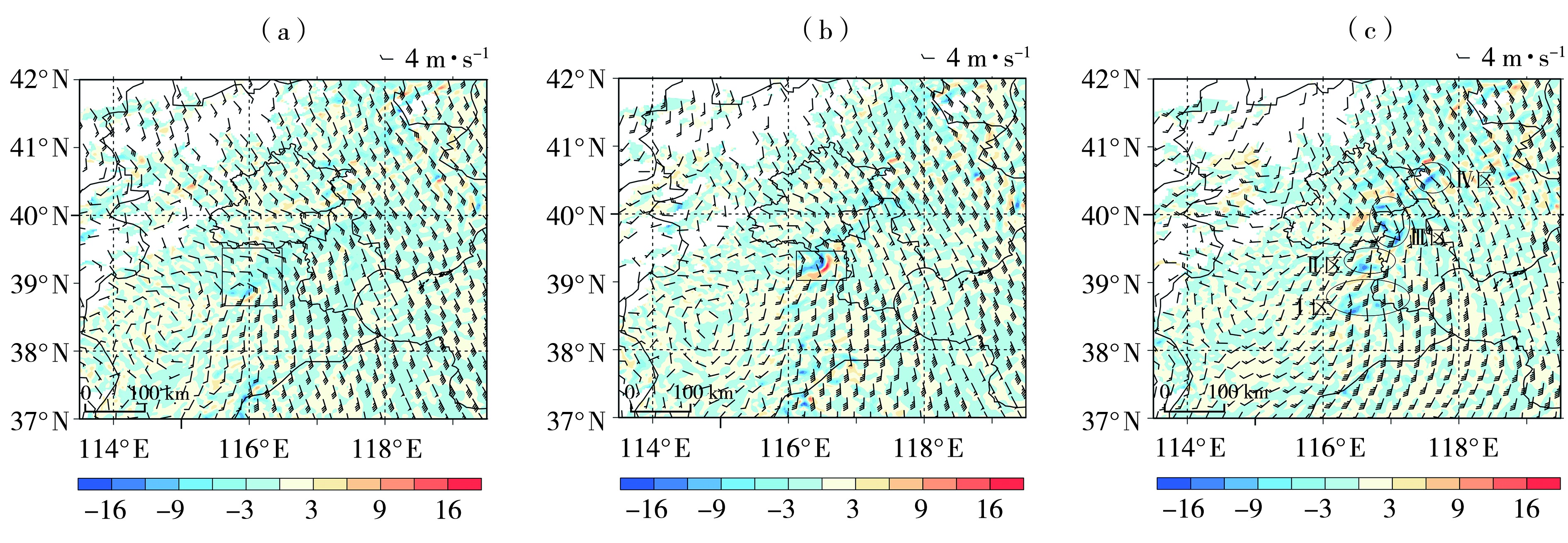
Fig.6 The simulated 850 hPa wind field (wind vectors,Unit: m·s-1) and divergence (the color shaded,Unit: 10-4 s-1) at 11:00 (a),13:00 (b),15:00 (c) on August 12,2020 (The black box indicates the area of strong convergence,and the ellipses represent the convergence point of the wind field)
Fig.6 The simulated 850 hPa wind field (wind vectors,Unit: m·s-1) and divergence (the color shaded,Unit: 10-4 s-1) at 11:00 (a),13:00 (b),15:00 (c) on August 12,2020 (The black box indicates the area of strong convergence,and the ellipses represent the convergence point of the wind field)
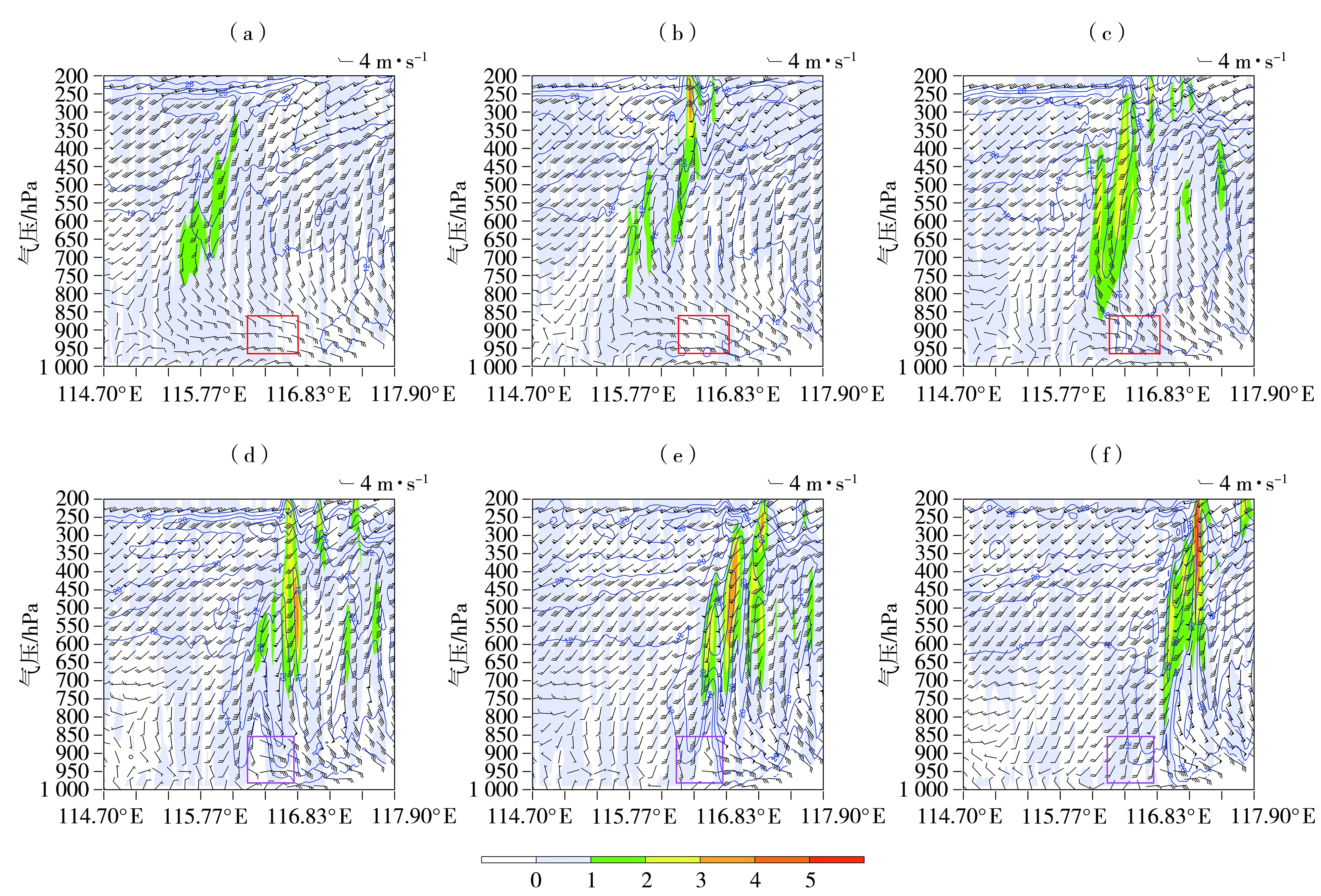
Fig.7 The simulated vertical cross sections of wind vectors (wind vectors,Unit: m·s-1),vertical velocity (the color shaded,Unit: m·s-1) and wind velocity (isolines,Unit: m·s-1) along the AB line of the Fig.4(d) from 10:00 to 15:00 on August 12,2020 (a)10:00,(b)11:00,(c)12:00,(d)13:00,(e)14:00,(f)15:00 (The red box indicates the area where the low-level easterly wind is gradually strengthening,and the purple box indicates the intensity pulsation zone of the low-level jet)
Fig.7 The simulated vertical cross sections of wind vectors (wind vectors,Unit: m·s-1),vertical velocity (the color shaded,Unit: m·s-1) and wind velocity (isolines,Unit: m·s-1) along the AB line of the Fig.4(d) from 10:00 to 15:00 on August 12,2020 (a)10:00,(b)11:00,(c)12:00,(d)13:00,(e)14:00,(f)15:00 (The red box indicates the area where the low-level easterly wind is gradually strengthening,and the purple box indicates the intensity pulsation zone of the low-level jet)
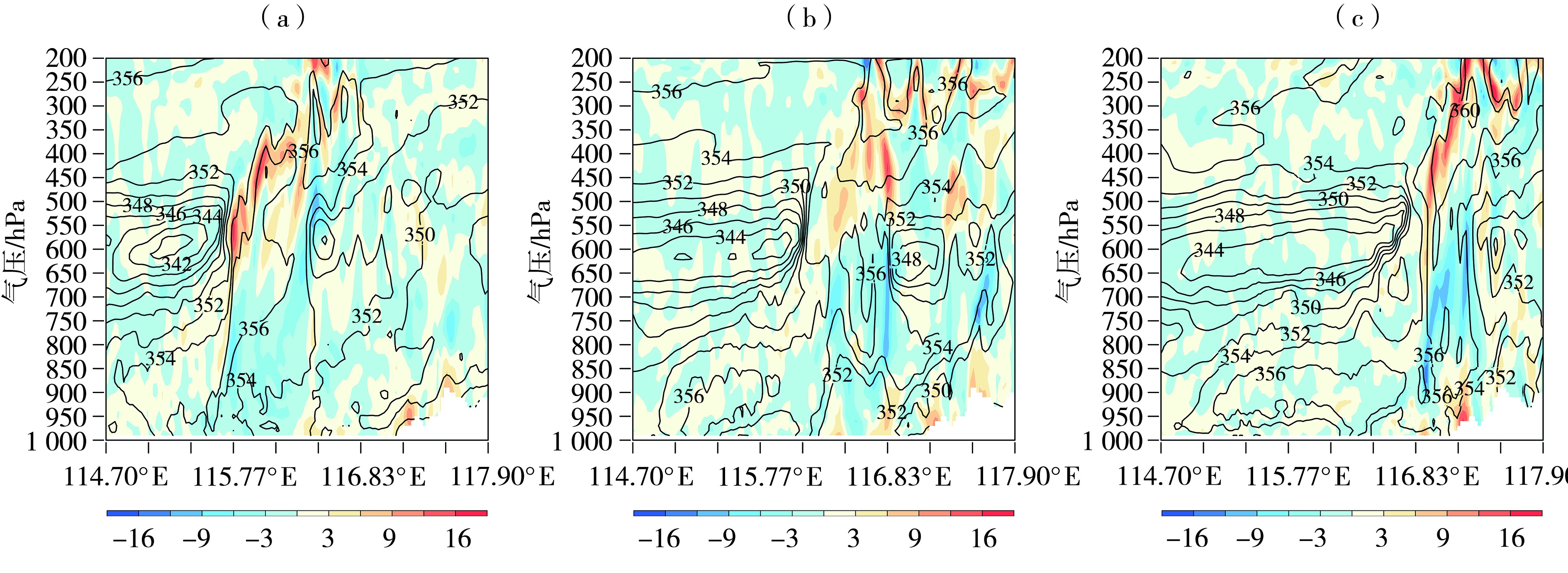
Fig.8 The simulated vertical cross sections of potential pseudo-equivalent temperature (isolines,Unit: K) and divergence (the color shaded,Unit: 10-4s-1) along the AB line of the Fig.4(d) at 11:00 (a),13:00 (b),15:00 (c) on August 12,2020
Fig.8 The simulated vertical cross sections of potential pseudo-equivalent temperature (isolines,Unit: K) and divergence (the color shaded,Unit: 10-4s-1) along the AB line of the Fig.4(d) at 11:00 (a),13:00 (b),15:00 (c) on August 12,2020
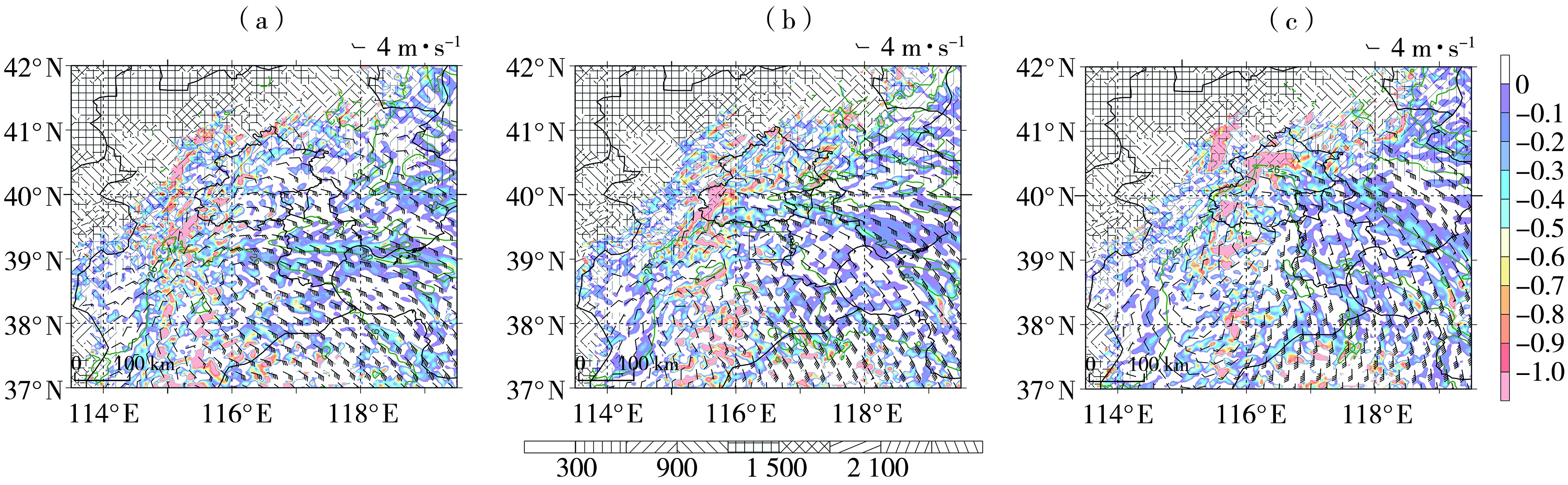
Fig.9 The simulated water vapour fux divergence (the color shaded,Unit: 10-6 g·cm-2·hPa-1·s-1),wind field (wind vectors,Unit: m·s-1),specific humidity (green isolines,Unit: g·kg-1) and terrain height (the area filled with line segments,Unit: m) at 950 hPa at 11:00 (a),13:00 (b),15:00 (c) on August 12,2020 (The black box denotes the region of intense water vapor convergence)
Fig.9 The simulated water vapour fux divergence (the color shaded,Unit: 10-6 g·cm-2·hPa-1·s-1),wind field (wind vectors,Unit: m·s-1),specific humidity (green isolines,Unit: g·kg-1) and terrain height (the area filled with line segments,Unit: m) at 950 hPa at 11:00 (a),13:00 (b),15:00 (c) on August 12,2020 (The black box denotes the region of intense water vapor convergence)
| [1] | 谌芸, 陈涛, 汪玲瑶, 等, 2019. 中国暖区暴雨的研究进展[J]. 暴雨灾害, 38(5): 483-493. |
| [2] | 谌芸, 吕伟绮, 于超, 等, 2018. 北方一次暖区大暴雨降水预报失败案例剖析[J]. 气象, 44(1): 15-25. |
| [3] | 谌芸, 孙军, 徐珺, 等, 2012. 北京721特大暴雨极端性分析及思考(一)观测分析及思考[J]. 气象, 38(10):1 255-1 266. |
| [4] | 段伯隆, 张文龙, 刘海文, 等, 2017. 北京“7·21”特大暴雨过程暖区降水和锋面降水的时空分布特征[J]. 暴雨灾害, 36(2): 108-117. |
| [5] | 段宇辉, 孙云, 刘昊野, 等, 2025. 一次华北暖区暴雨的边界层环境条件分析[J]. 暴雨灾害, 44(2): 156-166. |
| [6] | 高守亭, 周玉淑, 冉令坤, 2018. 我国暴雨形成机理及预报方法研究进展[J]. 大气科学, 42(4): 833-846. |
| [7] | 何立富, 陈涛, 孔期, 2016. 华南暖区暴雨研究进展[J]. 应用气象学报, 27(5): 559-569. |
| [8] | 黄美金, 俞小鼎, 林文, 等, 2022. 福建沿海冷锋前暖区和季风槽大暴雨环境背景与对流系统特征[J]. 气象, 48(5): 605-617. |
| [9] | 黄士松, 1986. 华南前汛期暴雨[M]. 广州: 广东科技出版社:9-10. |
| [10] | 雷蕾, 邢楠, 周璇, 等, 2020. 2018年北京“7·16”暖区特大暴雨特征及形成机制研究[J]. 气象学报, 78(1): 1-17. |
| [11] | 李向红, 庞传伟, 梁维亮, 等, 2015. 孟加拉湾旺盛对流作为广西连续暴雨的前兆信号特征分析[J]. 气象, 41(11):1 383-1 389. |
| [12] | 祁璇, 平凡, 沈新勇, 2021. 云微物理对一次吉林暖区降水过程的影响[J]. 大气科学, 45(5): 943-964. |
| [13] | 沈晓玲, 冯博, 李锋, 等, 2024. 一次弱天气背景下浙江局地暖区暴雨成因分析[J]. 气象, 50(2): 170-180. |
| [14] | 孙继松, 何娜, 王国荣, 等, 2012. “7·21”北京大暴雨系统的结构演变特征及成因初探[J]. 暴雨灾害, 31(3): 218-225. |
| [15] | 孙建华, 赵思雄, 傅慎明, 等, 2013. 2012年7月21日北京特大暴雨的多尺度特征[J]. 大气科学, 37(3): 705-718. |
| [16] | 孙密娜, 王秀明, 胡玲, 等, 2018. 华北一次暖区暴雨雷暴触发及传播机制研究[J]. 气象, 44(10):1 255-1 266. |
| [17] | 徐珺, 杨舒楠, 孙军, 等, 2014. 北方一次暖区大暴雨强降水成因探讨[J]. 气象, 40(12):1 455-1 463. |
| [18] | 杨晓亮, 杨敏, 段宇辉, 等, 2021. 京津冀一次暖区大暴雨的成因分析[J]. 暴雨灾害, 40(5): 455-465. |
| [19] | 俞小鼎, 2012. 2012年7月21日北京特大暴雨成因分析[J]. 气象, 38(11):1 313-1 329. |
| [20] | 张芹, 苏莉莉, 张秀珍, 等, 2019. 山东一次暖区暴雨的环境场特征和触发机制[J]. 干旱气象, 37(6): 933-943. |
| [21] | 张芹, 王洪明, 张秀珍, 等, 2018. 2017年山东雨季首场暖区暴雨的特征分析[J]. 高原气象, 37(6):1 696-1 704. |
| [22] | 周玉淑, 刘璐, 朱科锋, 等, 2014. 北京“7·21”特大暴雨过程中尺度系统的模拟及演变特征分析[J]. 大气科学, 38(5): 885-896. |
| [23] |
DU Y, CHEN G X, HAN B, et al, 2020. Convection initiation and growth at the coast of South China. Part II: Effects of the terrain, coastline, and cold pools[J]. Monthly Weather Review, 148(9):3 871-3 892.
DOI URL |
| [24] |
DU Y, CHEN G X, 2018. Heavy rainfall associated with double low-level jets over Southern China. Part I: Ensemble-based analysis[J]. Monthly Weather Review, 146(11):3 827-3 844.
DOI URL |
| [25] |
LUO Y L, ZHANG R H, WAN Q L, et al, 2017. The southern China monsoon rainfall experiment (SCMREX)[J]. Bulletin of the American Meteorological Society, 98(5): 999-1 013.
DOI URL |
| [26] |
MAO J H, PING F, YIN L, et al, 2018. A study of cloud microphysical processes associated with torrential rainfall event over Beijing[J]. Journal of Geophysical Research: Atmospheres, 123(16):8 768-8 791.
DOI URL |
| [27] |
MENARD R D, FRITSCH J M, 1989. A mesoscale convective complex-generated inertially stable warm core vortex[J]. Monthly Weather Review, 117(6):1 237-1 261.
DOI URL |
| [28] | SUN J H, ZHANG Y C, LIU R X, et al, 2019. A review of research on warm-sector heavy rainfall in China[J]. Advances in Atmospheric Sciences, 36: 1 299-1 307. |
| [29] | WANG H, LUO Y L, JOU B J, 2014. Initiation, maintenance, and properties of convection in an extreme rainfall event during SCMREX: Observational analysis[J]. Journal of Geophysical Research: Atmospheres, 119(23):13 206-13 232. |
| [30] |
WU M W, LUO Y L, 2016. Mesoscale observational analysis of lifting mechanism of a warm-sector convective system producing the maximal daily precipitation in China mainland during pre-summer rainy season of 2015[J]. Journal of Meteorological Research, 30(5): 719-736.
DOI URL |
| [31] |
ZENG W X, CHEN G X, DU Y, et al, 2019. Diurnal variations of low-level winds and precipitation response to large-scale circulations during a heavy rainfall event[J]. Monthly Weather Review, 147(11):3 981-4 004.
DOI URL |
| [32] | ZHANG L, MA X Y, ZHU S P, et al, 2022. Analyses and applications of the precursor signals of a kind of warm sector heavy rainfall over the coast of Guangdong, China[J]. Atmospheric Research, 280: 106425. DOI:10.1016/j.atmosres.2022.106425. |
| [33] |
ZHANG M R, MENG Z Y, 2018. Impact of synoptic-scale factors on rainfall forecast in different stages of a persistent heavy rainfall event in South China[J]. Journal of Geophysical Research: Atmospheres, 123(7):3 574-3 593.
DOI URL |
| [34] |
ZHONG L Z, MU R, ZHANG D L, et al, 2015. An observational analysis of warm-sector rain fall characteristics associated with the 21 July 2012 Beijing extreme rainfall event[J]. Journal of Geophysical Research: Atmospheres, 120(8):3 274-3 291.
DOI URL |
| [35] |
ZHOU C H, LI Y Q, 2024. Dynamic and thermodynamic characteristics of warm-sector rainstorms caused by the southwest China vortex in Sichuan basin[J]. Theoretical and Applied Climatology, 155:7 095-7 108.
DOI |
| [1] | WANG Wenbo, LI Xiaoli, CAO Yunfei, YANG Ming, GAO Xiaomei, YANG Meng. Characteristic analysis of wind profile radar data in a convective rainstorm [J]. Journal of Arid Meteorology, 2025, 43(4): 627-636. |
| [2] | LIN Hongjie, WEN Xiaohang, HUANG Xiaolu, LI Ruiqing. Numerical simulation study of Typhoon “Ambi” degeneration mechanism and its impact on heavy rainstorm in Inner Mongolia [J]. Journal of Arid Meteorology, 2024, 42(4): 588-597. |
| [3] | MAVLAN Kader, LIU Xinhua, LI Yunxiang, GUAN Wenjuan. Analysis of basic characteristics of low-level wind shear in the arid regions of northwest China [J]. Journal of Arid Meteorology, 2024, 42(3): 347-356. |
| [4] | SHA Honge, FU Zhao, LIU Weicheng, XU Lili, LIU Na, LIU Xinyu, MA Yihao. Mechanism of trigger and maintenance during an extremely torrential rain in semi-arid region of eastern Northwest China [J]. Journal of Arid Meteorology, 2022, 40(6): 933-944. |
| [5] | SHI Yueqin, ZHAO Junjie, SUN Jing, SUN Yuwen. Study on cloud structure and rainfall enhancement condition of a low-trough cold-front cloud over North China [J]. Journal of Arid Meteorology, 2022, 40(6): 1003-1013. |
| [6] | MA Minjin, CHEN Yue, KANG Guoqiang, ZHAO Zhenzhu, HUANG Wanlong, TAN Changrong, DING Fan. Deviation analysis of reanalysis data in boundary layer in summer over Tibetan Plateau and its simulation correction [J]. Journal of Arid Meteorology, 2022, 40(1): 95-107. |
| [7] |
WANG Jiajin, ZHANG Qi, ZHANG Tao, LONG Keji, SHI Rui, .
Low-level Wind Field Characteristic Observed by Wind Profile Radar During Two Rainstorm Processes in Chengdu#br#
#br#
[J]. Journal of Arid Meteorology, 2021, 39(1): 87-95.
|
| [8] | REN Yulong, ZHANG Tiejun, LIU Yuanpu, WU Jing. Numerical Simulation of Influence of Underlying Surface Heterogeneity on a Rainstorm Process in Summer Monsoon Transition Zone of China [J]. Journal of Arid Meteorology, 2020, 38(5): 755-763. |
| [9] | QI Yajie, CHEN Min, ZHONG Jiqin, FAN Shuiyong, LIU Ruiting, GUO Chunwei. Effect Evaluation of Short-term Forecast of Surface Meteorological Elements by Using RMAPS-ST Coupled Urban Canopy Model in North China [J]. Journal of Arid Meteorology, 2020, 38(5): 859-868. |
| [10] | YANG Kan JI Xiaoling, MAO Lu, ZHANG Suzhao. Numerical Simulation and Comparative Analysis of Topographic Effects on Two Extraordinary Severe Flood Rainstorms in Helan Mountain [J]. Journal of Arid Meteorology, 2020, 38(4): 581-590. |
| [11] | ZENG Yong, YANG Lianmei, ZHANG Yingxin. Numerical Simulation of Mesoscale System During a Rare Torrential Rainstorm Process in Yili of Xinjiang [J]. Journal of Arid Meteorology, 2020, 38(2): 290-300. |
| [12] | TANG Lin, LI Qiong, LI Zuxian, CAI Miao, CAI Ronghui, GAO Qin. Numerical Simulation of Mircophysical Structure of a Mixed Convective Stratiform Cloud System and Analysis of Seeding Conditions#br# [J]. Journal of Arid Meteorology, 2020, 38(1): 100-108. |
| [13] | MA Youxuan, LI Wanzhi, WANG Lixia, BAI Wenrong, WANG Ziwen. Spatial and Temporal Evolution and Atmospheric Circulation Diagnosis of Spring Drought Based on SPI in Qinghai Province [J]. Journal of Arid Meteorology, 2020, 38(03): 362-370. |
| [14] | HU Hao, LI Liping, WANG Jianpeng, MA Xiaohua. A Case Study on the Heavy Rainfall in Shaanxi-Gansu-Ningxia and Associated Atmospheric Circulations and Water Vapor Channels in 2016 [J]. Journal of Arid Meteorology, 2018, 36(5): 776-781. |
| [15] | ZHAO Cailing1,2, ZHANG Tiejun1, WANG Wei1, LIU Yuanpu1, ZENG Dingwen1, LI Yaohui1. Impacts of Land-use Data on the Simulation of 10 m Wind Speed in Northwest China [J]. Journal of Arid Meteorology, 2018, 36(3): 397-. |
| Viewed | ||||||
|
Full text |
|
|||||
|
Abstract |
|
|||||